

Archive position — measured, not model output
0 likes on Devpost
2,263 of the 7,850 archived projects have more likes, and 5,587 share exactly 0 — so this project's #5,116 place in the like-ranked listing is a tie-break inside that group, not a ranking.
Projects (log scale)
Likes on Devpost. ▲ marks this project's group.
Show the figures
| Likes | Projects | Share of archive |
|---|---|---|
| 0 | 5,587 | 71.2% |
| 1 | 1,758 | 22.4% |
| 2 | 284 | 3.6% |
| 3–4 | 132 | 1.7% |
| 5–9 | 75 | 1.0% |
| 10+ | 14 | 0.2% |
 User Stories BotA demo video on every pull request
Get a demo video on every new feature
GitHub App that watches your pull requests and records a narrated, captioned demo.
Save time on demo prep and make informed decisions faster with a video walkthrough of every new feature.
Executive Summary
What the company appears to be
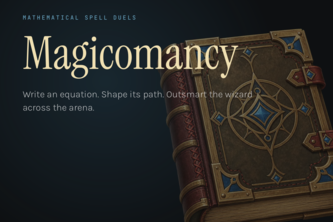
Magicometry is a browser-based real-time PVP/PVE wizard duel game where players cast spells using mathematical functions (Cartesian and polar coordinates). The game is built with Next.js, React, TypeScript, and uses Canvas 2D API for rendering. It includes features such as live trajectory previews, destructible terrain, time-varying barriers, and a spellbook system. The author states that it was developed as part of an OpenAI hackathon.
What changed
The project is described as a self-contained prototype built by one developer (Brendan Beh) over a short timeframe. It includes core gameplay mechanics like real-time combat, mathematical spell creation, and multiplayer support via websockets. The author notes that online multiplayer functionality is currently under development with Supabase authentication and cloud saves.
Single most important open question
Is there any evidence of user engagement or adoption beyond the developer’s own use and testing?
Note: This analysis is based solely on the self-reported, unverified project description provided by the author. No third-party data, revenue figures, customer names, or traction metrics are available.
What The Product Actually Is
The description states that Magicometry is a browser-based real-time PVP/PVE wizard duel game where players cast spells using mathematical functions. These functions can be expressed in Cartesian coordinates (e.g., x(t), y(t)) or polar coordinates (e.g., r(t), θ(t)). Players move, aim, and cast simultaneously within a wrapped arena.
Key technical components include:
- A custom tokenizer, parser, and bounded abstract syntax tree evaluator
- Use of Canvas 2D API for rendering
- WebSockets for online multiplayer via Digital Ocean
- Supabase for authentication and cloud saves (in development)
- Built-in expression editor with LaTeX-style input support
The game supports:
- Live trajectory and damage previews
- Destructible terrain that retains spell-created craters during rounds
- Time-varying barriers that fade between solid and intangible
- Starter spells for new users
- Health, mana, cooldowns, animated wizards, and combat feedback
Inference: The game appears to be a prototype built with minimal infrastructure beyond the developer's own tools and AI assistance (e.g., GPT-5.6). It is not evident whether it has been released publicly or tested by external users.
Positioning & Claim Evolution
The author positions Magicometry as a dynamic, fast-paced alternative to existing browser-based games like GraphWars 2, which they describe as turn-based and limited to Cartesian graphs. The game aims to combine mathematical creativity with real-time combat in an engaging setting.
Claims made:
- It allows players to "pull spells out of your spellbook on the go"
- Designed to make graph sketching more interesting for college students preparing for Oxbridge interviews
- Emphasizes creative freedom without punishing complexity
Claim vs Fact: These are claims about intent and positioning, not proof of traction or adoption. The author does not state any external validation or market testing.
Target Customer & ICP
The description indicates that the game was inspired by teaching graph sketching to college students preparing for Oxbridge interviews. However, no explicit target customer segment is defined beyond this context.
Inference: The initial audience may be students or educators interested in interactive math learning. There is no evidence of broader targeting or segmentation beyond this origin story.
Business Model & Pricing Evidence
There is no mention of pricing, monetization strategy, or business model in the description.
Not evidenced: No indication of how users would pay for the product or what revenue streams are planned.
Technical & Delivery Signals
The author describes:
- Development using Next.js, React, TypeScript, Tailwind CSS, and Canvas 2D API
- Custom tokenizer/parser/evaluator with safety limits on expression size, AST complexity, numerical range, and evaluation work
- Deterministic simulation loop at 60 Hz for reproducibility and networking
- Use of GPT-5.6 to assist in product specification and implementation decisions
- Modular architecture separating parsing, spell evaluation, collision rules, and terrain deformation
Inference: The technical stack suggests a lightweight, portable prototype built with modern web technologies and AI-assisted development practices.
Traction & Maturity Signals
The description states that the project was submitted to an OpenAI hackathon and is currently in early-stage development. It includes:
- Solo challenges (planned)
- Shareable spells and replays (planned)
- Player profiles (planned)
No evidence of:
- Public release
- User base or retention metrics
- Revenue generation
- Customer feedback or usage data
Absence of evidence: There is no indication of traction, adoption, or user engagement beyond the developer’s own testing and development.
Competitive Context
The author references GraphWars 2 as a prior art, describing it as turn-based and limited to Cartesian graphs. No other competitors are mentioned in the description.
Not evidenced: No competitive landscape analysis, no mention of similar products or platforms in the market.
Open Questions & Risks
- Single developer team: Only one member (Brendan Beh) is listed; lack of team structure may limit scalability.
- No verified traction: No evidence of users, customers, or adoption beyond personal use.
- Unproven monetization model: No indication of how the product will generate revenue.
- Limited external validation: The project was submitted to a hackathon and lacks independent review or testing.
- AI dependency: Heavy reliance on AI tools (e.g., GPT-5.6) may pose risks if those services change or become unavailable.
Inference: The lack of third-party verification, user data, or commercial traction raises concerns about viability as a scalable product.
Questions the description leaves open
- What is the intended path from prototype to full product release?
- Are there any plans for monetization or revenue generation?
- How do you plan to scale beyond a single developer?
- Have you conducted any user testing or gathered feedback from students or educators?
- What are your long-term goals for the game beyond the current features?
- Is there any intention to expand into mobile or desktop platforms?
Overall Assessment
This is a self-reported, unverified prototype developed by one individual as part of a hackathon. There is no evidence of revenue, customers, traction, or commercial viability.
Confidence Level: Low
Assessment: Not suitable for investment or partnership consideration at this stage due to lack of verified traction, business model, and user engagement. The project shows potential but requires further development, validation, and demonstration of market interest before any strategic move can be justified.
User Stories BotA demo video on every pull request
Get a demo video on every new feature
GitHub App that watches your pull requests and records a narrated, captioned demo.
Save time on demo prep and make informed decisions faster with a video walkthrough of every new feature.
Source
Submitted to the OpenAI 2026 hackathon on Devpost. Project home on Devpost. Back to the full gallery on Devpost.
This competitive analysis was produced by top-founders.com (opens in a new tab)
Generated by a language model from this project's public Devpost page — its tagline, the author's own write-up and any built-with tags listed there — as captured in August 2026. Short quotations are the author's words. It is an opinion on the idea as a business, not on the people behind it, and it reflects the description as published then. If the project has moved on, request a correction below. The analysis is not independent research and contains no verified traction, revenue or customer data.
An independent guide by KFG International LLC — not affiliated with, endorsed by, or connected to Devpost or OpenAI.