

Archive position — measured, not model output
0 likes on Devpost
2,263 of the 7,850 archived projects have more likes, and 5,587 share exactly 0 — so this project's #3,143 place in the like-ranked listing is a tie-break inside that group, not a ranking.
Projects (log scale)
Likes on Devpost. ▲ marks this project's group.
Show the figures
| Likes | Projects | Share of archive |
|---|---|---|
| 0 | 5,587 | 71.2% |
| 1 | 1,758 | 22.4% |
| 2 | 284 | 3.6% |
| 3–4 | 132 | 1.7% |
| 5–9 | 75 | 1.0% |
| 10+ | 14 | 0.2% |
 User Stories BotA demo video on every pull request
Get a demo video on every new feature
GitHub App that watches your pull requests and records a narrated, captioned demo.
Save time on demo prep and make informed decisions faster with a video walkthrough of every new feature.
Executive Summary
What the company appears to be
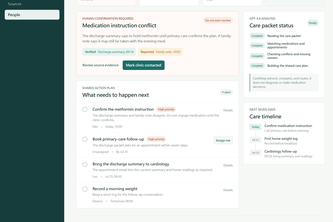
CareRelay is a self-reported prototype tool designed to help families manage post-discharge care by reconciling fragmented information into traceable actions. It uses GPT-5.6 and structured JSON outputs to extract facts, identify conflicts, assign tasks, and create handoffs between caregivers.
What changed
The project was submitted as a hackathon entry (OpenAI 2026) and is described as a proof-of-concept with no real-world deployment or traction yet.
Single most important open question
Is there any evidence that CareRelay has moved beyond the prototype stage, or whether it will be built into a product with real users?
What The Product Actually Is
The description states that CareRelay is a "traceable handoff layer for family care." It reconciles fragmented post-discharge information — such as discharge summaries, medication lists, appointment emails, and family chat logs — into clear, source-grounded actions.
It operates through a core loop:
- Evidence → Conflict or gap → Assigned action → Handoff
The tool is not described as a medical chatbot. Instead, it maps input documents into structured data (facts, conflicts, tasks, gaps) and generates a handoff that another caregiver can use.
It uses:
- GPT-5.6 via OpenAI’s API
- React + TypeScript frontend
- Vercel + Vite for deployment
- Local browser storage for demo state
The prototype is publicly accessible but only works with fictional data.
Inference The tool appears to be a demonstration of how structured AI could support family-based care coordination, not a production-ready product.
Positioning & Claim Evolution
The author states that CareRelay “turns fragmented post-discharge information into clear, source-grounded family action.”
It positions itself as:
- A coordination layer between existing tools (reminders, documents, chat)
- Not a replacement for clinicians or diagnosis
- A tool to make conflicts actionable without resolving them
The claim evolution shows:
- From a hackathon prototype → to a conceptual framework for care handoffs
- Emphasis on traceability and source-linking over automation or decision-making
Inference The positioning is focused on care coordination, not clinical decision support. It avoids making claims about replacing human judgment.
Target Customer & ICP
The description states that CareRelay targets families managing post-discharge care — particularly those dealing with fragmented information from hospitals, medications, and family communication.
It is designed for:
- Family members who need to coordinate care
- Caregivers who must act on incomplete or conflicting information
- Users who want a structured way to track next steps
There is no mention of institutional users (e.g., hospitals, clinics), nor any indication of whether the tool is intended for individuals or broader care teams.
Inference The ICP seems to be family caregivers, but it's unclear if this is limited to specific demographics or use cases.
Business Model & Pricing Evidence
The description does not provide any information on:
- Revenue model
- Pricing structure
- Monetization strategy
- Customer acquisition plans
It only describes a prototype with fictional data and no real-world usage.
Inference No evidence of a business model exists beyond the hackathon submission.
Technical & Delivery Signals
The project is built using:
- Frontend: React, TypeScript, Vercel, Vite
- Backend/ML: GPT-5.6 via OpenAI API
- Data handling: Local browser storage for demo state; server-side image processing for JPG/PNG files
- Safety features: Rate limiting, timeouts, caching of identical inputs, local persistence
The system is described as:
- Using strict structured JSON outputs from GPT-5.6
- Mapping results directly into UI elements (evidence, actions, handoff)
- Supporting bounded input and low reasoning effort for targeted extraction tasks
Inference The technical stack suggests a lightweight, demo-grade implementation with some safety controls in place.
Traction & Maturity Signals
There is no evidence of:
- Revenue
- Customers
- Users
- Product adoption
- Any real-world deployment or usage beyond the prototype
The project is explicitly described as a public demo for a hackathon, using only fictional data.
Inference No traction or maturity signals are evident. The product remains in early-stage development.
Competitive Context
The description states that existing tools often handle reminders, documents, or chat separately — and CareRelay aims to be the coordination layer between them.
It does not name competitors, nor does it describe how it compares to other tools in this space.
Inference The competitive context is implied but not detailed. It likely competes with or complements existing family care apps or digital health platforms that lack structured handoff features.
Open Questions & Risks
- Prototype only: No real-world usage, no customers, no revenue.
- No commercialization plan: No evidence of a path to monetization or product development beyond the demo.
- Unverified claims: The description is self-reported and unverified; there’s no external validation of its utility or effectiveness.
- Limited scope: Focused on family care coordination, not broader healthcare workflows.
- Dependency on GPT-5.6: Relies heavily on a proprietary API that may not be scalable or stable for production use.
Inference The project is at a very early stage and lacks any commercial viability indicators.
Questions the description leaves open
- What is the intended transition from prototype to product?
- Are there any plans to test with real users or caregivers?
- How would you scale this beyond the demo environment?
- Is there a plan for data privacy, consent, and clinical governance in a production version?
- What are your thoughts on integrating with existing healthcare systems or platforms?
Overall Assessment
The project is described as a hackathon prototype, not a commercial product.
There is no evidence of:
- Revenue
- Customers
- Product-market fit
- Scalable business model
- Real-world traction
Inference At this stage, there is no basis for investment or partnership. The project may be an idea worth exploring further, but it is not ready for commercial due diligence.
User Stories BotA demo video on every pull request
Get a demo video on every new feature
GitHub App that watches your pull requests and records a narrated, captioned demo.
Save time on demo prep and make informed decisions faster with a video walkthrough of every new feature.
Source
Submitted to the OpenAI 2026 hackathon on Devpost. Project home on Devpost. Back to the full gallery on Devpost.
This competitive analysis was produced by top-founders.com (opens in a new tab)
Generated by a language model from this project's public Devpost page — its tagline, the author's own write-up and any built-with tags listed there — as captured in August 2026. Short quotations are the author's words. It is an opinion on the idea as a business, not on the people behind it, and it reflects the description as published then. If the project has moved on, request a correction below. The analysis is not independent research and contains no verified traction, revenue or customer data.
An independent guide by KFG International LLC — not affiliated with, endorsed by, or connected to Devpost or OpenAI.