

Archive position — measured, not model output
0 likes on Devpost
2,263 of the 7,850 archived projects have more likes, and 5,587 share exactly 0 — so this project's #3,141 place in the like-ranked listing is a tie-break inside that group, not a ranking.
Projects (log scale)
Likes on Devpost. ▲ marks this project's group.
Show the figures
| Likes | Projects | Share of archive |
|---|---|---|
| 0 | 5,587 | 71.2% |
| 1 | 1,758 | 22.4% |
| 2 | 284 | 3.6% |
| 3–4 | 132 | 1.7% |
| 5–9 | 75 | 1.0% |
| 10+ | 14 | 0.2% |
 User Stories BotA demo video on every pull request
Get a demo video on every new feature
GitHub App that watches your pull requests and records a narrated, captioned demo.
Save time on demo prep and make informed decisions faster with a video walkthrough of every new feature.
Executive Summary
Company: CareGate AI
Self-reported basis: This analysis is based entirely on the project description supplied by the caller — its name, tagline, the author's own write-up and any technology tags. No archived history, third-party source or independent verification exists for this project.
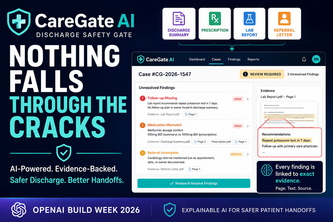
What it appears to be: A healthcare-focused AI tool designed to support hospital discharge processes by reconciling patient findings with human-readable explanations, using AI extraction and rule-based validation before patients leave the hospital.
What changed: The project was submitted to the OpenAI 2026 hackathon on Devpost, indicating a prototype or proof-of-concept stage.
Single most important open question: Is there evidence of any real-world use case or integration with actual hospital systems?
Confidence level: Very low — based on minimal self-reported information.
What The Product Actually Is
The description states:
"An explainable discharge-reconciliation gate — every finding a rule can point to, every AI extraction a human can check, before a patient leaves the hospital."
Inference (not evidenced): The product appears to be an AI-powered system that processes medical data at the time of patient discharge, reconciling findings with rules or guidelines and ensuring human review.
Evidence:
- Tagline describes a "discharge-reconciliation gate"
- AI extraction and rule-based validation are mentioned
- The system is intended for use before patient discharge
Not evidenced:
- No details on what the AI extracts from
- No description of how findings are reconciled or validated
- No information on whether this is a web app, API, or embedded system
Positioning & Claim Evolution
The author states:
"An explainable discharge-reconciliation gate — every finding a rule can point to, every AI extraction a human can check, before a patient leaves the hospital."
Claim: The product aims to improve safety and transparency in hospital discharges by using AI to extract findings and reconcile them with rules, allowing human review.
Inference (not evidenced): The positioning is likely aimed at hospitals or healthcare systems seeking to reduce errors during discharge processes, possibly targeting regulatory compliance or patient safety.
Not evidenced:
- No mention of specific use cases beyond "discharge"
- No indication of whether this is a general-purpose tool or tailored for a niche
- No evidence of prior positioning or evolution in claims
Target Customer & ICP
The description states:
"An explainable discharge-reconciliation gate — every finding a rule can point to, every AI extraction a human can check, before a patient leaves the hospital."
Inference (not evidenced): The target customer is likely hospitals or healthcare institutions that manage patient discharges and are concerned with safety, compliance, or documentation accuracy.
Not evidenced:
- No mention of specific hospital size, region, or type
- No indication of whether this is a B2B SaaS offering or internal tool
- No evidence of customer personas or ICP definition
Business Model & Pricing Evidence
The description states:
"An explainable discharge-reconciliation gate — every finding a rule can point to, every AI extraction a human can check, before a patient leaves the hospital."
Not evidenced:
- No mention of pricing model
- No indication of whether this is sold as SaaS, licensing, or a one-time tool
- No evidence of revenue streams or monetization strategy
Technical & Delivery Signals
The author declares:
"Built with (author-declared): codex, gemini-2.5-flash, gemini-3.5-flash, github, google-ai-sdk, gpt-5.6, next.js, pdf.js, postgresql, react, supabase, tailwind-css, tesseract.js, typescript, vercel, zod"
Evidence:
- The tool is built using a mix of AI models (Gemini, GPT, Codex), frontend (React, Next.js), backend (PostgreSQL, Supabase), and deployment (Vercel)
- It uses OCR (Tesseract.js) and PDF processing (pdf.js)
- The stack suggests a web-based prototype or MVP
Inference (not evidenced):
- The tool likely processes medical documents or reports
- AI models are used for extraction, rule validation, and explainability
Not evidenced:
- No details on how the AI models are integrated or trained
- No information on data privacy or compliance with healthcare regulations
- No evidence of scalability or production-grade infrastructure
Traction & Maturity Signals
The description states:
"This project was submitted to the OpenAI 2026 hackathon on Devpost."
Evidence:
- The project is a hackathon submission
- It has no archived history or prior traction
- No mention of users, customers, or adoption
Inference (not evidenced):
- The tool is likely in early prototype stage
- It may have limited real-world testing or validation
Not evidenced:
- No evidence of user feedback or pilot programs
- No indication of product maturity or roadmap
- No mention of funding or investor interest
Competitive Context
The description states:
"An explainable discharge-reconciliation gate — every finding a rule can point to, every AI extraction a human can check, before a patient leaves the hospital."
Not evidenced:
- No mention of competitors or similar tools in healthcare AI or discharge management
- No evidence of market analysis or differentiation strategy
- No indication of how this compares to existing systems
Open Questions & Risks
Inference (not evidenced):
- Regulatory risk: Healthcare AI tools must comply with strict regulations like HIPAA. No mention of compliance or data privacy is evident.
- Technical risk: The use of multiple AI models (GPT, Gemini) may raise questions about consistency and explainability in a regulated environment.
- Maturity risk: As a hackathon project, there is no evidence of product-market fit, traction, or scalability.
- Execution risk: With only one team member, the ability to build and scale this tool is uncertain.
Not evidenced:
- No evidence of any pilot, user testing, or feedback
- No indication of how the system handles edge cases or errors
- No mention of data governance or security practices
Questions the description leaves open
- What specific medical documents or data sources does the tool process?
- How are rules or guidelines encoded and validated in the system?
- Is there any integration with existing hospital systems (e.g., EHRs)?
- What is the current stage of development — prototype, MVP, or early user testing?
- Are you planning to test this in a real hospital setting?
- How does the tool ensure compliance with healthcare data regulations?
- What are the key assumptions about user behavior or workflow integration?
- How do you plan to scale beyond a single developer and hackathon prototype?
Overall Assessment
Not evidenced:
- No evidence of revenue, customers, or traction
- No indication of market size or opportunity
- No information on team experience or track record
- No evidence of product-market fit or competitive positioning
Inference (not evidenced):
- The project is in a very early stage — likely a hackathon prototype
- It has potential in the healthcare AI space, but lacks validation and traction
- Investment or partnership interest would be speculative at this point
Confidence level: Very low. This is not a viable investment or partnership opportunity based on the evidence provided.
User Stories BotA demo video on every pull request
Get a demo video on every new feature
GitHub App that watches your pull requests and records a narrated, captioned demo.
Save time on demo prep and make informed decisions faster with a video walkthrough of every new feature.
Source
Submitted to the OpenAI 2026 hackathon on Devpost. Project home on Devpost. Back to the full gallery on Devpost.
This competitive analysis was produced by top-founders.com (opens in a new tab)
Generated by a language model from this project's public Devpost page — its tagline and any built-with tags listed there, since the author published no write-up — as captured in August 2026. Short quotations are the author's words. It is an opinion on the idea as a business, not on the people behind it, and it reflects the description as published then. If the project has moved on, request a correction below. The analysis is not independent research and contains no verified traction, revenue or customer data.
An independent guide by KFG International LLC — not affiliated with, endorsed by, or connected to Devpost or OpenAI.