

Archive position — measured, not model output
0 likes on Devpost
2,263 of the 7,850 archived projects have more likes, and 5,587 share exactly 0 — so this project's #3,109 place in the like-ranked listing is a tie-break inside that group, not a ranking.
Projects (log scale)
Likes on Devpost. ▲ marks this project's group.
Show the figures
| Likes | Projects | Share of archive |
|---|---|---|
| 0 | 5,587 | 71.2% |
| 1 | 1,758 | 22.4% |
| 2 | 284 | 3.6% |
| 3–4 | 132 | 1.7% |
| 5–9 | 75 | 1.0% |
| 10+ | 14 | 0.2% |
 User Stories BotA demo video on every pull request
Get a demo video on every new feature
GitHub App that watches your pull requests and records a narrated, captioned demo.
Save time on demo prep and make informed decisions faster with a video walkthrough of every new feature.
Executive Summary
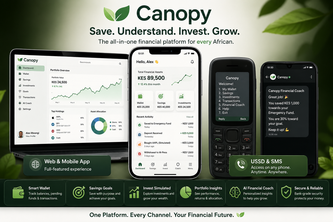
The company appears to be a single-person project (Antony Shikanda) building an inclusive financial platform named Canopy, which aims to combine saving, investing, and financial education into one accessible system. The platform supports both smartphone and feature-phone users via a Progressive Web App (PWA) and USSD/SMS channels, with a shared financial backend. It integrates AI tools like ChatGPT and Codex for development and includes features such as savings goals, investment simulation, portfolio tracking, and financial intelligence.
What changed: The project evolved from an initial concept into a functional MVP that demonstrates core financial architecture including wallet management, transaction integrity, savings mechanisms, and market data integration. It also supports dual access modes (PWA and USSD) with a unified backend.
The single most important open question: Is there a clear path to production readiness, including regulatory compliance, real payment infrastructure, and scalable user acquisition?
Analysis basis: This report is based solely on the self-reported project description provided by the author. No external verification or historical data are available.
What The Product Actually Is
- The description states that Canopy is an inclusive financial platform.
- It combines smart savings goals, investment tools, portfolio tracking, and personalized financial guidance.
- The product includes a wallet, double-entry ledger, savings mechanisms, transactions, investment simulation, portfolio analytics, and financial intelligence.
- It uses a shared financial backend across both a PWA and USSD/SMS access layers.
- Features include:
- Wallet management
- Savings goals
- Investment simulations
- Portfolio tracking
- AI-powered financial insights
- USSD and SMS support for feature-phone users
Inference: The system appears to be built with a focus on accessibility, particularly for low-resource users in Africa.
Positioning & Claim Evolution
- The description states that Canopy is designed to save, invest, and grow wealth in one place.
- It positions itself as an inclusive financial platform targeting users who face fragmented services, limited knowledge, and barriers to digital tools.
- The author claims it connects saving, investing, and financial education while remaining accessible to both smartphone and feature-phone users.
- The platform is described as combining multiple financial functions into a single interface.
Inference: The positioning reflects a mission-driven approach focused on financial inclusion in Africa, but lacks evidence of market traction or user adoption.
Target Customer & ICP
- The description states that the target audience includes people across Africa who want to save and invest but face fragmented services, limited knowledge, and barriers to accessing digital financial tools.
- It specifically mentions support for both smartphone and feature-phone users.
- There is no explicit segmentation beyond geography or device type.
Not evidenced: No specific customer personas, user demographics, or ICP definition provided.
Business Model & Pricing Evidence
- The description does not state any pricing model or monetization strategy.
- It mentions integration with mobile-money infrastructure and partnerships as future steps but does not describe how revenue will be generated.
- There is no mention of fees, subscriptions, transaction charges, or other business models.
Not evidenced: No evidence of a defined business model or pricing structure.
Technical & Delivery Signals
- The platform was built using:
- Flask (backend)
- Supabase (database)
- TypeScript
- Codex and ChatGPT for development assistance
- Africa Talking for USSD integration
- Gemini for AI components
- It uses a PWA architecture with shared backend between web and USSD channels.
- The system includes:
- Double-entry ledger
- Wallet and transaction architecture
- Savings goals with a 48-hour holding period
- Investment simulation and portfolio analytics
- Market data integration via OpenFIGI
- Development was done incrementally using AI tools like GPT-5.6 Tuna.
Inference: The technical stack suggests a modern, scalable architecture, but no evidence of production deployment or performance metrics.
Traction & Maturity Signals
- The description states that the project evolved from an initial concept into a functional MVP.
- It includes:
- Working wallet and transaction architecture
- Savings goals with 48-hour fund holding mechanism
- Simulated investment and portfolio tracking
- Market data integration
- AI financial intelligence
- USSD/SMS access layer
- The team is described as a single person (Antony Shikanda).
- No mention of users, customers, or usage metrics.
Not evidenced: No evidence of real-world adoption, user engagement, or customer base.
Competitive Context
- The description does not name any competitors.
- It implies a focus on financial inclusion in Africa, which may overlap with fintechs serving similar markets.
- There is no discussion of competitive advantages or differentiation strategies.
Not evidenced: No evidence of competitive landscape analysis or positioning relative to existing players.
Open Questions & Risks
- Single-person team (1 member) raises concerns about scalability and long-term maintenance.
- The platform is described as an MVP, not yet production-ready.
- Lack of real-world data, revenue, or customer feedback.
- Heavy reliance on AI-assisted development tools may indicate lack of deep technical expertise or control over the codebase.
- No mention of regulatory compliance or integration with regulated financial institutions.
- Financial systems require high levels of security and integrity — no evidence of audits or testing.
Inference: The project is early-stage, lacks commercial traction, and faces significant risks related to scalability, compliance, and execution.
Questions the description leaves open
- What are the key assumptions about user behavior and adoption that underpin this platform?
- How does the team plan to scale beyond a single developer?
- What is the current status of integration with real payment providers or mobile-money infrastructure?
- Are there any regulatory considerations or compliance frameworks being addressed?
- How will the system ensure transaction integrity, security, and data consistency at scale?
- What are the plans for monetization and revenue generation?
- How does the team intend to acquire users and build trust in a competitive financial space?
Overall Assessment
- Not evidenced: No evidence of commercial viability, traction, or financial performance.
- The project is described as an MVP with functional components but no real-world usage or revenue.
- It shows potential for solving a problem in financial inclusion but lacks the maturity and validation needed to assess investment or partnership readiness.
Assessment: Early-stage concept with strong technical execution. Not ready for investment or partnership without further development, traction, and commercial proof-of-concept.
User Stories BotA demo video on every pull request
Get a demo video on every new feature
GitHub App that watches your pull requests and records a narrated, captioned demo.
Save time on demo prep and make informed decisions faster with a video walkthrough of every new feature.
Source
Submitted to the OpenAI 2026 hackathon on Devpost. Project home on Devpost. Back to the full gallery on Devpost.
This competitive analysis was produced by top-founders.com (opens in a new tab)
Generated by a language model from this project's public Devpost page — its tagline, the author's own write-up and any built-with tags listed there — as captured in August 2026. Short quotations are the author's words. It is an opinion on the idea as a business, not on the people behind it, and it reflects the description as published then. If the project has moved on, request a correction below. The analysis is not independent research and contains no verified traction, revenue or customer data.
An independent guide by KFG International LLC — not affiliated with, endorsed by, or connected to Devpost or OpenAI.