

Archive position — measured, not model output
0 likes on Devpost
2,263 of the 7,850 archived projects have more likes, and 5,587 share exactly 0 — so this project's #3,091 place in the like-ranked listing is a tie-break inside that group, not a ranking.
Projects (log scale)
Likes on Devpost. ▲ marks this project's group.
Show the figures
| Likes | Projects | Share of archive |
|---|---|---|
| 0 | 5,587 | 71.2% |
| 1 | 1,758 | 22.4% |
| 2 | 284 | 3.6% |
| 3–4 | 132 | 1.7% |
| 5–9 | 75 | 1.0% |
| 10+ | 14 | 0.2% |
 User Stories BotA demo video on every pull request
Get a demo video on every new feature
GitHub App that watches your pull requests and records a narrated, captioned demo.
Save time on demo prep and make informed decisions faster with a video walkthrough of every new feature.
Executive Summary
What the company appears to be
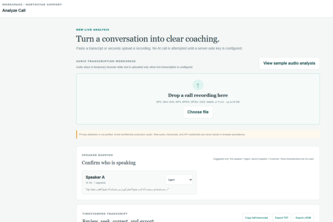
CallLens Coach is an AI-powered platform for analyzing customer-service calls, generating quality scores, compliance insights, and personalized agent training recommendations. It is described as a tool for quality assurance and coaching in multilingual call centers.
What changed
The project was submitted to the OpenAI 2026 hackathon, indicating it is likely early-stage or prototype-level work. No evidence of prior development, traction, or commercial deployment exists in the description.
The single most important open question
Is there any evidence that this platform has been tested with real customer-service data, or that it has moved beyond a hackathon prototype?
Analysis basis
This report is based solely on the self-reported, unverified description provided by the author. No third-party verification, archived records, or independent sources are available.
What The Product Actually Is
The description states: “An AI quality-assurance and coaching platform that analyzes multilingual customer-service calls and turns them into measurable scores, compliance insights, and personalized agent training.”
- Claimed functionality: Call analysis using AI.
- Output types: Measurable scores, compliance insights, personalized agent training.
- Target domain: Multilingual customer-service calls.
- Not evidenced Specific technical architecture, data handling methods, or integration capabilities.
The description does not clarify whether this is a SaaS product, an API, a dashboard, or a tool for internal use. It also does not specify how the AI performs analysis (e.g., speech-to-text, sentiment, intent recognition).
Positioning & Claim Evolution
The author states: “An AI quality-assurance and coaching platform that analyzes multilingual customer-service calls…”
- Positioning: A solution for improving call center performance through AI.
- Evolution of claims: The description does not indicate prior versions or evolution from an earlier product. It is a single, self-contained statement.
No evidence of prior positioning, branding, or market messaging is provided. The claim is presented as a standalone product without historical context.
Target Customer & ICP
The description states: “…turns them into measurable scores, compliance insights, and personalized agent training.”
- Target customer: Call centers or organizations with multilingual customer-service operations.
- ICP (Ideal Customer Profile): Not specified. No indication of size, industry, or use case.
The description does not define the ideal customer profile or segment. It is unclear whether this targets small businesses, enterprises, or specific verticals.
Business Model & Pricing Evidence
The description states: “An AI quality-assurance and coaching platform…”
- Business model: Not evidenced.
- Pricing: Not evidenced.
- Revenue streams: Not evidenced.
No mention of monetization strategy, pricing tiers, or customer acquisition methods. The product is described as a tool, but no commercial structure is outlined.
Technical & Delivery Signals
The author lists: “Built with (author-declared): ai, analytics, api, assurance, call, center, cloudflare-workers, codex, customer, drizzle, gpt-5.6, learning, machine, next.js, node.js, openai, openaid, quality, react, service, speech-to-text, sqlite, tailwind, typescript, whisper”
- Technology stack: Includes AI tools (OpenAI, Whisper), frontend (React, Next.js), backend (Node.js), and infrastructure (Cloudflare Workers, SQLite).
- Delivery signals: The use of hackathon technologies suggests a prototype or proof-of-concept.
- Not evidenced Deployment architecture, scalability, or production readiness.
The tech stack is indicative of a developer-focused prototype. No evidence of production-grade delivery or deployment strategy.
Traction & Maturity Signals
The description states: “This project was submitted to the OpenAI 2026 hackathon on Devpost.”
- Traction: None evidenced.
- Maturity: Not evident beyond hackathon submission.
- Customers or users: Not evidenced.
- Growth metrics or adoption: Not evidenced.
The only signal of progress is a hackathon submission. No evidence of user testing, pilot programs, or product development beyond the initial idea.
Competitive Context
The description states: “An AI quality-assurance and coaching platform…”
- Competitive landscape: Not described.
- Direct competitors: Not evidenced.
- Differentiation: Not evidenced.
No mention of existing solutions in this space. The author does not describe how this product compares to or differs from other tools.
Open Questions & Risks
- Prototype risk: Submitted to a hackathon; no evidence of commercial viability or traction.
- Unproven AI performance: No evidence of accuracy, reliability, or real-world testing of AI models.
- No business model: No indication of how the product will be monetized.
- No customer feedback: No evidence of user testing or validation.
- Single founder: The team size is listed as 1, suggesting limited development capacity.
These are all inferred from the lack of evidence in the description. The absence of any commercial or technical traction is a key open question.
Questions the description leaves open
- What specific problem does this platform solve for call centers?
- Has this been tested with real customer-service data?
- How does it handle multilingual calls, and what languages are supported?
- Is there any user feedback or pilot testing done so far?
- What is the intended pricing model or revenue strategy?
- Are there any existing partnerships or customers?
- How does this differ from other AI call analysis tools in the market?
These questions aim to uncover whether the idea has moved beyond a hackathon prototype and into real-world application.
Overall Assessment
Assessment Not evidenced.
- Investment potential: No evidence of traction, revenue, or validated product-market fit.
- Partnership opportunity: No evidence of commercial readiness or customer base.
- Confidence level: Low. The description is self-reported and unverified, with no signs of development beyond a hackathon submission.
This project appears to be in an early prototype phase. It has not demonstrated any commercial viability, user adoption, or technical maturity. Any investment or partnership decision should be based on further due diligence beyond this initial description.
User Stories BotA demo video on every pull request
Get a demo video on every new feature
GitHub App that watches your pull requests and records a narrated, captioned demo.
Save time on demo prep and make informed decisions faster with a video walkthrough of every new feature.
Source
Submitted to the OpenAI 2026 hackathon on Devpost. Project home on Devpost. Back to the full gallery on Devpost.
This competitive analysis was produced by top-founders.com (opens in a new tab)
Generated by a language model from this project's public Devpost page — its tagline and any built-with tags listed there, since the author published no write-up — as captured in August 2026. Short quotations are the author's words. It is an opinion on the idea as a business, not on the people behind it, and it reflects the description as published then. If the project has moved on, request a correction below. The analysis is not independent research and contains no verified traction, revenue or customer data.
An independent guide by KFG International LLC — not affiliated with, endorsed by, or connected to Devpost or OpenAI.