

Archive position — measured, not model output
0 likes on Devpost
2,263 of the 7,850 archived projects have more likes, and 5,587 share exactly 0 — so this project's #3,090 place in the like-ranked listing is a tie-break inside that group, not a ranking.
Projects (log scale)
Likes on Devpost. ▲ marks this project's group.
Show the figures
| Likes | Projects | Share of archive |
|---|---|---|
| 0 | 5,587 | 71.2% |
| 1 | 1,758 | 22.4% |
| 2 | 284 | 3.6% |
| 3–4 | 132 | 1.7% |
| 5–9 | 75 | 1.0% |
| 10+ | 14 | 0.2% |
 User Stories BotA demo video on every pull request
Get a demo video on every new feature
GitHub App that watches your pull requests and records a narrated, captioned demo.
Save time on demo prep and make informed decisions faster with a video walkthrough of every new feature.
Executive Summary
Company: Caller AI — We wait. You talk.
What it appears to be: A proof-of-concept tool that uses AI to navigate phone IVR systems on behalf of users, then bridges them to a live agent when one becomes available. It is built as a demo for a hackathon and includes a public evaluator interface but no verified production use or revenue.
Key change: The project was submitted to the OpenAI 2026 hackathon and describes itself as an experiment in AI-driven phone navigation with strict authorization, deterministic execution, and limited data handling.
Single most important open question: Is there any evidence of traction, revenue, or customer adoption beyond the author's own demonstration?
What The Product Actually Is
The description states that Caller AI:
- Navigates a bounded IVR flow on behalf of a user.
- Waits in the queue until a live representative is ready.
- Calls the user back only when a live agent is available.
- Does not impersonate the customer, handle credentials, authorize purchases, negotiate, or continue speaking after the human joins.
- Uses GPT-5.6 to propose actions based on current IVR observation.
- Enforces deterministic policy validation before Twilio executes anything.
- Operates with strict JSON schema and user authorization.
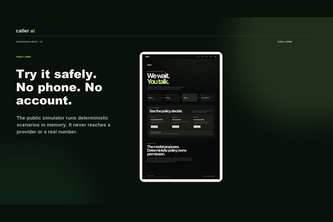
- Includes a public demo that allows judges to see live GPT proposals without making real calls.
Inference: The product is an experimental system designed to reduce time spent on hold by automating IVR navigation, but it is not yet deployed in production for actual users.
Positioning & Claim Evolution
The description states:
- The inspiration behind the project was that waiting on hold is a tax on people's time.
- The useful moment is the human conversation at the end—not navigating menus or listening to hold music.
- Caller AI gives that time back while keeping the customer in control.
Inference: The positioning is centered around user convenience and reducing friction in support interactions. It frames itself as a solution to a common pain point, but does not claim any market traction or adoption.
Target Customer & ICP
The description states:
- The system is designed for customers who interact with companies via phone support.
- Users must explicitly authorize a call and verify their callback number.
- A reviewed company route is required before dialing can occur.
Inference: The target customer appears to be individuals seeking help from businesses with IVR systems, but the product is not yet used by real customers. It is limited to authorized users in a controlled demo environment.
Business Model & Pricing Evidence
Not evidenced.
The description does not mention any pricing model, monetization strategy, or business model beyond the fact that it was built as a hackathon project.
Technical & Delivery Signals
The description states:
- Built with OpenAI, Twilio, and TypeScript.
- Each approved route is represented as a Call Graph.
- GPT-5.6 receives only current IVR observation and proposes one typed action under strict JSON Schema.
- Deterministic policy validates the proposal against graph, authorization, callback ownership, business hours, quotas, budget, and sensitive-data gates.
- Twilio Voice handles calls, DTMF, callbacks, and final human-to-human bridge.
- OpenAI API storage is disabled.
- Codex was a partner for implementation during Build Week expansion.
Inference: The technical architecture is designed with strong separation between AI interpretation and execution authority. It includes safeguards to prevent unauthorized actions or data leakage.
Traction & Maturity Signals
The description states:
- A private-pilot end-to-end UPS handoff with a verified callback and durable receipt.
- An independently enforced typed-action boundary.
- A live judge-facing GPT-5.6 evaluator with zero telecom side effects.
- Explicit refusal paths for credentials and unsupported requests.
- Meaningful post–July 13 Build Week extensions documented in the repository history.
Inference: There is evidence of development activity and some limited testing, but no verified customer base or revenue data. The system has not been deployed at scale or used by real customers.
Competitive Context
Not evidenced.
The description does not mention competitors or similar products in the market.
Open Questions & Risks
- No production use: The system is described only as a hackathon demo with no verified live users.
- Limited scope: It works only within reviewed IVR flows and requires explicit user authorization.
- Unverified claims: All statements are self-reported and unverified; there is no evidence of traction, revenue, or customer adoption.
- No pricing or monetization strategy: No indication of how the product would be sold or funded in a real-world scenario.
Questions the description leaves open
- What specific companies or departments have been reviewed for use with this system?
- Has the system been tested with actual users beyond the demo environment?
- Are there any plans to expand beyond the current demo scope, and if so, what are they?
- How does the team intend to scale the number of supported IVR routes?
- What is the plan for handling multilingual support or international use cases?
Overall Assessment
Not evidenced.
There is no evidence of revenue, customers, or traction beyond the authors' own demonstration. The project is presented as a hackathon submission with limited real-world application and no indication of commercial viability or scalability.
User Stories BotA demo video on every pull request
Get a demo video on every new feature
GitHub App that watches your pull requests and records a narrated, captioned demo.
Save time on demo prep and make informed decisions faster with a video walkthrough of every new feature.
Source
Submitted to the OpenAI 2026 hackathon on Devpost. Project home on Devpost. Back to the full gallery on Devpost.
This competitive analysis was produced by top-founders.com (opens in a new tab)
Generated by a language model from this project's public Devpost page — its tagline, the author's own write-up and any built-with tags listed there — as captured in August 2026. Short quotations are the author's words. It is an opinion on the idea as a business, not on the people behind it, and it reflects the description as published then. If the project has moved on, request a correction below. The analysis is not independent research and contains no verified traction, revenue or customer data.
An independent guide by KFG International LLC — not affiliated with, endorsed by, or connected to Devpost or OpenAI.