

Archive position — measured, not model output
0 likes on Devpost
2,263 of the 7,850 archived projects have more likes, and 5,587 share exactly 0 — so this project's #3,072 place in the like-ranked listing is a tie-break inside that group, not a ranking.
Projects (log scale)
Likes on Devpost. ▲ marks this project's group.
Show the figures
| Likes | Projects | Share of archive |
|---|---|---|
| 0 | 5,587 | 71.2% |
| 1 | 1,758 | 22.4% |
| 2 | 284 | 3.6% |
| 3–4 | 132 | 1.7% |
| 5–9 | 75 | 1.0% |
| 10+ | 14 | 0.2% |
 User Stories BotA demo video on every pull request
Get a demo video on every new feature
GitHub App that watches your pull requests and records a narrated, captioned demo.
Save time on demo prep and make informed decisions faster with a video walkthrough of every new feature.
Executive Summary
What the company appears to be
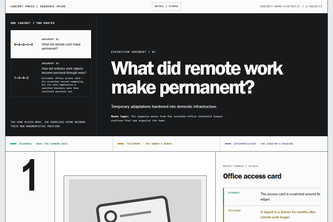
Cabinet Press is a self-reported tool for educational use that allows learners to photograph five objects, add notes, and generate two contrasting exhibitions from those inputs. The system claims to maintain source attribution for all claims made in each exhibition.
What changed
The author states they built this as a response to AI's tendency to blend different types of information (observation, testimony, interpretation) without clear distinction — particularly in learning contexts where such distinctions are pedagogically important.
Single most important open question
Does Cabinet Press actually deliver on its claim that it can reliably separate observable evidence from source testimony and curatorial interpretation, or does the system still allow for semantic blending that undermines its educational purpose?
Analysis basis
This report is based entirely on the self-reported project description provided by the author. It contains no external verification, revenue data, customer information, or traction metrics.
What The Product Actually Is
The description states that Cabinet Press:
- Accepts five objects photographed by a user
- Takes short notes about each object
- Produces two contrasting exhibitions from these inputs
- Types claims into three categories:
- Observable Evidence (grounded in supplied photographs)
- Source Testimony (exact quotation or paraphrase linked to note span)
- Curatorial Interpretation (must cite sources and show rationale)
- Uses a Sequence Spine to order objects, where changing the curatorial question reorders everything
- Renders output as static HTML that works offline and includes print-ready A5 accession cards
- Operates locally using Node.js with no external dependencies
Inference The product is described as a local tool built for educational use, not commercial or enterprise deployment.
Positioning & Claim Evolution
The author states:
- AI can write polished museum labels while blending observation, testimony, and interpretation
- This blending is problematic in learning contexts where distinction is key
- Cabinet Press aims to prevent this by keeping claims traceable back to their source
Claim
The product positions itself as a solution to the problem of semantic confusion in AI-generated educational content.
Inference The positioning implies an educational or pedagogical focus, not a general-purpose AI tool.
Target Customer & ICP
The description states:
- The intended user is a "learner"
- The system supports "learning contexts"
- It is designed to help users understand how different interpretations can be drawn from identical sources
Not evidenced No specific customer segment or persona described beyond "learner".
Business Model & Pricing Evidence
The description states:
- The tool is built for educational use
- It generates static HTML outputs
- It uses open-source technologies like Node.js, TypeScript, Playwright, Vitest, etc.
- There is no mention of pricing, monetization, or commercial model
Not evidenced No evidence of any business model or pricing structure.
Technical & Delivery Signals
The description states:
- Built with: CSS, GPT-5.6, HTML, JavaScript, JSON Schema, Node.js, OpenAI Codex, Playwright, TypeScript, Vitest
- Uses a deterministic verifier (TypeScript) to check schema shape, source existence, locator bounds, quotation matches, rationale requirements, and that arguments differ
- Codex was used for domain modeling, validation boundary definition, prototyping visual directions, accessibility testing, and authoring handoff
- Output is dependency-free static HTML with offline capability
- Includes print-ready A5 accession cards
Inference The system uses a hybrid approach combining AI for content generation and deterministic code for verification.
Traction & Maturity Signals
The description states:
- Submitted to the OpenAI 2026 hackathon on Devpost
- Team size: 1 person (Ayush Raj)
- No mention of revenue, customers, or adoption
- The public repository contains only fabricated source material and synthetic exhibition
- Real data lives in a private repository
Not evidenced No evidence of traction, usage, or market validation.
Competitive Context
The description states:
- No direct competitors mentioned
- Focus is on educational use cases where AI blends information without clear attribution
- The tool aims to provide reproducibility and source clarity
Not evidenced No competitive landscape or comparison with existing tools provided.
Open Questions & Risks
The description states:
- The hardest part was drawing an honest boundary between semantic judgment and deterministic validation
- Code can prove that a quotation matches a source span but cannot prove what a photograph means
- Real data is kept private, which limits external auditability
- A second challenge was keeping real five-object cabinet private while still giving judges a complete test path
Open Question
The system's reliance on AI for curatorial judgment combined with deterministic checks raises questions about whether the semantic boundaries are truly enforced.
Questions the description leaves open
- How does the tool ensure that the distinction between "observable evidence" and "curatorial interpretation" is maintained across different inputs?
- What mechanisms exist to validate that the AI-generated curatorial questions are genuinely distinct and not just reworded versions of each other?
- Can you demonstrate how the deterministic verifier catches errors in semantic grounding that the model might have missed?
- How would you handle cases where a user provides ambiguous or contradictory notes?
- What is the expected workflow for educators using this tool in a classroom setting?
Overall Assessment
The description states:
- The project is a hackathon submission
- No revenue, customers, or traction data available
- The author intends to package the authoring handoff as an installable Codex skill
- Future steps include giving learners review controls over proposed curatorial questions
Not evidenced No commercial viability, scalability, or investment potential can be determined from this description alone.
Confidence level Low. This is a self-reported educational prototype with no evidence of traction, revenue, or market validation.
User Stories BotA demo video on every pull request
Get a demo video on every new feature
GitHub App that watches your pull requests and records a narrated, captioned demo.
Save time on demo prep and make informed decisions faster with a video walkthrough of every new feature.
Source
Submitted to the OpenAI 2026 hackathon on Devpost. Project home on Devpost. Back to the full gallery on Devpost.
This competitive analysis was produced by top-founders.com (opens in a new tab)
Generated by a language model from this project's public Devpost page — its tagline, the author's own write-up and any built-with tags listed there — as captured in August 2026. Short quotations are the author's words. It is an opinion on the idea as a business, not on the people behind it, and it reflects the description as published then. If the project has moved on, request a correction below. The analysis is not independent research and contains no verified traction, revenue or customer data.
An independent guide by KFG International LLC — not affiliated with, endorsed by, or connected to Devpost or OpenAI.