

Archive position — measured, not model output
1 like on Devpost
505 of the 7,850 archived projects have more likes, and 1,758 share exactly 1 — so this project's #748 place in the like-ranked listing is a tie-break inside that group, not a ranking.
Projects (log scale)
Likes on Devpost. ▲ marks this project's group.
Show the figures
| Likes | Projects | Share of archive |
|---|---|---|
| 0 | 5,587 | 71.2% |
| 1 | 1,758 | 22.4% |
| 2 | 284 | 3.6% |
| 3–4 | 132 | 1.7% |
| 5–9 | 75 | 1.0% |
| 10+ | 14 | 0.2% |
 User Stories BotA demo video on every pull request
Get a demo video on every new feature
GitHub App that watches your pull requests and records a narrated, captioned demo.
Save time on demo prep and make informed decisions faster with a video walkthrough of every new feature.
Executive Summary
What the company appears to be
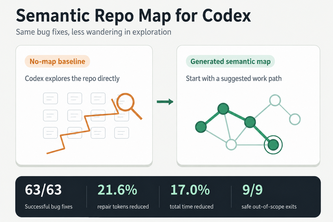
The project described by the caller is Bunya-Jido: One Semantic Map, a tool that creates a semantic map of a codebase for human understanding and AI agent navigation, with an execution layer that audits edits made by an AI agent (Codex) against declared boundaries. It was built as part of the OpenAI 2026 hackathon.
What changed
The author states that the project evolved from a static semantic map to include a map-guided Codex runner, which executes edits and audits them for compliance with defined boundaries, using a receipt system to track changes and token usage. The tool is designed to reduce unnecessary context use during AI-driven code editing.
Single most important open question
Is there evidence of real-world adoption or integration into an existing development workflow beyond the hackathon context?
What The Product Actually Is
The description states that Bunya-Jido consists of two components:
- A semantic map of a repository, generated by a scanner and blueprint pipeline, which provides:
- An offline interactive atlas for humans.
- Compact validated task routes (e.g., relevant files, tests, edit boundaries) for agents.
- A Codex runner, built during the hackathon, that:
- Takes a validated route from the map.
- Executes edits in a sandboxed environment.
- Audits every change against declared boundaries.
- Produces a receipt with:
- Route fingerprint
- Token usage
- Elapsed time
- Changed files
- Assessment
The tool is built using Codex, IDE, and Python. It was written with GPT-5.6 and tested using synthetic benchmarks.
Evidence
- The author states that the map side existed before Build Week.
- The execution half was built during Build Week.
- The system uses a sandboxed environment and audits changes post-edit.
Inference The tool is designed to reduce token consumption in AI-assisted code editing by limiting context to only relevant parts of the codebase.
Positioning & Claim Evolution
The author positions Bunya-Jido as a semantic atlas for developers, inspired by the Korean star chart Cheonsang Yeolcha Bunyajido. The tool aims to make repositories readable and navigable both for humans and AI agents.
Key claims
- The system reduces token usage in AI repairs by 19–23% in paired benchmarks.
- It prevents “fixes lost” by auditing every edit against boundaries.
- It allows agents to work within defined constraints, avoiding unintended changes.
The positioning evolved from a static map for humans to a map-guided agent execution system during the hackathon.
Evidence
- The author states that the tool was originally built to solve context window issues in AI agents.
- The evolution from map to runner occurred during Build Week.
Inference The tool is positioned as a solution for AI-driven code editing that improves both efficiency and safety, but it is not yet proven in production environments.
Target Customer & ICP
The description does not clearly identify the target customer or ICP (Ideal Customer Profile). It implies the tool is for developers working with AI agents in codebases, particularly those who face context window limitations or need to audit AI edits.
Evidence
- The author describes a personal use case involving an AI-based research automation harness.
- The tool is built for developers using Codex and working with large repositories.
Inference The ICP likely includes AI researchers, dev teams using AI agents, and developers managing large codebases where context window limitations are a problem.
Business Model & Pricing Evidence
There is no evidence of a business model or pricing structure in the description. The project was built as part of a hackathon and is not described as a commercial product.
Evidence
- The tool is presented as a prototype.
- No mention of monetization, subscriptions, or pricing.
Inference It is unclear if this will be monetized, and no business model has been stated.
Technical & Delivery Signals
The system uses:
- Codex (GPT-5.6) for writing the runner and tests.
- A sandboxed execution environment to enforce boundaries.
- A receipt system that tracks changes, token usage, and audit results.
- A map-guided approach where agents are instructed on what to read and edit.
The author mentions:
- Testing with a fake Codex executable to simulate deterministic behavior.
- A live run on Windows failed due to sandbox restrictions, but was re-run under WSL.
- The tool records session IDs and model metadata in the repo.
Evidence
- The system is built using Python and Codex.
- It includes a sandboxed execution layer with audit capabilities.
- The tool is tested via synthetic benchmarks and simulated environments.
Inference The technical architecture shows an attempt to build a secure, auditable AI agent workflow. However, it has not been validated in production or real-world use.
Traction & Maturity Signals
There is no evidence of traction, customers, or revenue. The project was built as part of a hackathon and has no stated adoption beyond the author’s own use case.
Evidence
- The tool is described as a hackathon submission.
- No mention of users, customers, or real-world deployment.
Inference The product is in an early prototype stage with no demonstrated market traction.
Competitive Context
There is no evidence of competitors or competitive positioning. The description does not reference similar tools or platforms in the AI-assisted development space.
Evidence
- No mention of existing tools for semantic mapping, agent auditing, or context management.
- No comparison to other AI coding tools or frameworks.
Inference It is unclear whether this addresses a known gap or overlaps with existing solutions.
Open Questions & Risks
- No real-world use case or adoption: The tool is built for a hackathon and lacks evidence of integration into a production workflow.
- Unproven scalability: The author notes that the system was tested in synthetic benchmarks, not live environments.
- Limited team size: Only one person is involved in development.
- Unclear commercial viability: No business model or pricing structure is described.
- Dependency on Codex: Reliance on a specific AI model (GPT-5.6) may limit adaptability.
Evidence
- The tool was built for a hackathon.
- No customer data, revenue, or adoption metrics are provided.
- The author does not describe any commercialization plan.
Questions the description leaves open
- What is the current state of integration with existing development workflows?
- Are there plans to expand beyond the hackathon prototype?
- How would this tool be adapted for enterprise or multi-developer use cases?
- Has the system been tested in real-world codebases, not just synthetic benchmarks?
- What are the long-term plans for maintaining and evolving the semantic map?
- Is there a plan to support other AI models beyond Codex?
Overall Assessment
Not evidenced — The project is described as a hackathon submission with no evidence of traction, revenue, or commercial viability.
Confidence Low
This is a self-reported prototype, built for a hackathon. There is no evidence of:
- Customers
- Revenue
- Product-market fit
- Commercialization strategy
The tool shows potential in addressing AI agent context and safety issues, but it has not been validated beyond the author’s own use case or synthetic testing.
Inference If this were to be developed further, it would require significant investment in real-world validation, product development, and market positioning. As a standalone prototype, it is not ready for investment or partnership consideration.
User Stories BotA demo video on every pull request
Get a demo video on every new feature
GitHub App that watches your pull requests and records a narrated, captioned demo.
Save time on demo prep and make informed decisions faster with a video walkthrough of every new feature.
Source
Submitted to the OpenAI 2026 hackathon on Devpost. Project home on Devpost. Back to the full gallery on Devpost.
This competitive analysis was produced by top-founders.com (opens in a new tab)
Generated by a language model from this project's public Devpost page — its tagline, the author's own write-up and any built-with tags listed there — as captured in August 2026. Short quotations are the author's words. It is an opinion on the idea as a business, not on the people behind it, and it reflects the description as published then. If the project has moved on, request a correction below. The analysis is not independent research and contains no verified traction, revenue or customer data.
An independent guide by KFG International LLC — not affiliated with, endorsed by, or connected to Devpost or OpenAI.