

Archive position — measured, not model output
0 likes on Devpost
2,263 of the 7,850 archived projects have more likes, and 5,587 share exactly 0 — so this project's #4,674 place in the like-ranked listing is a tie-break inside that group, not a ranking.
Projects (log scale)
Likes on Devpost. ▲ marks this project's group.
Show the figures
| Likes | Projects | Share of archive |
|---|---|---|
| 0 | 5,587 | 71.2% |
| 1 | 1,758 | 22.4% |
| 2 | 284 | 3.6% |
| 3–4 | 132 | 1.7% |
| 5–9 | 75 | 1.0% |
| 10+ | 14 | 0.2% |
 User Stories BotA demo video on every pull request
Get a demo video on every new feature
GitHub App that watches your pull requests and records a narrated, captioned demo.
Save time on demo prep and make informed decisions faster with a video walkthrough of every new feature.
Executive Summary
Project: inteRx (submitted by fuzzyLife)
Context: OpenAI 2026 hackathon submission on Devpost
Analysis basis: Self-reported, unverified author description only
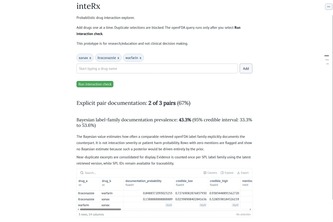
The project appears to be a proof-of-concept tool that assesses the probabilistic risk of harm from combinations of drugs based on literature review. It is described as an early-stage prototype built during a hackathon with no evidence of revenue, customers or product-market fit.
Key insight: The description states the team aims to build a system that interprets drug interactions using probabilistic scoring — but this is not demonstrated in any way. No actual functionality, data sources, or output examples are provided.
Most important open question: Is there any evidence of real-world applicability or integration with clinical systems? The project is described as a hackathon prototype with no indication it has moved beyond concept stage.
What The Product Actually Is
The description states:
- "it will provide a probabilistic score of harm from a combination of drugs"
- "go through drug interaction literature and extract relevant information, give probability scores for a given combination"
Inference: Based on the author's own words, this is a system that attempts to analyze drug interaction data and assign risk scores. It is not described as a fully functional product or platform.
Not evidenced: No actual software, API, UI, or working model is described. The project is presented as an idea in development, not a deliverable.
Positioning & Claim Evolution
The description states:
- "reduce iatrogenic issues"
- "interpret if any combination of drugs prescribed poses harm?"
- "probabilistic diagnosis, specifically, interpret lab tests and imaging results coming from suspected infectious disease and risk assessment of other conditions e.g. cancer"
Inference: The project is positioned as a tool to help clinicians assess drug safety risks, with a stated ambition to expand into broader diagnostic capabilities.
Not evidenced: No positioning against competitors, no market analysis, no differentiation strategy, or target use case beyond the hackathon context.
Target Customer & ICP
The description states:
- "interpret if any combination of drugs prescribed poses harm?"
- "probabilistic diagnosis, specifically, interpret lab tests and imaging results coming from suspected infectious disease and risk assessment of other conditions e.g. cancer"
Inference: The target audience appears to be healthcare professionals or systems that prescribe medications, with a possible future expansion to diagnostic use cases.
Not evidenced: No specific customer personas, no clinical workflows described, no indication of whether this is for hospitals, clinics, or individual practitioners.
Business Model & Pricing Evidence
The description states:
- No mention of pricing, licensing, or monetization strategy
- No evidence of any revenue model
Inference: There is no evidence of a business model. The project is described as a hackathon prototype with no indication of commercial viability or monetization.
Not evidenced: No pricing structure, no customer acquisition plan, no sales process, or distribution strategy.
Technical & Delivery Signals
The description states:
- "Built with (author-declared): marimo, python, wasm"
- "go through drug interaction literature and extract relevant information"
- "hard to find good resource"
Inference: The project is built using open-source tools and appears to be a lightweight prototype focused on data extraction and scoring logic.
Not evidenced: No technical architecture, no scalability assumptions, no deployment details, no integration points, or API exposure.
Traction & Maturity Signals
The description states:
- "got quite close to predicting effects"
- "what sounds easy to implement gets complicated as we progress..."
- "this project was submitted to the OpenAI 2026 hackathon"
Inference: The team has made progress on a prototype, but it is not demonstrated or validated beyond the hackathon stage.
Not evidenced: No user feedback, no performance metrics, no pilot data, no production use, no customer engagement.
Competitive Context
The description states:
- No mention of competitors
- No reference to existing tools in drug interaction analysis
Inference: The project does not appear to have a competitive analysis or awareness of the market landscape.
Not evidenced: No comparison to existing systems like Lexicomp, Micromedex, or other drug interaction tools. No indication of how this would differ from current offerings.
Open Questions & Risks
- Unproven concept: The project is described as a hackathon prototype with no demonstrated functionality.
- No clinical validation: No evidence of testing, validation, or integration into real-world systems.
- Data quality concerns: The team notes "hard to find good resource" — suggesting potential data limitations.
- Unclear path to market: No business model, no target customers, no go-to-market strategy.
- Limited team: Only one member listed (the team is described as "fuzzy Life").
Not evidenced: No evidence of regulatory compliance, safety standards, or clinical trials.
Questions the description leaves open
- What specific drug interaction data sources are being used?
- How is the probabilistic scoring algorithm validated or tested?
- Has this been tested in any clinical setting or with real healthcare providers?
- What is the intended integration path for clinicians or systems using this tool?
- Are there any existing partnerships or pilot programs with hospitals or health systems?
- How does this project plan to scale beyond a hackathon prototype?
Overall Assessment
Not evidenced: No financials, no traction, no market validation, and no clear path to commercialization.
Inference: This is an early-stage idea with no demonstrated product-market fit or business model. It may be of interest for incubation or strategic partnership if the team can demonstrate progress beyond a prototype.
Confidence level: Low — based entirely on self-reported claims from a hackathon submission, with no external validation or evidence of real-world use.
User Stories BotA demo video on every pull request
Get a demo video on every new feature
GitHub App that watches your pull requests and records a narrated, captioned demo.
Save time on demo prep and make informed decisions faster with a video walkthrough of every new feature.
Source
Submitted to the OpenAI 2026 hackathon on Devpost. Project home on Devpost. Back to the full gallery on Devpost.
This competitive analysis was produced by top-founders.com (opens in a new tab)
Generated by a language model from this project's public Devpost page — its tagline, the author's own write-up and any built-with tags listed there — as captured in August 2026. Short quotations are the author's words. It is an opinion on the idea as a business, not on the people behind it, and it reflects the description as published then. If the project has moved on, request a correction below. The analysis is not independent research and contains no verified traction, revenue or customer data.
An independent guide by KFG International LLC — not affiliated with, endorsed by, or connected to Devpost or OpenAI.