

Archive position — measured, not model output
1 like on Devpost
505 of the 7,850 archived projects have more likes, and 1,758 share exactly 1 — so this project's #749 place in the like-ranked listing is a tie-break inside that group, not a ranking.
Projects (log scale)
Likes on Devpost. ▲ marks this project's group.
Show the figures
| Likes | Projects | Share of archive |
|---|---|---|
| 0 | 5,587 | 71.2% |
| 1 | 1,758 | 22.4% |
| 2 | 284 | 3.6% |
| 3–4 | 132 | 1.7% |
| 5–9 | 75 | 1.0% |
| 10+ | 14 | 0.2% |
 User Stories BotA demo video on every pull request
Get a demo video on every new feature
GitHub App that watches your pull requests and records a narrated, captioned demo.
Save time on demo prep and make informed decisions faster with a video walkthrough of every new feature.
Executive Summary
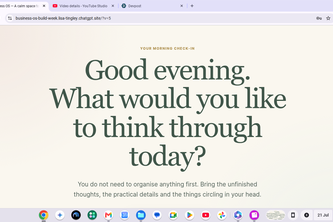
Business OS is described as an AI-powered tool designed to help solo business owners transform unstructured thinking into a logical daily pathway. The author, Lisa Tingley, built a web-based MVP using OpenAI Codex and React, focusing on a calm, non-judgmental interface that supports rather than takes over the user's decision-making process.
The product currently allows users to free-write their thoughts, which are then organized into four sections (priorities, attention items, commitments, risks) and presented as a suggested daily pathway. It is not intended to be a checklist or to enforce actions but to aid productivity by offering a structured yet flexible approach.
Key commercial signals:
- The description states the product is an MVP with one defined journey
- No revenue, customers or traction data are provided
- The author emphasizes user control and autonomy throughout
- Technical implementation relies on OpenAI APIs and React
The single most important open question
What is the actual user experience when the AI component is fully functional versus how it appears in the current prototype? The description indicates technical challenges with AI integration were encountered, but does not clarify whether these have been resolved or if the MVP reflects a working version.
What The Product Actually Is
The description states that Business OS:
- Takes unstructured free-writing from users
- Organizes thoughts into four categories: "Todays priorities", "things needing attention", "upcoming commitments", "possible risks"
- Produces a suggested daily pathway with prioritized tasks
- Is not a checklist or to-do list but a "suggested pathway through the day"
- Allows user editing of AI-generated suggestions
- Operates as a web-based MVP built with React and connected to OpenAI APIs
The author describes it as a tool that transforms "busy, unfinished thoughts" into "a calm and practical pathway" without removing the owner's authorship.
Positioning & Claim Evolution
The description states:
- Business OS is positioned as an AI operating system for solo business owners
- It aims to help users take "unstructured thinking" and turn it into a "logical pathway"
- The product emphasizes protecting user autonomy and agency
- It is described as supporting rather than taking over the user's decision-making process
- The author states they wanted users to feel "calm, organised but listened to and still in control of their own lives/business"
The positioning appears to have evolved from a broad vision to a focused MVP that demonstrates one complete transformation: from unstructured brain dumps to structured pathways.
Target Customer & ICP
The description states:
- The primary target is "solo business owners"
- The product is designed for users who "carry too many thoughts and ideas by myself at any one time"
- It addresses the challenge of managing "cognitive load" for small business owners
- The author identifies herself as someone with lived experience as a small business owner
The description does not provide evidence of specific customer segments beyond solo business owners, nor does it describe how this target might be further refined or validated.
Business Model & Pricing Evidence
Not evidenced. The description provides no information about:
- Revenue streams
- Pricing structure
- Monetization approach
- Customer acquisition costs
- Unit economics
Technical & Delivery Signals
The description states:
- Built with: codex, css, gpt5.6sol, html, openai, react, responses, typescript, vite
- Uses OpenAI Codex as a technical build partner
- Connected to OpenAI through the Responses API
- Built iteratively with user testing using "genuine, unstructured brain dumps"
- The author worked with the AI to refine instructions for better task prioritization
- The MVP includes: welcome screen, listening space, AI-supported executive thinking, owner review, and Today's Pathway
The description indicates technical challenges were encountered with AI integration but does not clarify whether these have been resolved or if the current prototype reflects a working version.
Traction & Maturity Signals
Not evidenced. The description provides no information about:
- Customer adoption
- Revenue generation
- User engagement metrics
- Product usage patterns
- Market traction
- Growth indicators
The author describes building an MVP but does not provide evidence of user testing beyond her own iterations or any external validation.
Competitive Context
Not evidenced. The description provides no information about:
- Direct competitors
- Indirect substitutes
- Market positioning relative to existing tools
- Competitive advantages
- Market size or growth trends
Open Questions & Risks
Inferences based on the description:
- Technical integration risk: The author states that without connecting to a live AI, sections seemed to repeat and were clunky. This suggests potential technical limitations in the current MVP.
- User experience risk: The product is described as "not designed to be a check list" but the author notes it's difficult to balance user confirmation with AI task prioritization without either taking over or being useless.
- Market positioning risk: The author mentions changing from "How are you feeling?" to avoid appearing like a mental health service, suggesting potential confusion in market positioning.
- Scalability risk: The product is described as having one defined journey and one clear transformation, which may limit its appeal beyond this specific use case.
Questions the description leaves open
- What specific AI capabilities are currently implemented vs. what remains to be built?
- How does the current prototype handle the integration of external data sources (calendar, email, accounting)?
- What is the actual user experience when the AI component functions as intended versus in the current prototype?
- How has the product evolved from initial concept to current MVP?
- What are the key assumptions about user behavior that have been tested and validated?
- How does the author plan to address the technical challenges with AI integration that were encountered during development?
Overall Assessment
Not evidenced. The description provides no information about:
- Financial performance
- Market opportunity size
- Competitive advantages
- Go-to-market strategy
- Team capabilities beyond the single founder
- Strategic fit for potential partners or investors
The author describes a personal project with one defined journey and an MVP, but does not provide evidence of commercial viability, traction, or scalable business model. The product appears to be in early development stage with no demonstrated revenue or customer base.
User Stories BotA demo video on every pull request
Get a demo video on every new feature
GitHub App that watches your pull requests and records a narrated, captioned demo.
Save time on demo prep and make informed decisions faster with a video walkthrough of every new feature.
Source
Submitted to the OpenAI 2026 hackathon on Devpost. Project home on Devpost. Back to the full gallery on Devpost.
This competitive analysis was produced by top-founders.com (opens in a new tab)
Generated by a language model from this project's public Devpost page — its tagline, the author's own write-up and any built-with tags listed there — as captured in August 2026. Short quotations are the author's words. It is an opinion on the idea as a business, not on the people behind it, and it reflects the description as published then. If the project has moved on, request a correction below. The analysis is not independent research and contains no verified traction, revenue or customer data.
An independent guide by KFG International LLC — not affiliated with, endorsed by, or connected to Devpost or OpenAI.