

Archive position — measured, not model output
0 likes on Devpost
2,263 of the 7,850 archived projects have more likes, and 5,587 share exactly 0 — so this project's #2,712 place in the like-ranked listing is a tie-break inside that group, not a ranking.
Projects (log scale)
Likes on Devpost. ▲ marks this project's group.
Show the figures
| Likes | Projects | Share of archive |
|---|---|---|
| 0 | 5,587 | 71.2% |
| 1 | 1,758 | 22.4% |
| 2 | 284 | 3.6% |
| 3–4 | 132 | 1.7% |
| 5–9 | 75 | 1.0% |
| 10+ | 14 | 0.2% |
 User Stories BotA demo video on every pull request
Get a demo video on every new feature
GitHub App that watches your pull requests and records a narrated, captioned demo.
Save time on demo prep and make informed decisions faster with a video walkthrough of every new feature.
Executive Summary
What the company appears to be
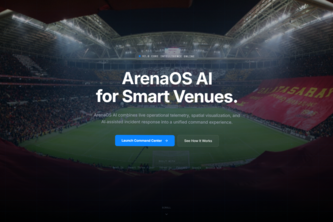
ArenaOS AI is a self-reported project that claims to use Digital Twins and AI to help stadium operators monitor crowds, predict incidents, and make faster, smarter operational decisions in real time. It was submitted to the OpenAI 2026 hackathon on Devpost.
What changed
The description does not indicate any prior version or evolution of the product; it is presented as a single project submission with no evidence of prior development or iteration.
The single most important open question
Is there any evidence of traction, revenue, customer adoption, or operational deployment beyond this hackathon submission?
What The Product Actually Is
The description states that ArenaOS AI uses Digital Twins and AI to help stadium operators monitor crowds, predict incidents, and make faster, smarter operational decisions in real time. It is described as an intelligent digital twin for smart stadiums.
Evidence
- The project name is "ArenaOS AI: Intelligent Digital Twin for Smart Stadiums"
- The tagline describes its use of Digital Twins and AI for stadium operations
- Technology stack includes: ai, codex, css, fastapi, fiber, framer, gpt-5.6, machine, motion, next.js, openai, python, react, tailwind, three, three.js, twin, typescript, vercel, zustand
Inference
- The product is likely a software platform or tool for stadium management
- It may involve real-time data processing and visualization of crowd behavior
Not evidenced
- No details about how the digital twin works in practice
- No information on actual implementation, deployment, or integration with existing stadium systems
- No mention of specific use cases beyond monitoring and prediction
Positioning & Claim Evolution
The description states that ArenaOS AI uses Digital Twins and AI to help stadium operators monitor crowds, predict incidents, and make faster, smarter operational decisions in real time.
Evidence
- The tagline reflects a positioning around digital twins, AI, and smart stadium operations
- It targets stadium operators as the primary user group
Inference
- The product is positioned as an operational intelligence tool for stadiums
- It implies a shift from traditional stadium management to data-driven decision-making
Not evidenced
- No indication of prior positioning or evolution of claims
- No evidence of how this differs from existing solutions or competitors
- No mention of market validation, customer feedback, or product iteration
Target Customer & ICP
The description states that ArenaOS AI helps stadium operators monitor crowds, predict incidents, and make faster, smarter operational decisions in real time.
Evidence
- The target is “stadium operators”
- The use case involves crowd monitoring and incident prediction
Inference
- The product may be aimed at large-scale venues such as sports arenas, concert halls, or event centers
- It likely targets decision-makers within stadium management teams
Not evidenced
- No information about specific customer segments (e.g., size of stadiums, types of events)
- No evidence of customer personas or buyer journey
- No mention of whether the product is B2B or B2C
Business Model & Pricing Evidence
There is no evidence in the description regarding business model or pricing.
Evidence
- The project was submitted to a hackathon and is not described as a commercial offering
Inference
- If this were a commercial product, it would likely be priced per stadium or per user
- It might be sold via subscription or licensing
Not evidenced
- No pricing structure, revenue model, or monetization strategy
- No indication of whether the project is intended for sale, licensing, or internal use
Technical & Delivery Signals
The author-declared technology stack includes: ai, codex, css, fastapi, fiber, framer, gpt-5.6, machine, motion, next.js, openai, python, react, tailwind, three, three.js, twin, typescript, vercel, zustand.
Evidence
- The project is built with a range of modern web and AI technologies
- It uses OpenAI tools (e.g., GPT-5.6), React, Next.js, FastAPI, and 3D visualization libraries
Inference
- The product likely involves real-time data processing and visualization
- It may integrate with existing stadium IoT or sensor systems
Not evidenced
- No information on how the digital twin is constructed or maintained
- No evidence of scalability, performance, or deployment architecture
- No mention of backend infrastructure or data pipelines
Traction & Maturity Signals
The description does not provide any traction or maturity signals.
Evidence
- The project was submitted to a hackathon
- It is described as a single submission with no prior development history
Inference
- The product is likely in early-stage prototype or proof-of-concept phase
- No evidence of customer adoption, revenue, or operational use
Not evidenced
- No metrics on user engagement, performance, or impact
- No evidence of team growth, funding, or partnerships
- No mention of pilot programs or deployments
Competitive Context
There is no evidence in the description about competitive context.
Evidence
- The project is described as a hackathon submission
- No mention of competitors or market landscape
Inference
- The product may compete with stadium management platforms, crowd analytics tools, or smart city solutions
- It might be positioned against AI-powered event management systems
Not evidenced
- No information on existing competitors or market positioning
- No evidence of differentiation from similar technologies
Open Questions & Risks
The project is a single hackathon submission with no traction or commercialization.
Evidence
- Submitted to a hackathon
- No evidence of revenue, customers, or product development beyond this point
Inference
- High risk of being a prototype with no real-world application
- Lack of team, funding, or market validation raises concerns about viability
- The use of AI and digital twin technologies may be aspirational rather than implemented
Not evidenced
- No evidence of intellectual property, regulatory compliance, or data privacy measures
- No indication of how the product would scale or integrate with real stadium systems
Questions the description leaves open
- What is the current stage of development beyond this hackathon submission?
- Has the team built any working prototypes or conducted pilot tests?
- What specific data sources does the system use to build its digital twin?
- How does the product integrate with existing stadium infrastructure or IoT systems?
- Are there any real-world use cases or partnerships in development?
- What is the business model for monetizing this solution?
- What are the technical limitations of the current implementation?
Overall Assessment
Not evidenced
The description provides no evidence of traction, revenue, customer adoption, or operational deployment. It is a single hackathon submission with no indication of commercialization or product maturity.
Confidence Low This analysis is based entirely on self-reported information from one source — the project description provided by the caller. There is no independent verification or historical data to support any claims beyond what was explicitly stated in the description.
User Stories BotA demo video on every pull request
Get a demo video on every new feature
GitHub App that watches your pull requests and records a narrated, captioned demo.
Save time on demo prep and make informed decisions faster with a video walkthrough of every new feature.
Source
Submitted to the OpenAI 2026 hackathon on Devpost. Project home on Devpost. Back to the full gallery on Devpost.
This competitive analysis was produced by top-founders.com (opens in a new tab)
Generated by a language model from this project's public Devpost page — its tagline and any built-with tags listed there, since the author published no write-up — as captured in August 2026. Short quotations are the author's words. It is an opinion on the idea as a business, not on the people behind it, and it reflects the description as published then. If the project has moved on, request a correction below. The analysis is not independent research and contains no verified traction, revenue or customer data.
An independent guide by KFG International LLC — not affiliated with, endorsed by, or connected to Devpost or OpenAI.