

Archive position — measured, not model output
1 like on Devpost
505 of the 7,850 archived projects have more likes, and 1,758 share exactly 1 — so this project's #747 place in the like-ranked listing is a tie-break inside that group, not a ranking.
Projects (log scale)
Likes on Devpost. ▲ marks this project's group.
Show the figures
| Likes | Projects | Share of archive |
|---|---|---|
| 0 | 5,587 | 71.2% |
| 1 | 1,758 | 22.4% |
| 2 | 284 | 3.6% |
| 3–4 | 132 | 1.7% |
| 5–9 | 75 | 1.0% |
| 10+ | 14 | 0.2% |
 User Stories BotA demo video on every pull request
Get a demo video on every new feature
GitHub App that watches your pull requests and records a narrated, captioned demo.
Save time on demo prep and make informed decisions faster with a video walkthrough of every new feature.
Executive Summary
What the company appears to be
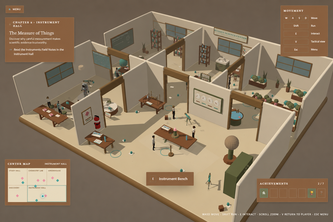
Bunsen is a self-reported 3D science learning platform built as a hackathon project by one developer. The platform allows students to navigate virtual labs, conduct hands-on experiments in a 3D environment, and interact with an AI tutor (Professor Quill) that guides them through questions using a Socratic method. It uses GPT-5.6 for generating experiments and tutoring, and is built with Next.js, React Three Fiber, and other web technologies.
What changed
The project was submitted as a hackathon entry to the OpenAI 2026 hackathon. No prior version or commercial evolution is evidenced.
Single most important open question
Is there any evidence of traction, revenue, or customer adoption beyond the author's own development and submission?
What The Product Actually Is
The description states that Bunsen is a 3D science center where students can walk through virtual labs (Chemistry Lab, Study Hall, Greenhouse), perform actual experiments with state machines, and interact with an AI tutor named Professor Quill. The AI tutor uses a Socratic method to guide students rather than directly answering questions.
The system includes:
- A research desk that generates new experiments using GPT-5.6.
- Zod validation to ensure generated experiments meet safety and schema requirements.
- A story mode with five chapters, from initial titration to an AI-generated experiment.
- NPCs, achievements, and field notes for engagement.
The description also states that the project was built in a few days using Codex, GPT-5.6, Next.js, React Three Fiber, Zustand, Tailwind CSS, and other technologies.
Inference This is a prototype or proof-of-concept product, not a commercial offering. The author describes it as a hackathon project with no evidence of prior versions or deployment beyond the submission.
Positioning & Claim Evolution
The author claims that Bunsen is:
- A 3D science center where students can walk virtual labs.
- A platform that allows students to run hands-on experiments.
- Powered by a Socratic GPT-5.6 tutor that turns questions into playable experiments.
The positioning is rooted in the author’s personal experience of lacking access to real science labs, and the goal is to provide an immersive, interactive learning environment for students in under-resourced schools.
Inference This is a self-reported educational tool with no external validation or market positioning beyond the author's own narrative. The claim of “world-class” or “revolutionary” learning tools is not evidenced.
Target Customer & ICP
The description states that Bunsen targets students in under-resourced schools, particularly those who lack access to real science labs, like the author’s own experience in Bangladesh.
It also mentions that the platform could be used by teachers (via a future dashboard) and potentially for multiplayer learning or multilingual support.
Inference The target customer is not clearly defined beyond students in low-resource settings. No evidence of actual customers, schools, or partnerships exists.
Business Model & Pricing Evidence
There is no evidence of any business model or pricing structure in the description. The author mentions a future teacher dashboard and potential monetization through chapters or subjects, but no revenue streams, pricing tiers, or commercial models are described.
Inference No business model or pricing data is evidenced. This is a self-reported prototype with no indication of monetization plans.
Technical & Delivery Signals
The project was built using:
- Next.js 14
- React Three Fiber and Drei for 3D rendering
- Zustand for game state management
- Tailwind CSS for UI
- GPT-5.6 for tutoring and experiment generation
- Codex for rapid development
The author notes:
- GPT-5.6 is used in two modes: one for streaming tutor dialogue, another for generating experiments.
- Zod validation ensures safety of generated content.
- The system includes a Zod validation loop to transform GPT output into game-safe content.
- Optimization was required to support a 5-zone 3D world with NPCs and audio.
Inference The technical stack is advanced, but the project is presented as a prototype. No evidence of scalability, performance metrics, or production deployment exists.
Traction & Maturity Signals
There is no evidence of traction, customers, or adoption beyond the author’s own development and hackathon submission. The project was built by one developer in a short timeframe and submitted to a hackathon.
Inference No traction, revenue, or user data are evidenced. This is a self-reported prototype with no commercial maturity.
Competitive Context
The description does not mention any competitors or similar products. It is unclear whether Bunsen is positioned against existing virtual lab platforms or educational tools in the market.
Inference No competitive analysis or positioning relative to other players is evidenced.
Open Questions & Risks
- Single developer project: The entire system was built by one person, which raises questions about scalability and long-term maintenance.
- Unverified claims: All descriptions are self-reported and unverified.
- Prototype nature: No evidence of production deployment or user feedback.
- No monetization strategy: No indication of how the product would be monetized or scaled.
- Dependency on GPT-5.6: The system relies heavily on a proprietary AI model, which may not be available or stable in the long term.
Inference The project is highly speculative and lacks any commercial or operational evidence to support its viability as a scalable product.
Questions the description leaves open
- What is the actual user base or pilot program for this platform, if any?
- How does the validation loop with Zod ensure safety in real-world usage?
- Are there plans to monetize or scale beyond the hackathon version?
- Has the AI tutor been tested with real students or educators?
- What are the technical limitations of running this in a browser at scale?
Overall Assessment
Not evidenced.
The description is entirely self-reported and unverified. There is no evidence of traction, revenue, customers, or commercial viability beyond a hackathon submission by one developer. The project is presented as a prototype with no indication of product-market fit, scalability, or monetization strategy.
Confidence Low. This analysis is based on a single self-reported source and lacks any external validation or evidence of real-world usage or impact.
User Stories BotA demo video on every pull request
Get a demo video on every new feature
GitHub App that watches your pull requests and records a narrated, captioned demo.
Save time on demo prep and make informed decisions faster with a video walkthrough of every new feature.
Source
Submitted to the OpenAI 2026 hackathon on Devpost. Project home on Devpost. Back to the full gallery on Devpost.
This competitive analysis was produced by top-founders.com (opens in a new tab)
Generated by a language model from this project's public Devpost page — its tagline, the author's own write-up and any built-with tags listed there — as captured in August 2026. Short quotations are the author's words. It is an opinion on the idea as a business, not on the people behind it, and it reflects the description as published then. If the project has moved on, request a correction below. The analysis is not independent research and contains no verified traction, revenue or customer data.
An independent guide by KFG International LLC — not affiliated with, endorsed by, or connected to Devpost or OpenAI.