

Archive position — measured, not model output
0 likes on Devpost
2,263 of the 7,850 archived projects have more likes, and 5,587 share exactly 0 — so this project's #3,044 place in the like-ranked listing is a tie-break inside that group, not a ranking.
Projects (log scale)
Likes on Devpost. ▲ marks this project's group.
Show the figures
| Likes | Projects | Share of archive |
|---|---|---|
| 0 | 5,587 | 71.2% |
| 1 | 1,758 | 22.4% |
| 2 | 284 | 3.6% |
| 3–4 | 132 | 1.7% |
| 5–9 | 75 | 1.0% |
| 10+ | 14 | 0.2% |
 User Stories BotA demo video on every pull request
Get a demo video on every new feature
GitHub App that watches your pull requests and records a narrated, captioned demo.
Save time on demo prep and make informed decisions faster with a video walkthrough of every new feature.
Executive Summary
Bug Court: AI Code Review Judge is a self-reported developer tool that claims to transform code review by structuring findings into evidence-backed case files using AI agents. The project was submitted as part of the OpenAI 2026 hackathon and is described as a prototype built with Codex, GitHub integration, and an agent-based architecture.
The description states that Bug Court organizes pull request findings into structured case files with severity, reproduction steps, test results, and suggested fixes. It emphasizes developer control over patch acceptance and transparency in AI decision-making.
Key commercial due-diligence read: The author claims Bug Court improves code review through AI-generated evidence-backed case files, but there is no evidence of revenue, customers, or product adoption. The project appears to be a prototype with no demonstrated traction or business model beyond the hackathon submission.
Most important open question: Is there any evidence that developers actually use this tool in production environments, or whether it has moved beyond a proof-of-concept?
What The Product Actually Is
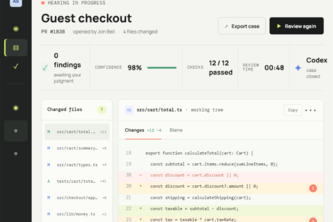
The description states that Bug Court is an AI-powered code review tool that turns pull requests into "evidence-backed case files". It uses Codex as a coding partner and organizes findings into structured reports containing:
- Severity and confidence levels
- Exact file and line locations
- Plain-language explanations
- Reproduction steps
- Test results
- Suggested fixes
- Developer decision state
The tool is described as having three cooperating agents:
- A diff and history agent
- A reproduction agent that creates and runs targeted test cases
- A judge agent that ranks findings and prepares the case file
The interface is described as a "focused developer workbench" with a pull request queue, annotated diff viewer, AI case file, test evidence panel, and activity timeline.
Evidence strength: Self-reported by author. No independent verification of functionality or delivery.
Positioning & Claim Evolution
The description states that Bug Court was inspired by the idea of turning code review into a "transparent hearing". It positions itself as an improvement over traditional code review where developers receive vague comments like “this may fail in production” without reliable reproduction, test cases, or safe fixes.
The author claims that Bug Court shows evidence behind each issue and makes AI behavior inspectable instead of hiding it behind a single "Generate fix" button. The tool is positioned as a way to improve trust in AI code review by showing precise code locations, reproducible failures, clear confidence levels, and visible chains of actions.
Evidence strength: Self-reported claims about positioning and intent. No evidence of market reception or adoption.
Target Customer & ICP
The description states that Bug Court is designed for developers reviewing pull requests. It is described as a "developer workbench" with an interface tailored to developer workflows.
The author notes that the tool was built around GitHub pull requests, suggesting a target audience of developers using GitHub for version control and collaboration.
Evidence strength: Self-reported customer targeting. No evidence of actual users or customer segments beyond developer personas.
Business Model & Pricing Evidence
Not evidenced.
The description does not contain any information about pricing, monetization strategy, or business model. There is no mention of subscriptions, usage fees, enterprise licensing, or revenue streams.
Evidence strength: None provided.
Technical & Delivery Signals
The project was built with:
- Codex as a coding partner
- GitHub integration
- OpenAI Responses API
- Agents SDK
- Sandboxed test runner
- Built with JavaScript, Python, HTML5, CSS3, and other developer technologies
The architecture is described as being designed around three cooperating agents. The current demo uses deterministic fixture data for reliability during judging.
The author states that the production integration is designed to work with GitHub pull requests, OpenAI APIs, and sandboxed test runners.
Evidence strength: Self-reported technical stack and architecture. No evidence of delivery or operational capability beyond prototype.
Traction & Maturity Signals
Not evidenced.
There is no evidence of revenue, customers, user adoption, or product maturity beyond the hackathon submission. The project is described as a demo with deterministic fixture data and not yet connected to live GitHub integrations.
Evidence strength: None provided.
Competitive Context
Not evidenced.
The description does not mention any competitors or competitive landscape. No information is provided about existing tools in the AI code review space or how Bug Court compares to them.
Evidence strength: None provided.
Open Questions & Risks
- Prototype-only status: The project is described as a hackathon submission and demo, with no evidence of production use or traction.
- No revenue or customers: There is no evidence of any monetization, users, or business development beyond the author's own description.
- Unverified claims: All claims about functionality, impact, and user experience are self-reported without independent verification.
- Limited scope: The demo works with fixture data rather than live GitHub integrations, suggesting incomplete delivery.
- Single-founder team: The project is described as being built by one person (Kiran R), which may limit development capacity.
Evidence strength: Inferences based on lack of evidence for key commercial signals.
Questions the description leaves open
- What specific problems in current code review workflows are you solving, and how do you know?
- Have you validated your approach with real developers using real pull requests?
- How does Bug Court differ from existing AI code review tools like GitHub Copilot, SonarQube, or CodeGPT?
- What is the path to production integration beyond the demo?
- Are there any early adopters or pilot users of this tool?
- What are your plans for monetization and scaling the product?
Overall Assessment
Not evidenced.
There is no evidence of revenue, customers, traction, or business model to support an investment or partnership decision. The project appears to be a prototype submitted to a hackathon with no demonstrated commercial viability or market adoption.
Evidence strength: None provided beyond self-reported claims.
User Stories BotA demo video on every pull request
Get a demo video on every new feature
GitHub App that watches your pull requests and records a narrated, captioned demo.
Save time on demo prep and make informed decisions faster with a video walkthrough of every new feature.
Source
Submitted to the OpenAI 2026 hackathon on Devpost. Project home on Devpost. Back to the full gallery on Devpost.
This competitive analysis was produced by top-founders.com (opens in a new tab)
Generated by a language model from this project's public Devpost page — its tagline, the author's own write-up and any built-with tags listed there — as captured in August 2026. Short quotations are the author's words. It is an opinion on the idea as a business, not on the people behind it, and it reflects the description as published then. If the project has moved on, request a correction below. The analysis is not independent research and contains no verified traction, revenue or customer data.
An independent guide by KFG International LLC — not affiliated with, endorsed by, or connected to Devpost or OpenAI.