

Archive position — measured, not model output
0 likes on Devpost
2,263 of the 7,850 archived projects have more likes, and 5,587 share exactly 0 — so this project's #3,045 place in the like-ranked listing is a tie-break inside that group, not a ranking.
Projects (log scale)
Likes on Devpost. ▲ marks this project's group.
Show the figures
| Likes | Projects | Share of archive |
|---|---|---|
| 0 | 5,587 | 71.2% |
| 1 | 1,758 | 22.4% |
| 2 | 284 | 3.6% |
| 3–4 | 132 | 1.7% |
| 5–9 | 75 | 1.0% |
| 10+ | 14 | 0.2% |
 User Stories BotA demo video on every pull request
Get a demo video on every new feature
GitHub App that watches your pull requests and records a narrated, captioned demo.
Save time on demo prep and make informed decisions faster with a video walkthrough of every new feature.
Executive Summary
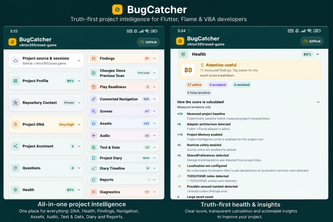
Bugcatcher is a self-reported developer tool for Flutter, Flame, and VBA projects that claims to provide "evidence-based insights" about project structure, risks, navigation, and architecture. The author states it was built using GPT-5.6 and Codex during an OpenAI Build Week hackathon. It is described as a "truth-first" tool aiming to help developers spend less time understanding projects and more time building.
The single most important open question is: What actual functionality does Bugcatcher deliver, and how does it distinguish between verified facts and inferred insights in its analysis?
This analysis is based entirely on the self-reported project description provided by the author. No independent verification or evidence of traction, revenue, customers, or product usage exists beyond what is stated.
What The Product Actually Is
The description states that Bugcatcher is a "truth-first mobile project intelligence tool for Flutter, Flame, and VBA projects." It analyzes projects and presents evidence-based insights about their structure, technologies, assets, navigation, health, risks, evolution, and architecture. It also allows side-by-side comparison of projects to identify feature differences and development decisions.
The author describes the tool as helping developers understand where they left off, what parts are strong or need attention, and what risks or hidden issues exist in a project. It is also described as enabling exploration of public projects without manually digging through thousands of files.
Inferred: The tool appears to be a static analysis or code intelligence platform that leverages AI for interpretation and summarization of project content.
Not evidenced: No details on how the tool actually works, what data it consumes, or what output formats it provides beyond "insights."
Positioning & Claim Evolution
The author positions Bugcatcher as a solution to the problem of time spent understanding projects versus building them. It is described as a "mobile project passenger" that follows developers wherever they go, allowing them to load and inspect projects anytime, anywhere.
The tool claims to be "truth-first," distinguishing verified information from inferred or uncertain findings. This suggests an emphasis on accuracy over speculation.
Inferred: The positioning implies Bugcatcher targets indie developers or teams working with Flutter, Flame, and VBA projects who want rapid project comprehension and decision-making support.
Not evidenced: No evidence of market positioning beyond the author’s own claims. No competitor comparison or differentiation strategy is described.
Target Customer & ICP
The description states that Bugcatcher was inspired by the needs of an "indie developer" returning to older projects, and also helps developers explore public projects without manual digging.
Inferred: The primary customer segment appears to be indie developers or small teams working with Flutter, Flame, and VBA projects who need quick project understanding and navigation support.
Not evidenced: No explicit identification of ICP beyond the author’s personal use case. No segmentation or targeting data is provided.
Business Model & Pricing Evidence
The description does not mention any pricing model, monetization strategy, or business model.
Inferred: Given that this is a hackathon project and no revenue or customer data are reported, it is likely either a prototype or early-stage tool with no commercial model yet defined.
Not evidenced: No information on how the product would be sold, licensed, or offered to users.
Technical & Delivery Signals
The author states that Bugcatcher was built using GPT-5.6 and Codex during an OpenAI Build Week hackathon. It involved four major implementation phases with extensive polishing, testing, and refinement.
The tool is described as being built for Flutter, Flame, and VBA projects and uses a "truth-first" approach to avoid assumptions.
Inferred: The tool likely leverages AI-based static analysis or code interpretation, possibly integrated with GitHub or similar platforms.
Not evidenced: No technical architecture details, data sources, or delivery mechanism beyond the author’s own account. No mention of APIs, integrations, or scalability.
Traction & Maturity Signals
The description states that this is a hackathon project submitted to the OpenAI 2026 hackathon on Devpost. It was built in a short timeframe and has no reported traction, customers, or usage metrics.
Inferred: The tool is likely in an early prototype phase with no evidence of product-market fit or user adoption.
Not evidenced: No data on users, downloads, engagement, or revenue. No mention of any beta program or customer feedback.
Competitive Context
The description does not provide any information about competitors or the competitive landscape for project intelligence tools in Flutter, Flame, or VBA environments.
Inferred: The tool may compete with static code analysis tools, IDE plugins, or developer navigation platforms, but no specific competitive positioning is stated.
Not evidenced: No mention of existing tools, market size, or competitive differentiation.
Open Questions & Risks
- Unverified claims: The description makes strong claims about "truth-first" insights and evidence-based analysis without demonstrating how this is achieved.
- No product delivery: There is no evidence that the tool has been delivered to users or tested in real-world conditions.
- Prototype nature: It is a hackathon project with no indication of further development or commercial viability.
- Lack of clarity on AI use: The role of GPT-5.6 and Codex in analysis is not explained, raising questions about reproducibility and reliability.
- No monetization strategy: No evidence of how the tool would be monetized or scaled.
Not evidenced: No risk assessment beyond the author’s own claims. No third-party validation or user feedback.
Questions the description leaves open
- What specific data inputs does Bugcatcher consume, and how does it process them?
- How does the tool distinguish between verified facts and inferred insights in its reports?
- What is the current state of the product — is it a prototype or has it been tested with users?
- How does Bugcatcher handle edge cases or complex project structures?
- Are there any integrations with IDEs, CI/CD pipelines, or version control systems?
- What are the plans for monetization and scaling beyond the hackathon phase?
Overall Assessment
The description indicates that Bugcatcher is a self-reported hackathon project with no evidence of traction, revenue, or customer adoption. It is described as a tool for Flutter, Flame, and VBA developers aiming to improve project understanding through AI-based analysis.
Inferred: This is likely an early-stage idea or prototype with no clear path to commercialization or product-market fit.
Not evidenced: No basis for evaluating investment potential or partnership viability beyond the author’s own claims. The tool has not demonstrated any measurable impact or user value.
User Stories BotA demo video on every pull request
Get a demo video on every new feature
GitHub App that watches your pull requests and records a narrated, captioned demo.
Save time on demo prep and make informed decisions faster with a video walkthrough of every new feature.
Source
Submitted to the OpenAI 2026 hackathon on Devpost. Project home on Devpost. Back to the full gallery on Devpost.
This competitive analysis was produced by top-founders.com (opens in a new tab)
Generated by a language model from this project's public Devpost page — its tagline, the author's own write-up and any built-with tags listed there — as captured in August 2026. Short quotations are the author's words. It is an opinion on the idea as a business, not on the people behind it, and it reflects the description as published then. If the project has moved on, request a correction below. The analysis is not independent research and contains no verified traction, revenue or customer data.
An independent guide by KFG International LLC — not affiliated with, endorsed by, or connected to Devpost or OpenAI.