

Archive position — measured, not model output
0 likes on Devpost
2,263 of the 7,850 archived projects have more likes, and 5,587 share exactly 0 — so this project's #3,046 place in the like-ranked listing is a tie-break inside that group, not a ranking.
Projects (log scale)
Likes on Devpost. ▲ marks this project's group.
Show the figures
| Likes | Projects | Share of archive |
|---|---|---|
| 0 | 5,587 | 71.2% |
| 1 | 1,758 | 22.4% |
| 2 | 284 | 3.6% |
| 3–4 | 132 | 1.7% |
| 5–9 | 75 | 1.0% |
| 10+ | 14 | 0.2% |
 User Stories BotA demo video on every pull request
Get a demo video on every new feature
GitHub App that watches your pull requests and records a narrated, captioned demo.
Save time on demo prep and make informed decisions faster with a video walkthrough of every new feature.
Executive Summary
BugProof is a self-reported local-first developer tool designed to support a "proof-first" approach to software repair. The author states that it transforms visual bug reports into reproducible tests, focused patches, and reviewable evidence — aiming to replace AI-generated patches with a workflow that requires proof. It is presented as a prototype built for the OpenAI 2026 hackathon.
The project has no evidenced traction, revenue, or customer data. The description contains no claims about funding, headcount, or market adoption beyond its submission to a hackathon.
Key open question
What is the actual utility of BugProof's proposed workflow in real-world development environments? Is there evidence that developers will adopt a tool that requires them to manually create reproducible tests and patches, rather than relying on automated patch generation?
What The Product Actually Is
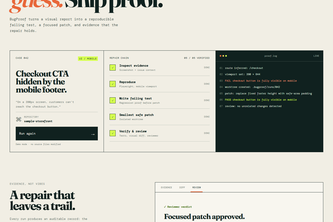
The description states that BugProof is a local-first developer tool for proof-first software repair. It guides users through an evidence chain:
- Inspect visual bug reports
- Reproduce the issue at the target viewport
- Create a failing regression test
- Apply the smallest safe patch in an isolated workspace
- Verify the result and record a focused review
The author notes that the current prototype is built with React, Vite, JavaScript, and CSS, and uses Codex for product design and implementation. The tool is described as being deterministic for demos, but the execution layer (local Codex, Playwright, Git worktree) is not yet connected.
Inference BugProof appears to be a developer-focused workflow tool that emphasizes reproducibility and verification over automated patch generation. It is not a standalone AI agent or a fully integrated development environment.
Positioning & Claim Evolution
The author states that BugProof was inspired by the idea that "a screenshot can make a bug obvious to a human, but it rarely provides enough evidence for a coding agent to repair the issue safely."
It positions itself as a tool that replaces "AI-generated patch" with a workflow that requires proof, aiming to ensure that repairs are safe and verifiable.
The description does not indicate any prior positioning or evolution of claims beyond this single stated intent. There is no evidence of prior versions, product iterations, or market feedback shaping the current offering.
Claim
BugProof is a tool for "proof-first" repair workflows.
Inference It is positioned as an alternative to AI-generated patches, emphasizing safety and reproducibility.
Target Customer & ICP
The description states that BugProof is a developer tool, and it is designed for local-first use. The author refers to the tool’s workflow being suitable for developers who want to "turn visual bug reports into reproducible tests, focused patches, and reviewable evidence."
There is no mention of specific developer roles (e.g., QA engineers, backend developers), target industries, or user personas.
Claim
BugProof targets developers working on software repair.
Inference The tool may appeal to teams that prioritize safety, verification, or reproducibility in their development workflows.
Business Model & Pricing Evidence
The description does not contain any information about pricing, monetization, or business model. There is no mention of subscriptions, licensing, or revenue streams.
Not evidenced
Technical & Delivery Signals
The prototype is built with:
- React
- Vite
- JavaScript
- CSS
- Codex (used in design and implementation)
It is described as being deterministic for demos, but the execution layer (local Codex, Playwright, Git worktree) is not yet connected.
The author states that they are now connecting these components to replace prototype fixtures.
Inference The tool is in early prototype phase. It is not yet integrated with real development tools or workflows.
Traction & Maturity Signals
There is no evidence of traction, revenue, customers, or adoption beyond its submission to the OpenAI 2026 hackathon.
The project is described as a prototype, and there is no mention of any user base, usage metrics, or product maturity.
Not evidenced
Competitive Context
The description does not provide information about competitors or the broader market landscape. It does not reference existing tools for bug reporting, patch generation, or verification workflows.
Not evidenced
Open Questions & Risks
- Prototype-only status: The tool is described as a prototype and has not yet integrated with real development tools.
- No evidence of adoption or traction: There is no indication that developers are using or interested in BugProof beyond its hackathon submission.
- High manual effort: The workflow requires users to manually create tests, patches, and verify results — which may be at odds with developer preferences for automation.
- Unclear utility: It is not evident whether the added complexity of proof-first workflows will be adopted by developers or if it creates friction in existing development practices.
Inference The tool’s value proposition may not align with current developer workflows, and its prototype status raises questions about scalability and real-world applicability.
Questions the description leaves open
- What specific bugs or use cases does BugProof aim to solve that current tools do not?
- How does the manual workflow of creating tests and patches compare to existing patch-generation tools in terms of developer time and effort?
- Are there any early adopters or users who have tested this workflow in real development environments?
- What are the technical challenges in integrating with Playwright, Git worktree, and Codex for execution?
- How does BugProof plan to scale beyond a hackathon prototype?
Overall Assessment
The description states that BugProof is a prototype built for a hackathon. There is no evidence of traction, revenue, or customer data.
Assessment Not evidenced.
Confidence Level Low — the project is described as a hackathon submission with no verified product-market fit, adoption, or business model. The tool’s utility and viability in real-world development environments remain unproven.
User Stories BotA demo video on every pull request
Get a demo video on every new feature
GitHub App that watches your pull requests and records a narrated, captioned demo.
Save time on demo prep and make informed decisions faster with a video walkthrough of every new feature.
Source
Submitted to the OpenAI 2026 hackathon on Devpost. Project home on Devpost. Back to the full gallery on Devpost.
This competitive analysis was produced by top-founders.com (opens in a new tab)
Generated by a language model from this project's public Devpost page — its tagline, the author's own write-up and any built-with tags listed there — as captured in August 2026. Short quotations are the author's words. It is an opinion on the idea as a business, not on the people behind it, and it reflects the description as published then. If the project has moved on, request a correction below. The analysis is not independent research and contains no verified traction, revenue or customer data.
An independent guide by KFG International LLC — not affiliated with, endorsed by, or connected to Devpost or OpenAI.