

Archive position — measured, not model output
1 like on Devpost
505 of the 7,850 archived projects have more likes, and 1,758 share exactly 1 — so this project's #732 place in the like-ranked listing is a tie-break inside that group, not a ranking.
Projects (log scale)
Likes on Devpost. ▲ marks this project's group.
Show the figures
| Likes | Projects | Share of archive |
|---|---|---|
| 0 | 5,587 | 71.2% |
| 1 | 1,758 | 22.4% |
| 2 | 284 | 3.6% |
| 3–4 | 132 | 1.7% |
| 5–9 | 75 | 1.0% |
| 10+ | 14 | 0.2% |
 User Stories BotA demo video on every pull request
Get a demo video on every new feature
GitHub App that watches your pull requests and records a narrated, captioned demo.
Save time on demo prep and make informed decisions faster with a video walkthrough of every new feature.
Executive Summary
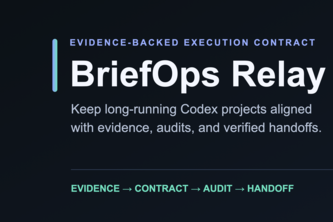
BriefOps Relay, as described by its author, is a command-line tool built in TypeScript and Node.js that aims to improve AI-assisted coding workflows by introducing an "execution contract" between repository context and task implementation. The system collects bounded, line-addressable evidence from Git repositories, creates a structured execution contract for tasks, audits Codex implementations against this contract, and generates verified handoffs.
The author states that the tool is designed to address continuity issues in long-running projects where requirements, decisions, and constraints are scattered across documents, earlier sessions, and code. It does not claim to be an AI memory summary but rather an evidence-backed execution loop with deterministic integrity scoring.
Key commercial due-diligence read: The description presents a technical solution for AI workflow integrity, but there is no evidence of traction, revenue, customers or adoption beyond the author's own development and testing. The project appears to be a proof-of-concept or prototype submitted to a hackathon, with no indication of market validation or commercial viability.
Most important open question: Is there any evidence that this tool has been used in production environments or by teams outside of the single developer who built it?
What The Product Actually Is
The description states that BriefOps Relay is:
- A command-line interface (CLI) tool built with TypeScript and Node.js
- Part of a larger system called "BriefOps"
- Designed to turn repository context into task contracts
- Capable of auditing Codex changes against those contracts
- Able to create verified handoffs between tasks
The tool uses:
- Commander for CLI
- Zod for artifact schemas
- Git diff collection for change evidence
- Vitest for regression coverage
- Generates self-contained HTML reports with no server or network access required
It operates in four main phases:
- Prepare – Collect bounded, line-addressable repository evidence and create an Execution Contract
- Build – Codex implements against the contract instead of vague repository summaries
- Audit – Examines Git diff and classifies each Contract item as met, at risk, violated, or unverified
- Handoff – Renders changes, checks, unresolved risks, and next action as Markdown and static HTML report
The system is described as being deliberately offline and API-key-free for its default demo.
Inference: The tool appears to be a prototype focused on integrity checking in AI-assisted coding workflows rather than a full-fledged product with commercial features or customer support.
Positioning & Claim Evolution
The author claims that BriefOps Relay addresses continuity problems in long-running projects where:
- Requirements live in documents
- Decisions live in earlier sessions
- Constraints live in code and tests
They state the tool makes "continuity inspectable rather than merely summarized."
The positioning is:
- Not an AI memory summary
- An evidence-backed execution loop with deterministic integrity score and completion gate
- A way to prove what implementation did against a defined contract
Inference: The product positions itself as solving a specific problem in AI-assisted development workflows around trust, accountability, and task boundary management. However, the claims are self-reported without external validation or demonstration of real-world usage.
Target Customer & ICP
The description does not explicitly identify target customers or personas.
However, it implies:
- Developers working with AI coding tools like Codex
- Teams managing long-running projects where context drift occurs
- Organizations seeking to improve trust in AI-generated code
It is unclear whether the tool targets individual developers or enterprise teams.
Inference: Based on the technical focus and use case described, the likely ICP includes developers using AI coding assistants who need structured task execution contracts and audit trails. But there's no evidence of customer segmentation or targeting strategy.
Business Model & Pricing Evidence
There is no evidence provided about business model or pricing.
The description mentions two opt-in providers:
- Codex provider (locally authenticated CLI)
- Optional OpenAI provider (structured responses API with store: false)
Both require explicit network flags before bounded repository evidence is sent.
Inference: The tool appears to be free to use in offline mode, with optional paid integrations for live AI providers. However, no pricing information or monetization strategy is stated.
Technical & Delivery Signals
The author states:
- Built with TypeScript and Node.js
- Uses Commander CLI framework
- Employs Zod for artifact schemas
- Leverages Git diff collection for change evidence
- Uses Vitest for regression coverage
- Generates self-contained HTML reports (no server, React app, analytics, or required network access)
- Default demo is offline and API-key-free
- Supports two explicit opt-in providers (Codex and OpenAI)
The system handles adversarial artifact-integrity scenarios including:
- Known violation
- Unknown evidence
- Duplicate findings
- Missing finding
- Score tampering
- All-met control
Inference: The technical stack is standard for CLI tools and Node.js applications. The emphasis on offline capability, deterministic validation, and bounded evidence suggests a focus on security and trustworthiness in AI workflows.
Traction & Maturity Signals
The description states:
- Project was submitted to the OpenAI 2026 hackathon
- Team size: 1 (Simon Yoon)
- No mention of revenue, customers, or adoption metrics
- The current offline evaluation is intentionally artifact-integrity coverage, not a claim about general model accuracy
- The system is described as a prototype, not a commercial product
Inference: There is no evidence of traction, revenue, or customer adoption beyond the author's own development and testing. This appears to be a hackathon submission with no indication of market readiness or commercial viability.
Competitive Context
The description does not provide any information about competitors or competitive landscape.
It does not mention:
- Similar tools in the AI coding space
- Existing solutions for task contracts or code auditing
- Market positioning relative to other AI workflow management systems
Inference: No competitive context is provided, making it impossible to assess how this tool might fit into existing markets or differentiate from alternatives.
Open Questions & Risks
Key risks and open questions based on the description:
- Single Developer Team: Only one person (Simon Yoon) is listed as a team member, which raises questions about scalability and long-term maintenance.
- No Traction or Revenue: No evidence of customers, revenue, or adoption beyond the author's own development.
- Hackathon Submission: The project was submitted to a hackathon, suggesting it may be incomplete or experimental.
- Limited Scope: The system is described as intentionally artifact-integrity coverage rather than general model accuracy, indicating limited functionality.
- No Market Validation: No evidence of market demand or customer feedback.
- Unproven Commercial Viability: No indication that the solution addresses a real commercial need beyond the author's own use case.
Inference: The tool lacks any signs of commercial traction or viability, and its hackathon origin suggests it may be more of a proof-of-concept than a scalable product.
Questions the description leaves open
- What specific problems in AI-assisted development workflows are you trying to solve?
- How does this tool integrate with existing development environments or CI/CD pipelines?
- Have you tested the system with real teams or organizations beyond yourself?
- What is your plan for expanding beyond the current offline demo and opt-in providers?
- How do you intend to monetize this product if at all?
- What are the key assumptions underlying your approach to task contracts and evidence-based execution?
- Are there any known limitations or edge cases where the system fails to perform as intended?
- How would you scale this solution beyond a single developer's use case?
Overall Assessment
The description presents a technical prototype for AI workflow integrity, but there is no evidence of commercial traction, revenue, customers, or adoption.
Assessment: Not ready for investment or partnership consideration at this stage. The project appears to be a hackathon submission with no indication of market validation or commercial viability.
Confidence Level: Low — based entirely on self-reported information without any external corroboration or evidence of real-world usage or impact.
Next Steps: If pursuing further diligence, would require:
- Evidence of customer adoption or pilot programs
- Revenue data or monetization strategy
- Market research showing demand for such a solution
- Proof of concept results from teams beyond the single developer
User Stories BotA demo video on every pull request
Get a demo video on every new feature
GitHub App that watches your pull requests and records a narrated, captioned demo.
Save time on demo prep and make informed decisions faster with a video walkthrough of every new feature.
Source
Submitted to the OpenAI 2026 hackathon on Devpost. Project home on Devpost. Back to the full gallery on Devpost.
This competitive analysis was produced by top-founders.com (opens in a new tab)
Generated by a language model from this project's public Devpost page — its tagline, the author's own write-up and any built-with tags listed there — as captured in August 2026. Short quotations are the author's words. It is an opinion on the idea as a business, not on the people behind it, and it reflects the description as published then. If the project has moved on, request a correction below. The analysis is not independent research and contains no verified traction, revenue or customer data.
An independent guide by KFG International LLC — not affiliated with, endorsed by, or connected to Devpost or OpenAI.