

Archive position — measured, not model output
0 likes on Devpost
2,263 of the 7,850 archived projects have more likes, and 5,587 share exactly 0 — so this project's #2,695 place in the like-ranked listing is a tie-break inside that group, not a ranking.
Projects (log scale)
Likes on Devpost. ▲ marks this project's group.
Show the figures
| Likes | Projects | Share of archive |
|---|---|---|
| 0 | 5,587 | 71.2% |
| 1 | 1,758 | 22.4% |
| 2 | 284 | 3.6% |
| 3–4 | 132 | 1.7% |
| 5–9 | 75 | 1.0% |
| 10+ | 14 | 0.2% |
 User Stories BotA demo video on every pull request
Get a demo video on every new feature
GitHub App that watches your pull requests and records a narrated, captioned demo.
Save time on demo prep and make informed decisions faster with a video walkthrough of every new feature.
Executive Summary
What the company appears to be
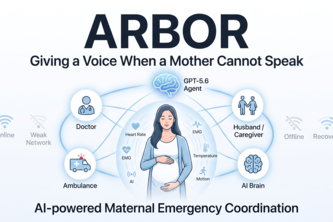
ARBOR is an AI-powered maternal emergency coordination platform designed for speech-impaired pregnant mothers. The description states it uses GPT-5.6 as a reasoning engine to coordinate actions among multiple stakeholders (mother, caregiver, doctor, ambulance, judge) during pregnancy emergencies. It simulates wearable sensors, supports edge-based monitoring, and aims to maintain workflow continuity even when internet connectivity is lost.
What changed
The project was built as a hackathon prototype for the OpenAI 2026 Build Week, using technologies like FastAPI, Python, Codex, and GPT-5.6. It claims to go beyond simple AI recommendations by integrating reasoning, adaptive planning, multi-dashboard collaboration, and offline resilience.
Single most important open question
Is there any evidence of real-world use cases or clinical validation for this system? The description makes no mention of actual deployment, testing with healthcare providers, or user feedback from speech-impaired mothers. Without such traction, the product remains unproven in its intended domain.
What The Product Actually Is
The description states that ARBOR is an AI-powered maternal emergency coordination platform for speech-impaired pregnant mothers. It combines:
- Live wearable sensor simulation
- Edge-based monitoring
- GPT-5.6 reasoning and planning
- Adaptive workflow coordination
- Human-in-the-loop decision making
- Offline continuity
- Multi-dashboard collaboration
It is described as a system where GPT-5.6 serves as the reasoning engine, analyzing physiological data and patient context, explaining why attention is needed, planning next steps, adapting plans based on caregiver feedback, and coordinating existing tools to complete tasks.
The platform supports dashboards for Mother, Caregiver, Doctor, Ambulance, and Judge, all synchronized through a continuous emergency workflow.
Not evidenced There is no evidence of actual product delivery, customer adoption, or real-world implementation beyond the hackathon prototype.
Positioning & Claim Evolution
The description states that ARBOR was inspired by the need to support speech-impaired pregnant mothers during emergencies where communication fails. The authors claim it goes beyond typical AI healthcare demos by:
- Explaining its reasoning
- Generating adaptive action plans
- Coordinating multiple stakeholders
- Accepting human feedback
- Updating its plan as circumstances change
- Supporting workflow continuity during offline periods
The positioning is that ARBOR does not replace doctors but instead acts as a transparent and collaborative coordination partner during critical moments.
Inference This suggests an intent to position the system in high-risk maternal care settings, possibly targeting underserved populations or regions with limited access to communication aids.
Target Customer & ICP
The description states that ARBOR targets speech-impaired pregnant mothers, particularly those who may experience life-threatening emergencies where communication is essential but hindered.
It also implies a broader audience in healthcare environments where coordination among caregivers, doctors, and emergency responders is crucial.
Not evidenced No specific customer segments, demographics, or market size data are provided. No mention of whether the system targets hospitals, clinics, home births, or remote areas.
Business Model & Pricing Evidence
The description does not contain any information about pricing models, monetization strategies, or business models.
It is clear that ARBOR is a hackathon prototype, not a commercial product.
Not evidenced No evidence of revenue streams, licensing, subscriptions, or B2B partnerships.
Technical & Delivery Signals
The project was built using:
- Built with (author-declared): api, codex, fastapi, gpt, python
- Technologies used: React frontend, FastAPI backend, PostgreSQL integration, WebSocket communication, AI workflow implementation, deployment automation, testing
- Development approach: Codex treated as a collaborative software engineer; architecture designed manually, then implemented with Codex assistance
Key technical features include:
- Real-time synchronization across dashboards
- Edge processing for local monitoring
- GPT-5.6 as reasoning agent
- Offline continuity and resumption of cloud-assisted coordination
- Human-in-the-loop feedback loop for replanning
Inference The use of Codex suggests a rapid prototyping approach, but no evidence of scalability or production-grade infrastructure.
Traction & Maturity Signals
The description explicitly states that ARBOR is a hackathon prototype, not a deployed product. It was submitted to the OpenAI 2026 Build Week and has no evidence of:
- Revenue
- Customers
- User adoption
- Clinical validation
- Regulatory approval
- Integration with existing healthcare systems
Not evidenced No traction data, usage metrics, or real-world testing are provided.
Competitive Context
The description does not reference any competitors or existing solutions in the maternal emergency coordination space. It focuses on how ARBOR differs from other AI healthcare demos by continuing beyond recommendations into adaptive planning and multi-stakeholder coordination.
Not evidenced No competitive analysis, market positioning, or comparison to current tools in the field.
Open Questions & Risks
- Unproven concept: The system is a hackathon prototype with no clinical validation or real-world testing.
- Overreliance on AI: GPT-5.6 is central to the system's operation, but there is no indication of how it handles uncertainty or error in medical contexts.
- No commercial viability: No evidence of monetization strategy or business model.
- Regulatory risk: Healthcare applications require extensive validation and compliance; none mentioned.
- Technical feasibility: While described as resilient, no evidence of robustness under real-world conditions.
Inference The project lacks the maturity to be considered a viable product for immediate commercialization or investment.
Questions the description leaves open
- What specific clinical scenarios were envisioned for ARBOR’s use? Were any healthcare professionals involved in shaping the design?
- How was the accuracy of GPT-5.6 validated during development? Was there any testing with real physiological data?
- Has the team considered regulatory requirements (e.g., HIPAA, FDA) for deploying such a system in healthcare settings?
- What are the limitations of the current prototype that would need to be addressed before real-world deployment?
- Are there plans to partner with hospitals or maternal care organizations to test and refine the system?
Overall Assessment
The description states that ARBOR is a hackathon prototype, not a commercial product. There is no evidence of traction, revenue, customers, or clinical validation.
Not evidenced No indication of investment readiness, scalability, or path to market.
Assessment This project is currently at an early conceptual stage and lacks the commercial due-diligence signals required for investment or partnership consideration. It may be a promising idea with significant potential, but it has not yet demonstrated viability in its target domain.
User Stories BotA demo video on every pull request
Get a demo video on every new feature
GitHub App that watches your pull requests and records a narrated, captioned demo.
Save time on demo prep and make informed decisions faster with a video walkthrough of every new feature.
Source
Submitted to the OpenAI 2026 hackathon on Devpost. Project home on Devpost. Back to the full gallery on Devpost.
This competitive analysis was produced by top-founders.com (opens in a new tab)
Generated by a language model from this project's public Devpost page — its tagline, the author's own write-up and any built-with tags listed there — as captured in August 2026. Short quotations are the author's words. It is an opinion on the idea as a business, not on the people behind it, and it reflects the description as published then. If the project has moved on, request a correction below. The analysis is not independent research and contains no verified traction, revenue or customer data.
An independent guide by KFG International LLC — not affiliated with, endorsed by, or connected to Devpost or OpenAI.