

Archive position — measured, not model output
1 like on Devpost
505 of the 7,850 archived projects have more likes, and 1,758 share exactly 1 — so this project's #733 place in the like-ranked listing is a tie-break inside that group, not a ranking.
Projects (log scale)
Likes on Devpost. ▲ marks this project's group.
Show the figures
| Likes | Projects | Share of archive |
|---|---|---|
| 0 | 5,587 | 71.2% |
| 1 | 1,758 | 22.4% |
| 2 | 284 | 3.6% |
| 3–4 | 132 | 1.7% |
| 5–9 | 75 | 1.0% |
| 10+ | 14 | 0.2% |
 User Stories BotA demo video on every pull request
Get a demo video on every new feature
GitHub App that watches your pull requests and records a narrated, captioned demo.
Save time on demo prep and make informed decisions faster with a video walkthrough of every new feature.
Executive Summary
What the company appears to be
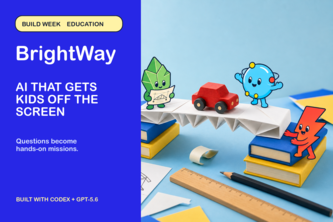
BrightWay is a self-reported AI-powered tool designed for children and parents, using GPT-5.6 to generate age-appropriate educational missions that encourage off-screen exploration and learning.
What changed
The project was submitted to the OpenAI 2026 hackathon, indicating an early-stage development or prototype effort with no evidence of prior traction or commercial deployment.
Single most important open question
Is there any evidence of actual user testing, customer feedback, or real-world usage beyond the hackathon submission?
What The Product Actually Is
The description states that BrightWay uses GPT-5.6 to turn one child’s question into a parent-supervised, age-matched mission they can build, test, and explain off-screen.
Inference Based on the technology stack (anthropic, codex, gpt-5.6, grok, openai-imagegen, openai-realtime-api, openai-responses-api), it appears to be a generative AI application that leverages large language models and multimodal tools to create interactive educational content.
Not evidenced No details about the actual functionality or interface of the product beyond its intended use case.
Positioning & Claim Evolution
The tagline claims BrightWay uses GPT-5.6 to turn a child’s question into a parent-supervised, age-matched mission they can build, test, and explain off-screen.
Claim
The tool aims to promote educational engagement through AI-generated missions that encourage hands-on learning outside digital screens.
Not evidenced No indication of how the product differentiates from existing educational platforms or whether it has evolved from an earlier concept. The description does not show any prior positioning or claims made by the team.
Target Customer & ICP
The description states that BrightWay is intended for children and parents, with a focus on parent-supervised missions.
Inference The target customer segment appears to be families with young children who are interested in combining digital tools with offline activities.
Not evidenced No evidence of specific demographics, user personas, or segmentation strategies. There is no mention of how the product will reach its users or whether it targets a particular age group or educational setting.
Business Model & Pricing Evidence
The description does not provide any information on pricing, monetization strategy, or business model.
Not evidenced No indication of how the company intends to make money, if at all. There is no mention of subscriptions, one-time purchases, freemium models, or other revenue mechanisms.
Technical & Delivery Signals
The project was built using several AI and web technologies including:
- anthropic
- codex
- gpt-5.6
- grok
- next.js
- openai-imagegen
- openai-realtime-api
- openai-responses-api
- react
- sqlite
- tailwind-css
- typescript
- xai
Inference The team appears to be leveraging modern AI and frontend frameworks, suggesting a technical foundation for an interactive web application.
Not evidenced No evidence of delivery timeline, product roadmap, or whether the tool is live or in beta. There is no mention of scalability, performance metrics, or deployment architecture.
Traction & Maturity Signals
The project was submitted to the OpenAI 2026 hackathon on Devpost.
Fact
This indicates a prototype or early-stage development effort, not a mature product with users or revenue.
Not evidenced No evidence of customer acquisition, user engagement, retention, or any form of traction beyond the hackathon submission. No mention of funding, partnerships, or growth metrics.
Competitive Context
The description does not provide any information about competitors or market positioning.
Not evidenced No indication of who else is doing similar work in the educational AI space, nor how BrightWay might compare to existing tools or platforms.
Open Questions & Risks
- No evidence of traction or user feedback: The project appears to be a hackathon submission with no prior adoption or validation.
- Unverified claims about GPT-5.6: The description references GPT-5.6, which is not a publicly known model version; this may be speculative or inaccurate.
- Lack of business model clarity: No indication of how the company plans to monetize or sustain itself.
- Single founder team: With only one member listed (Philip Standley), there are potential risks related to execution capacity and scalability.
Questions the description leaves open
- What is the actual user experience of BrightWay? How does it work in practice?
- Has there been any real-world testing with children or parents?
- What is the intended business model, and how do you plan to scale?
- Is GPT-5.6 a real model, or is this a placeholder name for an internal or proprietary system?
- How does BrightWay ensure safety and age-appropriate content generation?
- What are the key assumptions behind your product vision?
Overall Assessment
Not evidenced There is insufficient evidence to assess whether BrightWay has investment potential or strategic value for partnership.
Confidence level Low — the project description offers no data on traction, revenue, customers, or even a clear definition of what the product does beyond its hackathon submission. The lack of any commercial or user validation makes it difficult to evaluate further.
Inference If this is an early-stage idea with no evidence of execution or market testing, it may be too early for due diligence or investment consideration.
User Stories BotA demo video on every pull request
Get a demo video on every new feature
GitHub App that watches your pull requests and records a narrated, captioned demo.
Save time on demo prep and make informed decisions faster with a video walkthrough of every new feature.
Source
Submitted to the OpenAI 2026 hackathon on Devpost. Project home on Devpost. Back to the full gallery on Devpost.
This competitive analysis was produced by top-founders.com (opens in a new tab)
Generated by a language model from this project's public Devpost page — its tagline and any built-with tags listed there, since the author published no write-up — as captured in August 2026. Short quotations are the author's words. It is an opinion on the idea as a business, not on the people behind it, and it reflects the description as published then. If the project has moved on, request a correction below. The analysis is not independent research and contains no verified traction, revenue or customer data.
An independent guide by KFG International LLC — not affiliated with, endorsed by, or connected to Devpost or OpenAI.