

Archive position — measured, not model output
0 likes on Devpost
2,263 of the 7,850 archived projects have more likes, and 5,587 share exactly 0 — so this project's #4,659 place in the like-ranked listing is a tie-break inside that group, not a ranking.
Projects (log scale)
Likes on Devpost. ▲ marks this project's group.
Show the figures
| Likes | Projects | Share of archive |
|---|---|---|
| 0 | 5,587 | 71.2% |
| 1 | 1,758 | 22.4% |
| 2 | 284 | 3.6% |
| 3–4 | 132 | 1.7% |
| 5–9 | 75 | 1.0% |
| 10+ | 14 | 0.2% |
 User Stories BotA demo video on every pull request
Get a demo video on every new feature
GitHub App that watches your pull requests and records a narrated, captioned demo.
Save time on demo prep and make informed decisions faster with a video walkthrough of every new feature.
Executive Summary
Company: Intelligent Intern
Self-reported basis: The entire analysis is based on a single author-supplied description, submitted as part of a Devpost entry for the OpenAI 2026 hackathon. No external verification or historical data are available.
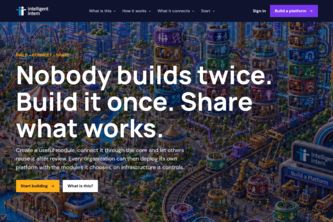
What it appears to be: A modular ERP system builder that uses AI (specifically Codex-like tools) to generate and deploy ERP modules such as CRM, HR lifecycle, invoice automation, and videocall systems.
What changed: The author states they have been working on this project for ~22 years, with intensive effort over the last 6 years (~500 hours/month), and now believe GPT-5.6 is capable of completing it.
Most important open question: Is there any evidence that this system has been deployed or used by anyone beyond the author?
What The Product Actually Is
The description states:
- Intelligent Intern is a system to create and deploy modular ERP systems.
- Modules can be added or removed, like in other frameworks or CMSs.
- It uses Codex-like tools (e.g., AI code generation) for architecture design and implementation.
- The author built it using VS Code, Codex extension, and various technologies including Docker, Python, Rust, Shellscripting, and Vue.
Inference: The system appears to be an AI-assisted framework or toolset for building ERP modules, but the description does not clarify whether this is a product for end-users or a developer tool.
Positioning & Claim Evolution
The author states:
- They started building a free website builder ~22 years ago and this project is the "essence of their professional work life."
- The system is described as a modular ERP framework, but not explicitly positioned as a SaaS product or platform.
- There is no mention of target customers, pricing, or commercial intent beyond personal development.
Inference: The author's positioning appears to be that of a long-term developer with a personal obsession, not a commercial product. No clear market positioning or customer value proposition is evident.
Target Customer & ICP
The description states:
- The system allows creation and deployment of ERP modules like CRM, HR lifecycle, invoice automation, etc.
- It is described as a modular system that can be extended with new modules.
Not evidenced: No explicit target customer or ideal customer profile (ICP) is defined. No mention of whether the tool is for developers, enterprises, or end-users.
Business Model & Pricing Evidence
The description states:
- The author built it using AI tools and has been working on it intensively for years.
- It is not described as a commercial product or service.
Not evidenced: No pricing model, monetization strategy, or business model is mentioned. The system appears to be personal development rather than a commercial offering.
Technical & Delivery Signals
The description states:
- Built with Docker, Python, Rust, Shellscripting, Vue.
- Uses VS Code and Codex extension for AI-assisted development.
- The author describes a "ping pong chat" and refactoring process with the AI tool.
- There is some "dirty code" and "dead code" in the project, but it is documented.
Inference: The system uses modern development tools and AI-assisted coding, but lacks evidence of production-ready or scalable delivery.
Traction & Maturity Signals
The description states:
- The author has worked on this for ~22 years with ~500 hours/month over the last 6 years.
- It is described as a "personal obsession" and not yet fully complete.
- No mention of users, customers, or deployment in production.
Not evidenced: No evidence of traction, adoption, or maturity beyond personal development.
Competitive Context
The description states:
- The system is described as a modular ERP framework, similar to other CMS or frameworks.
- It uses AI tools like Codex for development.
Not evidenced: No mention of competitors, market positioning, or competitive advantages. The author does not reference existing ERP or AI development platforms.
Open Questions & Risks
The description states:
- The system is described as incomplete and still in development.
- There is "dirty code" and "dead code" that needs refactoring.
- The author has been working on it for years without commercial traction.
Inference:
- Risk of over-engineering or lack of market fit.
- No evidence of product-market fit or commercial viability.
- The system may not be ready for deployment or use by others.
Questions the description leaves open
- Is this system intended to be used by developers, enterprises, or end-users?
- What is the current state of the codebase and how much of it is production-ready?
- Has the system been tested or deployed in any real-world environment?
- Are there any plans for monetization or commercial use beyond personal development?
- How does the AI-assisted development process work, and what are its limitations?
Overall Assessment
Not evidenced: No evidence of revenue, customers, or traction is provided. The system appears to be a long-term personal project without clear commercial intent or market validation.
Confidence level: Low — based entirely on self-reported information with no external corroboration or data on product usage, adoption, or commercial viability.
Assessment: Not ready for investment or partnership consideration at this time. The author's claims are aspirational and lack evidence of product-market fit or traction.
User Stories BotA demo video on every pull request
Get a demo video on every new feature
GitHub App that watches your pull requests and records a narrated, captioned demo.
Save time on demo prep and make informed decisions faster with a video walkthrough of every new feature.
Source
Submitted to the OpenAI 2026 hackathon on Devpost. Project home on Devpost. Back to the full gallery on Devpost.
This competitive analysis was produced by top-founders.com (opens in a new tab)
Generated by a language model from this project's public Devpost page — its tagline, the author's own write-up and any built-with tags listed there — as captured in August 2026. Short quotations are the author's words. It is an opinion on the idea as a business, not on the people behind it, and it reflects the description as published then. If the project has moved on, request a correction below. The analysis is not independent research and contains no verified traction, revenue or customer data.
An independent guide by KFG International LLC — not affiliated with, endorsed by, or connected to Devpost or OpenAI.