

Archive position — measured, not model output
1 like on Devpost
505 of the 7,850 archived projects have more likes, and 1,758 share exactly 1 — so this project's #723 place in the like-ranked listing is a tie-break inside that group, not a ranking.
Projects (log scale)
Likes on Devpost. ▲ marks this project's group.
Show the figures
| Likes | Projects | Share of archive |
|---|---|---|
| 0 | 5,587 | 71.2% |
| 1 | 1,758 | 22.4% |
| 2 | 284 | 3.6% |
| 3–4 | 132 | 1.7% |
| 5–9 | 75 | 1.0% |
| 10+ | 14 | 0.2% |
 User Stories BotA demo video on every pull request
Get a demo video on every new feature
GitHub App that watches your pull requests and records a narrated, captioned demo.
Save time on demo prep and make informed decisions faster with a video walkthrough of every new feature.
Executive Summary
What the company appears to be
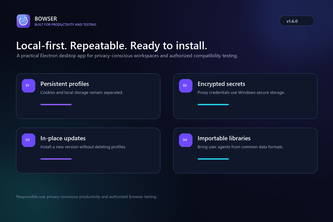
Bowser Profile Browser is a self-reported desktop application built for Windows, aimed at creating isolated browser workspaces. The author states it supports managing multiple browser profiles with consistent user-agent settings, cookies, local storage, and proxy configurations. It uses Electron and integrates AI tools like OpenAI Codex and GPT-5.6 during development.
What changed
The project is described as a personal hackathon submission (Devpost entry) with no evidence of prior commercial activity or traction. The author reports building it from scratch using a single-person team, including AI-assisted development.
Single most important open question
Is there any evidence of actual usage, revenue, customer feedback, or product-market fit beyond the self-reported developer narrative?
What The Product Actually Is
The description states that Bowser Profile Browser is:
- A desktop app for Windows
- Designed to create and manage isolated browser workspaces
- Focused on privacy, reproducibility, productivity, and legitimate browser testing
- Built using Electron, Node.js, JavaScript, HTML, CSS
- Uses OpenAI Codex and GPT-5.6 during development
It allows users to:
- Create and manage isolated browser profiles
- Choose from 100 environment presets
- Import user-agent lists from TXT, CSV, JSON, or JSONL files
- Preserve separate cookies and local storage per profile
- Configure proxy settings specific to each profile
- Navigate using built-in controls (Back, Forward, Reload, etc.)
- Update the app without uninstalling previous versions
Confidence Low — all details are self-reported.
Positioning & Claim Evolution
The author positions Bowser Profile Browser as:
- A privacy-focused tool for managing browser environments
- Intended for productivity and authorized testing
- Not designed for fraud or bypassing protections
Claims include:
- Focus on consistency, isolation, and reproducibility
- Support for 100 presets
- Use of secure OS storage for proxy credentials
- AI-assisted development
Inference The positioning suggests a niche B2B developer tool or internal testing utility. However, the lack of customer data or market validation makes it unclear whether this is a product in demand or just an idea.
Target Customer & ICP
The description states:
- Intended for privacy-conscious productivity and authorized testing
- Not designed for fraud or abuse
- Likely used by developers performing responsive and compatibility testing
Inference The target audience appears to be technical users, possibly developers or QA engineers who need isolated browser environments. No explicit customer segments or personas are mentioned.
Confidence Low — no evidence of actual customers or user research.
Business Model & Pricing Evidence
The description does not state:
- Whether the product is free or paid
- How it generates revenue
- Any pricing model or monetization strategy
Confidence Not evidenced.
Technical & Delivery Signals
The author reports:
- Built with Electron, Node.js, JavaScript, HTML, CSS
- Uses WebContentsView for browser workspace
- Integrates OpenAI Codex and GPT-5.6 in development
- Preset system connects OS properties, browser versions, screen settings, user-agent values
- Profile identity remains stable across restarts or updates
- Sensitive proxy credentials stored securely via OS capabilities
- In-place Windows installer for updates
Inference The technical stack and architecture suggest a functional prototype with some advanced features. However, no evidence of production deployment, scalability, or performance data.
Traction & Maturity Signals
The description states:
- Submitted to the OpenAI 2026 hackathon
- Built by one person (Dimas Dm)
- No mention of users, downloads, or adoption metrics
- No revenue or funding rounds mentioned
Confidence Not evidenced.
Competitive Context
No information is provided about:
- Competitors in the browser profile management space
- Market size or competitive landscape
- Prior art or existing solutions
Confidence Not evidenced.
Open Questions & Risks
Key risks and open questions based on the description:
- Single-person team implies limited capacity for scaling or support
- No evidence of traction, revenue, or customer feedback
- Product is described as a hackathon submission — not a commercial product
- AI-assisted development may raise questions about code quality, maintainability, or intellectual property
- Not clear if the app has been tested beyond the developer’s own use case
Inference The project lacks commercial viability signals and appears to be an experimental tool with no proven market demand.
Questions the description leaves open
- What is your actual user base, if any?
- Are there any customers or early adopters who have provided feedback?
- How do you plan to monetize this product?
- Is there a roadmap for expanding beyond Windows or adding cross-platform support?
- What are the technical limitations of the current implementation that could affect scalability?
- How do you intend to ensure long-term maintenance and security updates?
Overall Assessment
Assessment Not evidenced.
There is no evidence of revenue, customers, traction, or commercial viability beyond a self-reported hackathon project. The product appears to be an experimental tool built by one developer with no indication of market demand or business model. Any investment or partnership opportunity would require further due diligence into actual usage, user feedback, and monetization plans.
Confidence Very low — this is a speculative assessment based entirely on the author's own account.
User Stories BotA demo video on every pull request
Get a demo video on every new feature
GitHub App that watches your pull requests and records a narrated, captioned demo.
Save time on demo prep and make informed decisions faster with a video walkthrough of every new feature.
Source
Submitted to the OpenAI 2026 hackathon on Devpost. Project home on Devpost. Back to the full gallery on Devpost.
This competitive analysis was produced by top-founders.com (opens in a new tab)
Generated by a language model from this project's public Devpost page — its tagline, the author's own write-up and any built-with tags listed there — as captured in August 2026. Short quotations are the author's words. It is an opinion on the idea as a business, not on the people behind it, and it reflects the description as published then. If the project has moved on, request a correction below. The analysis is not independent research and contains no verified traction, revenue or customer data.
An independent guide by KFG International LLC — not affiliated with, endorsed by, or connected to Devpost or OpenAI.