

Archive position — measured, not model output
0 likes on Devpost
2,263 of the 7,850 archived projects have more likes, and 5,587 share exactly 0 — so this project's #4,649 place in the like-ranked listing is a tie-break inside that group, not a ranking.
Projects (log scale)
Likes on Devpost. ▲ marks this project's group.
Show the figures
| Likes | Projects | Share of archive |
|---|---|---|
| 0 | 5,587 | 71.2% |
| 1 | 1,758 | 22.4% |
| 2 | 284 | 3.6% |
| 3–4 | 132 | 1.7% |
| 5–9 | 75 | 1.0% |
| 10+ | 14 | 0.2% |
 User Stories BotA demo video on every pull request
Get a demo video on every new feature
GitHub App that watches your pull requests and records a narrated, captioned demo.
Save time on demo prep and make informed decisions faster with a video walkthrough of every new feature.
Executive Summary
InsightCast is a self-reported AI-powered tool that converts dense documents into structured podcast conversations using a multi-agent system. The author describes building a workflow with specialized agents for extraction, research, planning, writing, and review before generating audio. It includes features like chapter navigation, transcript highlighting, and distinct speaker voices.
The project appears to be a hackathon submission with no evidence of revenue, customers, or traction beyond the author's own account. The system is described as relying on structured prompts, fact references, and validation steps to maintain grounding — but this is unverified.
Key open question
Is there any evidence that InsightCast has moved beyond prototype or demo stage? If not, what are the technical and commercial risks of scaling such a multi-agent system for real-world document processing?
What The Product Actually Is
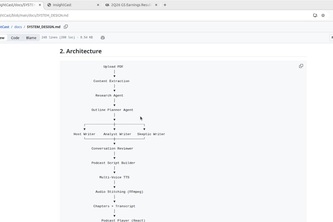
The description states that InsightCast is a tool that turns dense documents into grounded podcast conversations. It uses a multi-agent pipeline:
- Document → Extraction → Research → Planning → Writing → Review → Multi-Voice Podcast
It includes:
- A podcast player with chapter navigation
- Transcript highlighting
- Replayable briefings
- Distinct voices for each speaker
The system is built using technologies including:
- AI agents
- LLMs (including GPT-5.6)
- PDF processing tools (pdfplumber)
- FastAPI, React, Vite
- Text-to-speech and voice engineering components
Inference The product appears to be a proof-of-concept or prototype built for a hackathon, not a commercial offering.
Positioning & Claim Evolution
The author states that InsightCast was inspired by the idea that listening can be easier than reading, especially for long technical documents. They note that AI summaries are convenient but often lack transparency about their conclusions.
Claim
The tool aims to provide an easy-to-consume format that remains transparent and trustworthy.
There is no evidence of prior positioning or evolution in claims beyond this single self-reported narrative.
Target Customer & ICP
Not evidenced.
The description does not state who the intended users are, what industries they come from, or how they would use InsightCast. No customer personas or market segments are described.
Business Model & Pricing Evidence
Not evidenced.
There is no mention of pricing models, monetization strategies, or any indication of a business model beyond the author's own description of building it as a hackathon project.
Technical & Delivery Signals
The system is described as:
- Using a structured multi-agent pipeline
- Splitting workflow into specialized agents with defined roles
- Passing stable fact IDs between stages to maintain traceability
- Including structured output validation, response repair, and retry logic
- Optimizing prompts to stay within API limits
- Limiting reviewer rewrites to avoid infinite loops
- Using deterministic demo fixtures for testing
Inference The author has implemented some technical safeguards around grounding and reliability, but these are described as part of a hackathon prototype.
Traction & Maturity Signals
Not evidenced.
There is no evidence of revenue, customers, user engagement, or product adoption. The team size is listed as zero, and the project appears to be a solo effort submitted for a hackathon.
Competitive Context
Not evidenced.
No mention of competitors or market landscape. The author does not reference existing tools that might perform similar functions.
Open Questions & Risks
- Prototype-only: The system is described as a hackathon submission with no evidence of commercial viability or production use.
- Limited team size: No team members are listed, suggesting either solo development or lack of team formation.
- Hardware constraints: Challenges were noted around limited hardware and API constraints — this may indicate scalability issues.
- Unverified claims: All descriptions are self-reported and unverified; no third-party validation exists.
Questions the description leaves open
- What is the actual use case or problem you're solving for users?
- Have you tested InsightCast with real documents from target industries?
- How does the system handle edge cases like ambiguous or incomplete documents?
- Are there any plans to scale beyond a single-user demo environment?
- What are your thoughts on integrating with existing document platforms (e.g., Notion, Confluence)?
- Is there any plan for monetization or commercial deployment?
Overall Assessment
Not evidenced.
There is no evidence of funding rounds, valuation, or investor interest. The project is described as a hackathon submission with no indication of commercial traction or strategic partnerships. Any potential investment or partnership value would depend on whether the author can demonstrate progress beyond prototype status and a clear path to market adoption.
User Stories BotA demo video on every pull request
Get a demo video on every new feature
GitHub App that watches your pull requests and records a narrated, captioned demo.
Save time on demo prep and make informed decisions faster with a video walkthrough of every new feature.
Source
Submitted to the OpenAI 2026 hackathon on Devpost. Project home on Devpost. Back to the full gallery on Devpost.
This competitive analysis was produced by top-founders.com (opens in a new tab)
Generated by a language model from this project's public Devpost page — its tagline, the author's own write-up and any built-with tags listed there — as captured in August 2026. Short quotations are the author's words. It is an opinion on the idea as a business, not on the people behind it, and it reflects the description as published then. If the project has moved on, request a correction below. The analysis is not independent research and contains no verified traction, revenue or customer data.
An independent guide by KFG International LLC — not affiliated with, endorsed by, or connected to Devpost or OpenAI.