

Archive position — measured, not model output
0 likes on Devpost
2,263 of the 7,850 archived projects have more likes, and 5,587 share exactly 0 — so this project's #2,686 place in the like-ranked listing is a tie-break inside that group, not a ranking.
Projects (log scale)
Likes on Devpost. ▲ marks this project's group.
Show the figures
| Likes | Projects | Share of archive |
|---|---|---|
| 0 | 5,587 | 71.2% |
| 1 | 1,758 | 22.4% |
| 2 | 284 | 3.6% |
| 3–4 | 132 | 1.7% |
| 5–9 | 75 | 1.0% |
| 10+ | 14 | 0.2% |
 User Stories BotA demo video on every pull request
Get a demo video on every new feature
GitHub App that watches your pull requests and records a narrated, captioned demo.
Save time on demo prep and make informed decisions faster with a video walkthrough of every new feature.
Executive Summary
What the company appears to be
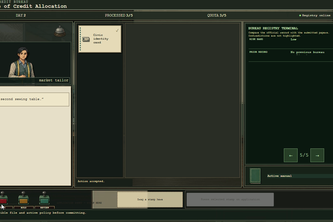
Approve: The Loan Officer is a self-reported narrative simulation game built as a hackathon submission. It presents a pixel-art, deterministic simulation where players assume the role of a loan officer evaluating applications under pressure. The project is described as a bounded, playable experience with data-driven content and test-verified logic.
What changed
The author states this was developed during Build Week for an OpenAI 2026 hackathon. It includes a production-ready web build, test suite, and multiple applicant profiles. No evidence of prior development or commercial traction is provided.
Single most important open question
Is the described product a playable simulation game or a prototype with limited commercial potential? The author does not describe any monetization strategy, customer base, or revenue model beyond its hackathon submission.
What The Product Actually Is
The description states that Approve: The Loan Officer is a narrative management game built as a pixel-art simulation. It is described as a bounded work-desk interface where players review applicant files and make approval decisions under quota and pressure.
It includes:
- A playable landscape work-desk interface
- Multiple applicant/customer profiles
- Data-driven documents and case content
- Approve/reject decisions with reactions
- A deterministic game-state logic layer separate from presentation
- A verified production web build
- A test suite covering core simulation behavior
The author describes it as a "compact but playable loan officer experience", where the player "sits at a bank desk, reviews applicant documents, weighs risk against policy, and decides whether to approve or reject each case."
It was built with:
- TypeScript, React, Vite
- Codex and GPT-5.6 for development assistance
- Deterministic simulation design
- Pixel-art UI elements
Not evidenced: No information on actual gameplay mechanics beyond the described interface or how decisions affect outcomes beyond immediate feedback.
Positioning & Claim Evolution
The author states that Approve: The Loan Officer was inspired by "tense desk-job simulation games" where small administrative decisions become moral and personal pressure. The goal was to build a "compact but playable loan officer experience", not a simple form-checking toy.
It is positioned as:
- A narrative management game
- A simulation of a loan officer role
- A playable experience with moral and financial tension
The author claims the project communicates the core fantasy that “you are the loan officer,” and every case asks the player to make a judgment rather than just click through screens.
Inferred: The positioning suggests an educational or experiential product, but no evidence of market fit, user feedback, or commercial intent is provided.
Target Customer & ICP
The description does not state a specific target customer or ideal customer profile (ICP). It is described as a simulation game, and the author mentions that each applicant feels like a person with a situation and financial tension. However, no evidence of:
- Specific user personas
- Demographics
- Use cases beyond gameplay
- Target audience beyond hackathon judges
Not evidenced: No information on who would use this product or why.
Business Model & Pricing Evidence
The description does not include any information about a business model or pricing strategy. It is described as a hackathon submission, and no evidence of:
- Revenue streams
- Monetization plans
- Subscription or licensing models
- Pricing tiers
- Customer acquisition costs
Not evidenced: No commercial or financial structure is described.
Technical & Delivery Signals
The project was built with:
- TypeScript, React, Vite
- Codex and GPT-5.6 for development assistance
- A deterministic simulation layer separate from rendering
- Data-driven content including applicant profiles, documents, policies, and consequences
It includes:
- A verified production web build
- A test suite with 180/180 tests passing
- Linting and build verification
- A clean Git commit history
- A public repository
- A live web deployment
Challenges mentioned include:
- Time constraints
- Layout stability issues
- Deployment compatibility (Array.prototype.at issue)
Inferred: The technical stack suggests a modern, testable frontend with AI-assisted development. However, no evidence of scalability, performance metrics, or production infrastructure beyond the hackathon build.
Traction & Maturity Signals
The description states that this was built during Build Week for an OpenAI 2026 hackathon. It includes:
- A playable, test-verified version
- A production-ready web build
- A public repository
- A live deployment
No evidence of:
- User adoption or engagement
- Customer feedback
- Revenue or monetization
- Product iteration beyond the hackathon submission
Not evidenced: No traction or maturity beyond a single hackathon project.
Competitive Context
The description does not provide any information about competitors or market context. It is described as a simulation game, but no evidence of:
- Similar products in the market
- Market size or opportunity
- Competitive positioning
- Industry trends
Not evidenced: No competitive analysis or market data provided.
Open Questions & Risks
- No commercial traction or revenue model — it is described as a hackathon submission with no evidence of monetization.
- No target customer or ICP — unclear who would use this product beyond its creators.
- No evidence of scalability or infrastructure — only a single build and test suite are described.
- Unverified claims — all descriptions are self-reported, unverified, and lack independent corroboration.
- Limited scope — the project was constrained by time and may not reflect long-term viability.
Inferred: The product is likely a prototype with no clear path to commercialization or user adoption.
Questions the description leaves open
- What is your intended use case for this simulation beyond the hackathon?
- Do you have any plans to monetize or scale this product?
- How do you plan to validate the narrative and decision-making elements with real users?
- Are there any plans to expand beyond the current applicant profiles or gameplay mechanics?
- What are your long-term goals for this project, if any?
Overall Assessment
The description states that Approve: The Loan Officer is a hackathon submission and not a commercial product. There is no evidence of:
- Revenue
- Customers
- Traction
- Product-market fit
- Commercial strategy
Inferred: This is a prototype or proof-of-concept, not a product ready for investment or partnership.
Not evidenced: No basis to evaluate commercial viability, scalability, or return potential.
User Stories BotA demo video on every pull request
Get a demo video on every new feature
GitHub App that watches your pull requests and records a narrated, captioned demo.
Save time on demo prep and make informed decisions faster with a video walkthrough of every new feature.
Source
Submitted to the OpenAI 2026 hackathon on Devpost. Project home on Devpost. Back to the full gallery on Devpost.
This competitive analysis was produced by top-founders.com (opens in a new tab)
Generated by a language model from this project's public Devpost page — its tagline, the author's own write-up and any built-with tags listed there — as captured in August 2026. Short quotations are the author's words. It is an opinion on the idea as a business, not on the people behind it, and it reflects the description as published then. If the project has moved on, request a correction below. The analysis is not independent research and contains no verified traction, revenue or customer data.
An independent guide by KFG International LLC — not affiliated with, endorsed by, or connected to Devpost or OpenAI.