

Archive position — measured, not model output
0 likes on Devpost
2,263 of the 7,850 archived projects have more likes, and 5,587 share exactly 0 — so this project's #2,687 place in the like-ranked listing is a tie-break inside that group, not a ranking.
Projects (log scale)
Likes on Devpost. ▲ marks this project's group.
Show the figures
| Likes | Projects | Share of archive |
|---|---|---|
| 0 | 5,587 | 71.2% |
| 1 | 1,758 | 22.4% |
| 2 | 284 | 3.6% |
| 3–4 | 132 | 1.7% |
| 5–9 | 75 | 1.0% |
| 10+ | 14 | 0.2% |
 User Stories BotA demo video on every pull request
Get a demo video on every new feature
GitHub App that watches your pull requests and records a narrated, captioned demo.
Save time on demo prep and make informed decisions faster with a video walkthrough of every new feature.
Executive Summary
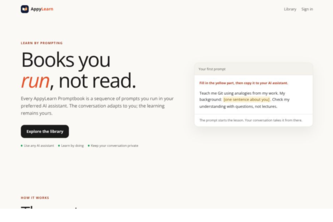
What the company appears to be: AppyLearn is a self-reported AI-powered learning platform that offers “Promptbooks” — structured, AI-guided learning journeys for practical skills. The product is built around the idea of “books you run, not read,” where learners interact with prompts in their preferred AI assistant (e.g., ChatGPT, Claude) rather than passively consuming content.
What changed: The author states that AppyLearn was developed iteratively through collaboration with an AI assistant (Codex, powered by GPT-5.6), and that the product evolved from early decisions about structure, user flow, and privacy. It is described as a learner-focused tool, not a marketplace for unreviewed content.
Single most important open question: Is there evidence of real user engagement or feedback beyond the author’s own account? The description lacks any data on actual learners, completion rates, or product usage — all key indicators of traction or commercial viability.
Note: This analysis is based solely on the self-reported and unverified project description provided by the caller. No external verification or historical data are available.
What The Product Actually Is
The description states that AppyLearn offers “Promptbooks” — sequences of prompts designed to guide learners through practical skills using AI assistants like ChatGPT, Claude, or Gemini. These Promptbooks are structured to encourage active learning via Socratic questioning, deliberate practice, and reflection.
Each Promptbook:
- Calibrates to the learner’s background.
- Guides them through prompts to copy into an AI assistant.
- Encourages progress tracking (chapters, capstone scores, likes, recall).
- Ends with a concrete skill or outcome.
The platform includes features such as:
- Learner dashboard
- Searchable library
- Book detail pages
- Guided Promptbook runner
- Chapter transitions and spaced-recall flows
It is built using Next.js, Supabase, Vercel, PostHog, Tailwind, React, TypeScript, PostgreSQL, and OpenAI tools.
Inference: The product appears to be a minimal viable product (MVP) or prototype, not yet a full commercial offering. It is described as being in an early stage of development, with plans for feedback gathering and catalog expansion.
Positioning & Claim Evolution
The author positions AppyLearn as a tool that shifts learning from passive reading to active “running” of conversations with AI. The tagline — Short AI-guided Promptbooks for learning practical skills by doing and not just reading — reflects this core idea.
Key claims:
- Learning should be an active conversation shaped around the learner.
- Books should not be a passive journey through pages, but a guided experience.
- Promptbooks are designed to calibrate to background, encourage Socratic questioning, and promote reflection.
- The platform avoids storing or reading private AI conversations — it tracks only learning progress.
The positioning has evolved from an idea about how books should change in an AI-first world into a concrete product with UI components, data tracking, and learner flows.
Inference: The positioning is consistent with current trends in AI-assisted education but lacks evidence of market validation or adoption. The author’s own narrative suggests the platform is still in early experimentation rather than mature commercial use.
Target Customer & ICP
The description states that AppyLearn is for:
- Self-directed learners
- Working people who need to get useful at a practical skill quickly
- People who already have access to AI assistants (e.g., ChatGPT) but lack a reliable path from a blank chat to a real outcome
It is not described as targeting educators, institutions, or content creators — it is framed as a learner-only product.
Inference: The ICP appears to be individuals seeking quick, practical skill-building through AI. However, there is no evidence of actual user segmentation, personas, or feedback from target users beyond the author’s own account.
Business Model & Pricing Evidence
The description does not provide any information on:
- Revenue streams
- Pricing models
- Monetization strategy
- Subscription plans or one-time purchases
It only mentions that the product is learner-focused and avoids becoming a marketplace for unreviewed AI content.
Not evidenced: No business model or pricing data are provided. The author does not describe how they plan to monetize the platform or whether it is currently generating revenue.
Technical & Delivery Signals
The platform is built with:
- Next.js (frontend and server rendering)
- Supabase (authentication, learner profiles, progress tracking)
- Vercel (deployment, analytics)
- PostHog and Google Analytics (user funnel measurement)
- Tailwind CSS, React, TypeScript, PostgreSQL
- OpenAI tools (GPT, Codex)
Features include:
- Google and magic-link sign-in
- Learner dashboard
- Searchable library
- Promptbook runner with chapter transitions
- Capstone feedback and spaced recall flows
The author notes that the product was built iteratively using Codex, which helped in UI design, data modeling, and implementation.
Inference: The technical stack suggests a modern SaaS approach, but there is no evidence of scalability, performance metrics, or production deployment beyond the MVP stage.
Traction & Maturity Signals
The description does not include:
- Customer numbers
- Revenue figures
- User engagement data
- Completion rates
- Retention metrics
- Product usage statistics
It states that the author is currently gathering feedback and refining the experience before expanding the catalog.
Not evidenced: No traction or maturity indicators are provided. The project appears to be in an early development phase, with no evidence of real-world adoption or user behavior data.
Competitive Context
The description does not mention:
- Competitors
- Market positioning relative to other AI learning platforms
- Differentiation from existing tools like Coursera, Udemy, or Notion AI
It only implies that AppyLearn is distinct in its focus on “books you run, not read” and its emphasis on learner privacy.
Not evidenced: No competitive analysis or market positioning data are available. The author does not reference any direct competitors or established players in the AI education space.
Open Questions & Risks
- No traction or user feedback: The product is described as being in an early stage, with no real-world usage or engagement metrics.
- Unproven business model: There is no indication of how the platform will monetize or scale.
- Single founder: The team size is listed as 1, which raises questions about execution capacity and scalability.
- Self-reported only: All claims are based on the author’s own account — there is no independent verification.
- Unclear differentiation: Without a clear comparison to existing tools, it's hard to assess its market relevance.
Inference: The lack of evidence for traction or monetization makes this a high-risk investment or partnership opportunity. The platform appears to be an idea in motion, not yet validated in the market.
Questions the description leaves open
- What specific feedback have you gathered from early learners?
- How do you plan to scale beyond a single founder and MVP?
- Are there any plans for monetization or revenue generation?
- What are your key performance indicators (KPIs) for learning outcomes?
- How do you intend to differentiate from existing AI learning tools?
- What is the timeline for expanding the catalog of Promptbooks?
- Have you considered privacy and data governance in a commercial context?
Overall Assessment
Assessment: The project is described as an early-stage prototype or MVP, built by a single founder with no evidence of traction, revenue, or customer engagement. It is positioned as a learner-focused AI education tool that emphasizes active learning through prompt-based interaction.
Confidence level: Low — based entirely on self-reported information and no external validation.
Recommendation: This project is not ready for investment or partnership at this time. The lack of user data, revenue, or product-market fit makes it difficult to assess commercial viability. Further development and evidence of traction are required before considering deeper due diligence.
User Stories BotA demo video on every pull request
Get a demo video on every new feature
GitHub App that watches your pull requests and records a narrated, captioned demo.
Save time on demo prep and make informed decisions faster with a video walkthrough of every new feature.
Source
Submitted to the OpenAI 2026 hackathon on Devpost. Project home on Devpost. Back to the full gallery on Devpost.
This competitive analysis was produced by top-founders.com (opens in a new tab)
Generated by a language model from this project's public Devpost page — its tagline, the author's own write-up and any built-with tags listed there — as captured in August 2026. Short quotations are the author's words. It is an opinion on the idea as a business, not on the people behind it, and it reflects the description as published then. If the project has moved on, request a correction below. The analysis is not independent research and contains no verified traction, revenue or customer data.
An independent guide by KFG International LLC — not affiliated with, endorsed by, or connected to Devpost or OpenAI.