

Archive position — measured, not model output
3 likes on Devpost
128 of the 7,850 archived projects have more likes, and 93 share exactly 3 — so this project's #144 place in the like-ranked listing is a tie-break inside that group, not a ranking.
Projects (log scale)
Likes on Devpost. ▲ marks this project's group.
Show the figures
| Likes | Projects | Share of archive |
|---|---|---|
| 0 | 5,587 | 71.2% |
| 1 | 1,758 | 22.4% |
| 2 | 284 | 3.6% |
| 3–4 | 132 | 1.7% |
| 5–9 | 75 | 1.0% |
| 10+ | 14 | 0.2% |
 User Stories BotA demo video on every pull request
Get a demo video on every new feature
GitHub App that watches your pull requests and records a narrated, captioned demo.
Save time on demo prep and make informed decisions faster with a video walkthrough of every new feature.
Executive Summary
What the company appears to be
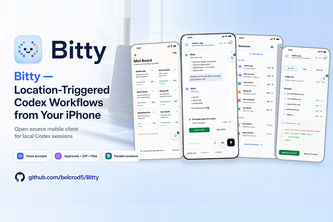
Bitty is a self-reported local-first mobile app that connects to a Codex workflow running on a Mac. It allows developers to monitor, interact with, and trigger Codex sessions from an iPhone or iPad using location-based triggers and time windows.
What changed
The author reports adding location- and time-window-triggered Codex runs during a Build Week hackathon, along with improvements in WebSocket reconnection, approval handling, voice interaction, and context reporting.
Single most important open question
Is there any evidence of actual usage or adoption beyond the developer's own use case?
What The Product Actually Is
The description states that Bitty is:
- A local-first mobile app for iOS (iPhone/iPad)
- Designed to connect to a private Node.js runner on macOS
- Built with Expo, React Native, and TypeScript
- Uses Codex CLI integration, exposing session state, streaming responses, approvals, files, Git changes, and job information
- Communicates via authenticated HTTP and WebSocket connections
- Supports QR pairing and secure local storage
- Does not require a separate OpenAI API key — uses existing Codex authentication
The app enables:
- Starting, resuming, and monitoring Codex sessions
- Sending prompts by text or voice
- Listening to assistant responses with TTS
- Reviewing tool approval requests
- Inspecting Git diffs, workspace files, and running jobs
- Tracking token usage, context usage, and runtime status
- Managing multiple coding sessions through the Mini Board
- Receiving notifications when work completes or requires approval
- Triggering Codex runs based on location and time window
Inferred: The app is a companion tool for developers using local Codex workflows.
Positioning & Claim Evolution
The author states:
- Bitty is intended as a local-first iPhone companion for Codex sessions
- It aims to make it easier to supervise local coding agents while moving around
- It does not aim to replace the desktop development environment
Inferred: The positioning reflects a niche use case — supporting developers who work locally but want mobile access and control.
The claim evolution shows:
- Initial version supported basic Codex session management
- During Build Week, it added location-triggered workflows, background recovery, and push notifications
- The author emphasizes that this is not about replacing desktop tools, but enhancing them
Not evidenced: No claims about market positioning, competitive differentiation, or strategic direction beyond the developer’s own use case.
Target Customer & ICP
The description states:
- Bitty targets developers using local Codex workflows
- It supports those who want to monitor and interact with Codex sessions from mobile devices
- The tool is designed for users who are already familiar with Codex CLI, Node.js, and macOS development
Inferred: The ICP likely includes:
- Developers working on local AI coding agents
- Users of Codex or similar tools (e.g., ChatGPT plugins, GPT-4)
- Tech professionals who value local-first and secure workflows
Not evidenced: No explicit customer personas, segmentation data, or user feedback.
Business Model & Pricing Evidence
The description states:
- Bitty uses the developer’s existing Codex authentication
- It does not require a separate OpenAI API key
- The app is built as a personal tool during a hackathon
- No pricing model, monetization strategy or revenue streams are mentioned
Inferred: There is no evidence of any business model or pricing structure.
Not evidenced: No information on monetization, subscriptions, licensing, or paid features.
Technical & Delivery Signals
The description states:
- Built with Expo, React Native, TypeScript
- Uses Node.js as backend runner
- Communicates via HTTP and WebSocket connections
- Integrates with Codex CLI
- Supports QR pairing, secure local storage, TTS, and approval handling
- Includes push notifications, background recovery, and multi-session support
Inferred:
- The tool is a developer-focused prototype built for personal use
- It uses modern mobile and backend stacks (React Native, Node.js)
- It handles complex technical challenges like reconnection logic, secure state sharing, and approval boundaries
Not evidenced: No evidence of production deployment, scalability, or performance metrics.
Traction & Maturity Signals
The description states:
- The app was built during a Build Week hackathon
- It supports features like location-triggered runs and background recovery
- The author reports improvements made during the hackathon
- No mention of users, adoption, or usage beyond personal use
Inferred: This is a proof-of-concept prototype, not a product with traction.
Not evidenced:
- No user base
- No customer feedback
- No revenue or monetization data
- No production deployment or long-term usage metrics
Competitive Context
The description states:
- Bitty is a companion tool for developers using local Codex workflows
- It integrates with Codex CLI, which is used in AI coding environments
- The author does not reference any competitors directly
Inferred: The competitive context includes:
- Other tools that enable local AI agent workflows
- Tools that support mobile access to development tasks
- Platforms like ChatGPT plugins, local LLMs, or AI coding assistants
Not evidenced: No mention of existing tools, market analysis, or competitive positioning.
Open Questions & Risks
The description states:
- Bitty is a personal project built during a hackathon
- It uses developer-specific tools (Codex CLI, Node.js)
- The author is the only team member (1 person)
- No evidence of production use or scalability
Inferred risks and open questions:
- No commercial traction or user base
- Single-person development limits scalability and product maturity
- Limited market validation — no external feedback or adoption
- Highly niche use case — likely only useful to developers using Codex locally
- Unproven business model — no monetization strategy
Not evidenced:
- No risk analysis, financials, or user retention data
- No evidence of product-market fit or long-term viability
Questions the description leaves open
- What is the actual use case for Bitty beyond your own development workflow?
- Have you tested it with other developers or users outside of yourself?
- Are there any plans to support more than one Codex authentication profile?
- How do you plan to scale this beyond a single developer’s personal tool?
- What are the technical limitations of running Codex workflows locally and remotely?
- Is there any intention to monetize Bitty or offer it as a service?
- How does Bitty handle edge cases like network interruptions, approval timeouts, or file access failures?
Overall Assessment
The description states:
- Bitty is a personal hackathon project built by one developer
- It integrates with Codex CLI and supports local workflows
- No evidence of traction, revenue, or commercial viability
Inferred: This is a pre-product concept, not a product ready for investment or partnership.
Not evidenced:
- No financials, customer data, or market validation
- No indication of product-market fit or scalability
- No roadmap beyond the developer’s own use case
Assessment Not suitable for investment or partnership at this stage. It is a developer prototype, not a commercial product.
User Stories BotA demo video on every pull request
Get a demo video on every new feature
GitHub App that watches your pull requests and records a narrated, captioned demo.
Save time on demo prep and make informed decisions faster with a video walkthrough of every new feature.
Source
Submitted to the OpenAI 2026 hackathon on Devpost. Project home on Devpost. Back to the full gallery on Devpost.
This competitive analysis was produced by top-founders.com (opens in a new tab)
Generated by a language model from this project's public Devpost page — its tagline, the author's own write-up and any built-with tags listed there — as captured in August 2026. Short quotations are the author's words. It is an opinion on the idea as a business, not on the people behind it, and it reflects the description as published then. If the project has moved on, request a correction below. The analysis is not independent research and contains no verified traction, revenue or customer data.
An independent guide by KFG International LLC — not affiliated with, endorsed by, or connected to Devpost or OpenAI.