

Archive position — measured, not model output
0 likes on Devpost
2,263 of the 7,850 archived projects have more likes, and 5,587 share exactly 0 — so this project's #2,942 place in the like-ranked listing is a tie-break inside that group, not a ranking.
Projects (log scale)
Likes on Devpost. ▲ marks this project's group.
Show the figures
| Likes | Projects | Share of archive |
|---|---|---|
| 0 | 5,587 | 71.2% |
| 1 | 1,758 | 22.4% |
| 2 | 284 | 3.6% |
| 3–4 | 132 | 1.7% |
| 5–9 | 75 | 1.0% |
| 10+ | 14 | 0.2% |
 User Stories BotA demo video on every pull request
Get a demo video on every new feature
GitHub App that watches your pull requests and records a narrated, captioned demo.
Save time on demo prep and make informed decisions faster with a video walkthrough of every new feature.
Executive Summary
What the company appears to be
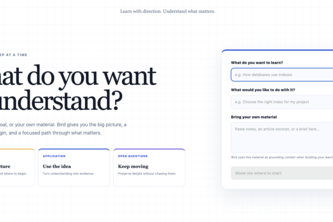
Bird is an AI-powered learning platform that transforms complex topics into structured, step-by-step learning paths. The description states it uses LLMs (specifically GPT-5.6 Terra) to generate a topic map and detailed content for each concept in a sequence. Learners provide a topic, outcome goal, and optional context; Bird then presents concepts through four aspects: what it means, why it matters, how it works, and a concrete example. The platform supports recording open questions and applying knowledge via concept-specific quizzes.
What changed
The author describes building this as a personal solution to their own learning challenges—getting lost in details, feeling overwhelmed by information, and failing to apply what they’ve learned. They built the product using AI tools like Codex (GPT-5.6 Sol) and GPT-5.6 Terra, iterating through design and implementation without a clear initial vision.
Single most important open question
Is there a market need for this type of bounded, structured learning experience, or is it primarily a personal tool that lacks scalability or commercial traction?
What The Product Actually Is
The description states that Bird is an AI-powered platform designed to help users learn complex topics through structured, step-by-step learning paths. It uses LLMs (specifically GPT-5.6 Terra) to identify essential concepts and present them in a sequence with four components per concept:
- What it means
- Why it matters
- How it works
- A concrete example
Users input:
- A topic they want to understand
- The outcome they are working toward
- Optional context or source material
Bird generates a topic map and detailed content for each component, rendered visually as a graph. Learners can record unresolved questions and answer quizzes generated for each concept.
The frontend is built with React, TypeScript, Tailwind, Vite, and Next.js; the backend uses typed API routes, domain validation, and structured model instructions.
Inference The product appears to be a prototype or proof-of-concept rather than a finished product, given its self-reported development process and lack of customer data.
Positioning & Claim Evolution
The author claims Bird addresses common learning problems:
- Getting caught up in details
- Feeling overwhelmed by too much information
- Failing to apply what is learned
It positions itself as an AI-powered, bounded, and structured learning experience that helps users stay focused on their goals while avoiding long, unfocused conversations with ChatGPT.
The evolution of the idea seems to have been iterative—starting from a vague concept and evolving through experimentation with Codex (GPT-5.6 Sol), which acted as both collaborator and thought partner.
Inference The positioning is based on personal experience rather than market research or user feedback, suggesting it may not yet reflect actual demand.
Target Customer & ICP
The description does not name specific customer segments or personas. However, the author’s stated use case implies a learner who:
- Wants to understand complex topics
- Struggles with information overload
- Needs structured guidance to apply knowledge
- Uses AI tools like ChatGPT for learning
There is no evidence of segmentation beyond the general “learner” persona.
Inference The ICP likely includes individuals seeking self-directed learning, possibly students or professionals looking to upskill. No clear indication of enterprise or institutional adoption.
Business Model & Pricing Evidence
No business model or pricing information is provided in the description. There is no mention of monetization strategies, subscription tiers, or revenue streams.
Inference The project appears to be a prototype with no commercialized business model evident.
Technical & Delivery Signals
The author reports building Bird using:
- Frontend: React, TypeScript, Tailwind, Vite, Next.js
- Backend: TypeScript, typed API routes, domain validation, structured model instructions
- AI tools: Codex (GPT-5.6 Sol), GPT-5.6 Terra
The system generates topic maps and content using LLMs, with a focus on optimizing performance by reducing reasoning effort.
Inference The technical stack suggests a modern web application built for rapid iteration and experimentation. However, no evidence of scalability, infrastructure, or production deployment is provided.
Traction & Maturity Signals
The project was submitted to the OpenAI 2026 hackathon on Devpost. It has:
- One team member (Joanna999 Yang)
- No reported customers, users, or revenue
- No mention of growth metrics, usage data, or product adoption
Inference This is a personal project with no evidence of traction or market validation.
Competitive Context
The description does not reference any competitors. However, the idea of structured AI learning paths overlaps with:
- Traditional e-learning platforms (e.g., Coursera, Udemy)
- AI-powered tutoring systems
- Chatbots designed for education
No direct comparison to existing tools is made.
Inference The competitive landscape is unknown, but similar offerings exist in the edtech and AI-assisted learning space.
Open Questions & Risks
- Lack of commercial traction or user feedback: No evidence of real-world usage or customer validation.
- Unproven market need: The positioning is based on personal experience rather than market research.
- Prototype nature: Built as a hackathon submission, not a scalable product.
- No pricing or monetization strategy: No indication of how the platform would generate revenue.
- Dependency on AI models: Reliance on specific LLMs (GPT-5.6 Terra) may pose risks if those models change or become unavailable.
Questions the description leaves open
- What specific learning outcomes are you targeting, and how do you plan to validate demand?
- Have you tested the product with real users beyond yourself?
- How do you intend to scale this from a personal tool into a commercial offering?
- What is your long-term vision for monetization or business model?
- Are there any technical or AI-related dependencies that could affect product viability?
Overall Assessment
Not evidenced.
The description provides no data on revenue, customers, traction, or financials. It describes a prototype built by one person as part of a hackathon submission. There is no indication of commercial readiness, market validation, or scalability.
Inference This is not a viable investment or partnership opportunity at this stage. It may be an early-stage idea with potential for development but lacks the evidence required for due diligence.
User Stories BotA demo video on every pull request
Get a demo video on every new feature
GitHub App that watches your pull requests and records a narrated, captioned demo.
Save time on demo prep and make informed decisions faster with a video walkthrough of every new feature.
Source
Submitted to the OpenAI 2026 hackathon on Devpost. Project home on Devpost. Back to the full gallery on Devpost.
This competitive analysis was produced by top-founders.com (opens in a new tab)
Generated by a language model from this project's public Devpost page — its tagline, the author's own write-up and any built-with tags listed there — as captured in August 2026. Short quotations are the author's words. It is an opinion on the idea as a business, not on the people behind it, and it reflects the description as published then. If the project has moved on, request a correction below. The analysis is not independent research and contains no verified traction, revenue or customer data.
An independent guide by KFG International LLC — not affiliated with, endorsed by, or connected to Devpost or OpenAI.