

Archive position — measured, not model output
0 likes on Devpost
2,263 of the 7,850 archived projects have more likes, and 5,587 share exactly 0 — so this project's #4,905 place in the like-ranked listing is a tie-break inside that group, not a ranking.
Projects (log scale)
Likes on Devpost. ▲ marks this project's group.
Show the figures
| Likes | Projects | Share of archive |
|---|---|---|
| 0 | 5,587 | 71.2% |
| 1 | 1,758 | 22.4% |
| 2 | 284 | 3.6% |
| 3–4 | 132 | 1.7% |
| 5–9 | 75 | 1.0% |
| 10+ | 14 | 0.2% |
 User Stories BotA demo video on every pull request
Get a demo video on every new feature
GitHub App that watches your pull requests and records a narrated, captioned demo.
Save time on demo prep and make informed decisions faster with a video walkthrough of every new feature.
Executive Summary
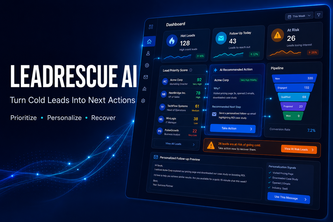
LeadRescue AI is a self-reported lead-recovery copilot built for small service businesses. The author states it imports CSV lead data, ranks leads using deterministic rules, and optionally enhances those rankings with GPT-5.6 under human review. It is described as an explainable system that avoids automatic outreach and prevents spam by limiting AI use to explicit user requests.
The product appears to be a proof-of-concept or early-stage prototype, built in Next.js with TypeScript, deployed on Vercel, and open-sourced on GitHub. The author reports no revenue, customers, or traction beyond the demo environment.
Key commercial due-diligence read: There is no evidence of product-market fit, revenue, or customer adoption. The project is self-reported as a hackathon submission with no verified business activity. The single most important open question is whether this concept has any real-world demand from small service businesses, and if so, how it would scale beyond the current demo.
What The Product Actually Is
The description states that LeadRescue AI:
- Imports lead data from CSV files
- Normalizes CRM column variations
- Ranks leads using transparent recovery-priority rules
- Identifies missed callbacks, stalled price conversations, missed appointments, delayed responses, and other follow-up gaps
- Shows the evidence behind every score
- Creates a deterministic recovery message before any AI call is made
- Uses GPT-5.6 only when an authorized user explicitly requests an enhancement
- Provides an improved recovery message, explanation, and conversation guidance
- Prevents unnecessary outreach for recently contacted leads
- Requires human review before any message is sent
The product is described as a Next.js and TypeScript application with two layers: a deterministic engine and a controlled GPT-5.6 enhancement layer.
Inference: The product is not a full CRM but a lead-scoring and recovery assistant, focused on prioritizing and guiding follow-ups for neglected leads.
Positioning & Claim Evolution
The author states that LeadRescue AI was built to solve the gap in CRM systems where "they do not clearly explain which lead needs attention first, why that lead matters, what action should happen next, or when outreach should be avoided."
It positions itself as an explainable AI lead-recovery copilot, emphasizing:
- Transparency in scoring
- Human-in-the-loop design
- Avoidance of spam and unsafe automation
The author claims the system is designed to help small service businesses recover more opportunities without increasing operational complexity.
Inference: The positioning is that of a lightweight, safe, and explainable assistant for lead recovery — not a full CRM or AI-powered sales platform.
Target Customer & ICP
The description states:
- LeadRescue AI targets small service businesses
- It addresses the problem of "losing valuable leads every day" due to delayed callbacks, missed appointments, stalled price discussions, and follow-ups falling through the cracks
- The system is designed for users who already use CRM systems but want better prioritization and guidance
Inference: The ICP appears to be small service businesses (e.g., real estate agents, consultants, freelancers) that have leads in CRM or CSV format and need help recovering neglected opportunities.
Business Model & Pricing Evidence
The description does not state anything about pricing, monetization, or a business model.
Not evidenced: No information is provided on how the product would be sold, whether it's free, subscription-based, or one-time use.
Technical & Delivery Signals
The author states:
- Built with Next.js, TypeScript
- Uses GPT-5.6 only when an authorized user explicitly requests an enhancement
- OpenAI API is called only from a server-side route
- API key is never exposed to the browser
- Additional protections include:
- Private demo access code
- Human-review requirement
- No automatic outreach
- Browser caching of unchanged AI results
- Confirmation before regeneration
- Zero automatic retries
- 15-second timeout
- Vercel firewall rate limiting
- Maximum 3 enhancement requests per minute per IP address
The application is deployed on Vercel, and the source code is published on GitHub.
Inference: The technical architecture shows a focus on safety, cost control, and user control. It is not a fully automated system but one that requires explicit user action for AI use.
Traction & Maturity Signals
The description states:
- This is a hackathon submission
- The demo uses fictional lead data
- The author reports no revenue or customers
- No evidence of product adoption, usage metrics, or customer feedback
Not evidenced: No traction, revenue, or user data beyond the demo.
Competitive Context
The description does not mention any competitors. It is unclear whether LeadRescue AI is positioned against CRM systems like HubSpot, Salesforce, or Zoho, or other lead-recovery tools.
Not evidenced: No competitive analysis or positioning relative to existing solutions.
Open Questions & Risks
- The product is described as a hackathon submission, with no evidence of real-world traction or adoption
- It is built for small service businesses, but there is no evidence of market demand or validation
- The system is not integrated with any CRM (as of the description)
- No pricing, monetization, or business model is described
- The use of GPT-5.6 is limited to user-initiated enhancement — this may limit perceived utility
- The team size is listed as 1, which raises questions about scalability and execution
Inference: The risk is high that the product has no real-world demand or path to monetization without further development and market validation.
Questions the description leaves open
- What specific small service business pain points did you observe before building this?
- Have you tested this with any actual users or businesses?
- How do you plan to integrate with existing CRMs like HubSpot, Zoho, or Salesforce?
- What is your go-to-market strategy for reaching small service businesses?
- Are there any plans to monetize the product? If so, what pricing model are you considering?
- What is the expected user journey from CSV import to lead recovery?
- How do you plan to scale beyond a single-user demo environment?
Overall Assessment
Not evidenced: No information on valuation, funding rounds, or investment interest.
The product is described as a self-reported hackathon submission, with no evidence of traction, revenue, or customer adoption. It is not clear whether the idea has commercial viability or market demand beyond the demo.
Inference: Without further evidence of product-market fit, user feedback, or business model, this project does not appear to be ready for investment or partnership at this stage. The concept may have potential but requires significant development and validation before it can be considered a viable business.
User Stories BotA demo video on every pull request
Get a demo video on every new feature
GitHub App that watches your pull requests and records a narrated, captioned demo.
Save time on demo prep and make informed decisions faster with a video walkthrough of every new feature.
Source
Submitted to the OpenAI 2026 hackathon on Devpost. Project home on Devpost. Back to the full gallery on Devpost.
This competitive analysis was produced by top-founders.com (opens in a new tab)
Generated by a language model from this project's public Devpost page — its tagline, the author's own write-up and any built-with tags listed there — as captured in August 2026. Short quotations are the author's words. It is an opinion on the idea as a business, not on the people behind it, and it reflects the description as published then. If the project has moved on, request a correction below. The analysis is not independent research and contains no verified traction, revenue or customer data.
An independent guide by KFG International LLC — not affiliated with, endorsed by, or connected to Devpost or OpenAI.