

Archive position — measured, not model output
0 likes on Devpost
2,263 of the 7,850 archived projects have more likes, and 5,587 share exactly 0 — so this project's #6,868 place in the like-ranked listing is a tie-break inside that group, not a ranking.
Projects (log scale)
Likes on Devpost. ▲ marks this project's group.
Show the figures
| Likes | Projects | Share of archive |
|---|---|---|
| 0 | 5,587 | 71.2% |
| 1 | 1,758 | 22.4% |
| 2 | 284 | 3.6% |
| 3–4 | 132 | 1.7% |
| 5–9 | 75 | 1.0% |
| 10+ | 14 | 0.2% |
 User Stories BotA demo video on every pull request
Get a demo video on every new feature
GitHub App that watches your pull requests and records a narrated, captioned demo.
Save time on demo prep and make informed decisions faster with a video walkthrough of every new feature.
Executive Summary
Project: Soundboard Command Center
Self-reported basis: The description is entirely self-reported by the author, unverified, and lacks any evidence of revenue, customers, or traction.
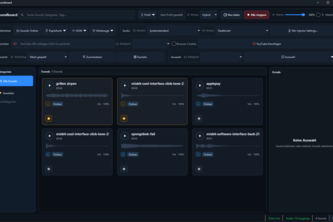
What it appears to be: A local Windows soundboard application for organizing, routing, and playing audio clips during streams, games, and live sessions.
What changed: During OpenAI Build Week, the author used AI tools (Codex, GPT-5.6) to improve stability, test coverage, crash diagnostics, and release readiness of an existing project.
Single most important open question: Is there any evidence of user adoption or market demand beyond the single developer's personal use case?
What The Product Actually Is
The description states that Soundboard Command Center is a local Windows soundboard for organizing, routing, importing, and playing audio clips during streams, games, and live sessions. It runs entirely on Windows.
- The app allows users to:
- Import and organize sounds
- Search the library
- Create categories
- Mark favorites
- Adjust individual and master volume
- Choose monitor or stream audio outputs
Evidence: The author’s own write-up describes these features.
Inference: The product is a desktop application, not cloud-based.
Positioning & Claim Evolution
The project is positioned as a reliable local soundboard, emphasizing:
- No dependency on cloud services
- Simplicity and reliability for gaming, streaming, and live sessions
Evidence: The author states the inspiration was to build a simple and reliable way to organize and play audio clips without relying on cloud services.
Inference: This is a niche tool for content creators or streamers who prefer local solutions over online ones.
Claim vs Fact: The claim of being “reliable” and “simple” is self-reported, not substantiated by any external validation.
Target Customer & ICP
The author describes the intended use case as:
- Gaming
- Streaming
- Live sessions
Evidence: The tagline and write-up mention these contexts.
Inference: The target customer is likely a content creator or streamer, possibly with a small to medium-sized audience, who values local audio management tools.
Not evidenced: No specific customer segments, personas, or user data are provided.
Business Model & Pricing Evidence
There is no evidence of:
- Revenue streams
- Pricing model
- Monetization strategy
- Paid features or subscriptions
Evidence: The description does not mention any business model or pricing.
Inference: It appears to be a free, open-source tool, possibly with no commercial intent.
Technical & Delivery Signals
The author states:
- Built with Python, PySide6, FFmpeg, PyInstaller, pytest, Ruff
- Used Codex and GPT-5.6 for development assistance
- The app runs locally on Windows
- Improvements included crash diagnostics, worker lifecycle, privacy protections, and automated test coverage
Evidence: The write-up lists the tech stack and development process.
Inference: The project is a Python-based desktop application, with some AI-assisted development.
Not evidenced: No information about scalability, performance metrics, or production deployment details.
Traction & Maturity Signals
There is no evidence of:
- Users
- Downloads
- Customer feedback
- Usage data
- Product adoption
Evidence: The project was submitted to a hackathon and described as an existing tool that was improved during the event.
Inference: It is likely in early development or prototype stage, with no verified traction.
Competitive Context
The description does not mention:
- Competitors
- Market size
- Competitive advantages
- Differentiation from similar tools
Evidence: No competitive analysis or market positioning provided.
Inference: The author may be targeting a niche within the broader soundboard or audio management space, but no evidence of existing competition is given.
Open Questions & Risks
- Single developer team: Only one member listed (Draaagonix L), which raises concerns about scalability and long-term maintenance.
- No revenue or traction: No evidence of monetization, users, or adoption.
- Unverified claims: All features and improvements are self-reported; no independent validation.
- AI dependency: Heavy reliance on AI tools (Codex, GPT-5.6) for development may indicate a lack of deep technical expertise or a high-risk approach to tooling.
Questions the description leaves open
- What is the actual user base or adoption rate for this tool?
- Are there any plans for monetization or commercial use?
- How does this tool differ from existing local soundboard solutions?
- What are the long-term maintenance and scalability plans for the project?
- Is there any feedback or engagement from users beyond personal use?
Overall Assessment
Not evidenced: No evidence of revenue, customers, or traction to support a commercial due-diligence read.
Inference: This appears to be a personal or prototype project, likely not ready for investment or partnership.
Confidence level: Low — based entirely on self-reported claims with no external validation.
User Stories BotA demo video on every pull request
Get a demo video on every new feature
GitHub App that watches your pull requests and records a narrated, captioned demo.
Save time on demo prep and make informed decisions faster with a video walkthrough of every new feature.
Source
Submitted to the OpenAI 2026 hackathon on Devpost. Project home on Devpost. Back to the full gallery on Devpost.
This competitive analysis was produced by top-founders.com (opens in a new tab)
Generated by a language model from this project's public Devpost page — its tagline, the author's own write-up and any built-with tags listed there — as captured in August 2026. Short quotations are the author's words. It is an opinion on the idea as a business, not on the people behind it, and it reflects the description as published then. If the project has moved on, request a correction below. The analysis is not independent research and contains no verified traction, revenue or customer data.
An independent guide by KFG International LLC — not affiliated with, endorsed by, or connected to Devpost or OpenAI.