

Archive position — measured, not model output
0 likes on Devpost
2,263 of the 7,850 archived projects have more likes, and 5,587 share exactly 0 — so this project's #2,941 place in the like-ranked listing is a tie-break inside that group, not a ranking.
Projects (log scale)
Likes on Devpost. ▲ marks this project's group.
Show the figures
| Likes | Projects | Share of archive |
|---|---|---|
| 0 | 5,587 | 71.2% |
| 1 | 1,758 | 22.4% |
| 2 | 284 | 3.6% |
| 3–4 | 132 | 1.7% |
| 5–9 | 75 | 1.0% |
| 10+ | 14 | 0.2% |
 User Stories BotA demo video on every pull request
Get a demo video on every new feature
GitHub App that watches your pull requests and records a narrated, captioned demo.
Save time on demo prep and make informed decisions faster with a video walkthrough of every new feature.
Executive Summary
What the company appears to be
BioPathAI, as described by its author, is an agentic AI platform designed for microbial pathway engineering, with a focus on accelerating biofuel discovery. It integrates autonomous AI agents, knowledge graphs, predictive machine learning, and real-time analytics to support scientific research workflows in synthetic biology.
What changed
This project was submitted as a hackathon prototype (Devpost entry for OpenAI 2026). The author describes it as an end-to-end AI-assisted research platform that combines multiple technologies including LangGraph for agent orchestration, Neo4j for knowledge graphs, and various ML models like TFT and PELT. It is presented as a proof-of-concept for how AI can be used to accelerate enzyme optimization and fermentation monitoring.
The single most important open question
Is there evidence of traction or commercial viability beyond the hackathon prototype? The description does not indicate any revenue, customers, or adoption data — only self-reported claims about functionality and future plans.
What The Product Actually Is
- The description states that BioPathAI is an agentic AI platform for microbial pathway engineering.
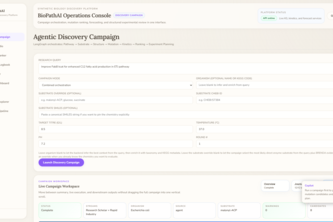
- It enables researchers to launch AI-powered discovery campaigns to identify promising enzyme mutations.
- It coordinates multiple specialized AI agents for tasks such as pathway analysis, mutation generation, kinetics prediction, and experiment planning.
- It integrates biological knowledge using a Neo4j knowledge graph enriched with ontology-driven relationships.
- It uses real-time fermentation anomaly detection via the PELT algorithm.
- It forecasts future experimental outcomes using Temporal Fusion Transformer (TFT) models.
- It visualizes AlphaFold protein structures and ranked mutation candidates.
- It includes an AI research assistant that explains results and provides scientific recommendations.
Inference The platform appears to be a research tool built for computational biologists or synthetic biology researchers working in biofuel development. It is not described as a commercial product, but rather as a prototype with potential for future industrial application.
Positioning & Claim Evolution
- The description states that BioPathAI aims to accelerate microbial pathway engineering and biofuel discovery.
- It positions itself as an "intelligent scientific collaborator" connecting biological knowledge, predictive models, and autonomous reasoning into a single research workflow.
- It is described as more than a chatbot — it functions as an AI-native research platform with multi-agent orchestration.
Inference The positioning has evolved from a hackathon prototype to a vision of becoming a production-ready platform for industrial biotechnology. However, there is no evidence of market traction or product-market fit beyond the author’s own claims.
Target Customer & ICP
- The description states that BioPathAI targets researchers working in microbial pathway engineering and biofuel research.
- It is intended for use by scientists who need to optimize enzymes and monitor fermentation processes.
- It supports synthetic biology, pharmaceutical research, and industrial biotechnology applications.
Not evidenced No specific customer segments, personas, or use cases beyond general scientific research are detailed. No indication of whether the target audience includes academic labs, startups, or large corporations.
Business Model & Pricing Evidence
- The description does not mention any pricing model or business model.
- There is no evidence of revenue streams, licensing, subscriptions, or monetization strategies.
- The project is described as a hackathon prototype with no indication of commercial deployment.
Inference The business model remains undefined. It is unclear whether the platform will be sold as SaaS, offered through partnerships, or integrated into existing lab infrastructure.
Technical & Delivery Signals
- Built using FastAPI for backend APIs.
- Uses LangGraph to orchestrate autonomous AI agents.
- Leverages OpenAI GPT-4o for reasoning and explanation.
- Employs Neo4j for knowledge graph integration.
- Implements PELT algorithm for fermentation change-point detection.
- Uses Temporal Fusion Transformer (TFT) for forecasting.
- Integrates AlphaFold for structure visualization.
- Frontend built with HTML, CSS, JavaScript, React.
- Deployed using Docker Compose.
Inference The technical stack suggests a modern, modular architecture suitable for scientific research. However, the delivery signals are limited to a hackathon prototype and lack evidence of scalability or production readiness.
Traction & Maturity Signals
- The project is described as a hackathon submission (Devpost entry).
- No evidence of revenue, customers, or adoption.
- No mention of user feedback, pilot programs, or product iterations beyond the initial prototype.
- The author notes challenges in integrating components and balancing usability with scientific accuracy.
Inference There are no signs of traction or maturity beyond a proof-of-concept. The platform has not been tested in real-world conditions or scaled for commercial use.
Competitive Context
- The description does not reference direct competitors.
- It is positioned within the broader field of AI-assisted synthetic biology and biofuel research.
- Technologies such as knowledge graphs, agent-based systems, and predictive modeling are common in this space.
- No indication of competitive advantages or differentiation strategies.
Inference The competitive landscape includes other platforms focused on computational biology, pathway engineering, and AI-driven drug discovery. However, no specific competitive positioning is evident from the description.
Open Questions & Risks
- The platform is described as a hackathon prototype with no evidence of commercial viability or traction.
- Lack of data on real-world performance or validation in laboratory settings.
- No indication of funding, team size beyond one person, or investor interest.
- Risk of over-reliance on proprietary tools (e.g., GPT-4o) without clear path to self-sufficiency.
- Potential difficulty in scaling from prototype to production-level deployment.
Inference The risk of failure is high due to lack of evidence for product-market fit, scalability, or commercialization strategy. The single-person team raises concerns about execution capability.
Questions the description leaves open
- What specific scientific problems does BioPathAI solve that current tools do not?
- How will the platform be monetized once it moves beyond prototype stage?
- Has the team validated the platform with actual researchers or labs?
- What are the technical limitations of the current prototype, and how will they be addressed?
- Are there any partnerships or collaborations in place to support commercial development?
- What is the roadmap for integrating live biological databases and expanding functionality?
- How does the platform handle data privacy and compliance in research environments?
Overall Assessment
- The description indicates that BioPathAI is a hackathon prototype with no evidence of traction, revenue, or customer adoption.
- It is described as an ambitious vision for AI-assisted synthetic biology but lacks any demonstration of real-world impact or scalability.
- The single-founder team and lack of funding or external validation raise concerns about execution capability.
Assessment Not evidenced. There is insufficient information to assess commercial viability or investment potential. This appears to be a conceptual prototype with no demonstrated path to market.
User Stories BotA demo video on every pull request
Get a demo video on every new feature
GitHub App that watches your pull requests and records a narrated, captioned demo.
Save time on demo prep and make informed decisions faster with a video walkthrough of every new feature.
Source
Submitted to the OpenAI 2026 hackathon on Devpost. Project home on Devpost. Back to the full gallery on Devpost.
This competitive analysis was produced by top-founders.com (opens in a new tab)
Generated by a language model from this project's public Devpost page — its tagline, the author's own write-up and any built-with tags listed there — as captured in August 2026. Short quotations are the author's words. It is an opinion on the idea as a business, not on the people behind it, and it reflects the description as published then. If the project has moved on, request a correction below. The analysis is not independent research and contains no verified traction, revenue or customer data.
An independent guide by KFG International LLC — not affiliated with, endorsed by, or connected to Devpost or OpenAI.