

Archive position — measured, not model output
0 likes on Devpost
2,263 of the 7,850 archived projects have more likes, and 5,587 share exactly 0 — so this project's #6,867 place in the like-ranked listing is a tie-break inside that group, not a ranking.
Projects (log scale)
Likes on Devpost. ▲ marks this project's group.
Show the figures
| Likes | Projects | Share of archive |
|---|---|---|
| 0 | 5,587 | 71.2% |
| 1 | 1,758 | 22.4% |
| 2 | 284 | 3.6% |
| 3–4 | 132 | 1.7% |
| 5–9 | 75 | 1.0% |
| 10+ | 14 | 0.2% |
 User Stories BotA demo video on every pull request
Get a demo video on every new feature
GitHub App that watches your pull requests and records a narrated, captioned demo.
Save time on demo prep and make informed decisions faster with a video walkthrough of every new feature.
Executive Summary
What the company appears to be
Sound Pedagogy is a self-reported AI-powered platform designed to transform classroom audio into structured coaching insights for teachers and instructional leaders. The author describes it as an instructional intelligence tool that uses AI models, structured evidence indexing, and Retrieval-Augmented Generation (RAG) to generate actionable coaching recommendations grounded in observable classroom behavior.
What changed
The project was built by a single developer (Derek Oldfield) over the course of a hackathon. It represents an experimental approach to instructional feedback using AI, combining audio transcription, diarization, and evidence-based reasoning pipelines. The author states that early versions struggled with generic outputs but were improved through architectural redesign focused on structured evidence and domain-specific playbooks.
The single most important open question
Is there a viable market need for this type of AI-powered instructional coaching tool, and can the platform scale beyond a hackathon prototype to deliver meaningful value to schools or districts?
Note: This analysis is based entirely on the self-reported project description provided by the author. No external verification, revenue data, customer feedback, or traction metrics are available.
What The Product Actually Is
The description states that Sound Pedagogy:
- Transcribes and analyzes classroom audio
- Distinguishes teacher and student voices
- Identifies instructional patterns throughout a lesson
- Maps evidence against customizable instructional playbooks
- Generates evidence-grounded coaching reports
- Tracks instructional growth across multiple classroom observations
It also claims to use:
- AI models including ChatGPT, GPT-5.5, 5.6, and others
- RAG (Retrieval-Augmented Generation)
- Structured outputs and prompt orchestration
- Embeddings, vector search, and data models
- Evidence-first reasoning pipeline
The system is described as combining lesson audio with administrative walkthroughs to build a richer picture of instruction.
Inference: The platform appears to be an experimental AI tool built for educational use, not yet proven in production environments or at scale. It is not evidenced whether it has been deployed in real classrooms or tested with educators.
Positioning & Claim Evolution
The author positions Sound Pedagogy as:
- An AI system that moves beyond summarizing transcripts to reasoning about teaching like a human coach
- A tool for teacher reflection, coaching continuity, and district-wide improvement
- Designed to reduce generic AI feedback by grounding recommendations in structured evidence from classroom audio
It is claimed that the platform answers three core instructional questions:
- What are our instructional expectations?
- Where is this classroom in relation to those expectations?
- What should the teacher do next to close the gap?
The evolution of the product, according to the author, involved:
- Moving away from generic prompting toward structured evidence-based reasoning
- Developing a strategy bank based on sources like Marzano and Danielson
- Implementing a core priority profile with evidence indicators and strategies
Inference: The positioning reflects an attempt to differentiate from general-purpose AI tools by focusing on domain-specific, actionable insights. However, the lack of real-world deployment or user testing makes it unclear how well this approach works in practice.
Target Customer & ICP
The description states that Sound Pedagogy is intended for:
- Teachers
- Instructional leaders and coaches
- Districts seeking to improve instruction at scale
It is described as addressing a problem where:
- Teachers receive little feedback on classroom instruction
- Traditional methods of collecting instructional data are infrequent and uncalibrated
- Teacher shortages make it difficult for districts to afford experienced coaches
The author also mentions that the platform aims to give every teacher access to thoughtful, evidence-based coaching typically available only through expert mentors.
Inference: The target customer is likely K–12 school districts or instructional leadership teams. However, no specific ICP (Ideal Customer Profile) has been defined beyond broad educational roles. No evidence of actual users or pilot programs is provided.
Business Model & Pricing Evidence
There is no mention in the description of a business model or pricing structure.
The author states that the goal is to provide access to expert-level coaching to all teachers, but does not elaborate on how this would be monetized.
Not evidenced: No information about revenue streams, pricing tiers, licensing models, or customer acquisition strategies.
Technical & Delivery Signals
The platform is built using:
- AI technologies: ChatGPT, GPT-5.5, 5.6, Codex, GitHub Copilot, embeddings, RAG
- Infrastructure: Firebase, PostgreSQL, Node.js, React, TypeScript, Cloudflare, Render
- Data processing pipeline: Transcription, diarization, pattern recognition, evidence indexing
The author notes that ChatGPT was used as a development partner throughout the project and that tools like Copilot accelerated implementation.
Inference: The technical stack suggests a modern web application with AI integration. However, there is no evidence of scalability, performance testing, or production deployment details.
Traction & Maturity Signals
The description indicates:
- A single developer (Derek Oldfield) built the entire platform
- It was submitted to the OpenAI 2026 hackathon
- The author has learned that “lesson audio evidence is the missing data layer” for schools and districts
- There are no mentions of pilot users, beta testers, or real-world usage
Not evidenced: No traction, adoption, or user feedback. No evidence of revenue, ARR, headcount, or product-market fit.
Competitive Context
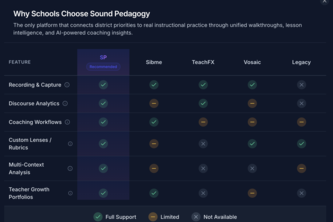
The author does not reference any competitors directly in the description.
However, the problem space involves:
- Instructional coaching tools
- AI-powered education platforms
- Classroom observation and feedback systems
It is implied that current solutions lack the ability to provide detailed, evidence-based coaching from audio data alone.
Inference: The competitive landscape includes various edtech vendors offering coaching or analytics tools. However, no specific competitor analysis or differentiation strategy is presented.
Open Questions & Risks
Key risks and open questions include:
- Single-person development team — raises questions about scalability and long-term maintenance
- No evidence of real-world testing or user feedback
- Self-reported claims without independent validation
- Unclear monetization model
- Lack of data privacy or compliance considerations (e.g., FERPA, GDPR)
- No indication of how the platform will handle diverse instructional frameworks across schools
Inference: The project is in early stages and lacks commercial viability indicators. It may be more of a proof-of-concept than a scalable product.
Questions the description leaves open
- What specific instructional frameworks or playbooks are currently supported, and how do you plan to adapt them for different districts?
- Have you conducted any pilot testing with teachers or administrators? If so, what were the results?
- How does the platform ensure data privacy and compliance (e.g., FERPA)?
- What is your path to market and go-to-market strategy?
- How do you plan to scale beyond a single developer?
- Are there any existing partnerships with schools or districts?
- What are the key assumptions behind the product’s value proposition, and how have they been validated?
Overall Assessment
Not evidenced: No financials, traction, or commercial readiness indicators are available.
Assessment: Based solely on the self-reported description, Sound Pedagogy appears to be a conceptual prototype addressing an educational challenge. It shows potential but lacks evidence of market demand, product maturity, or viable business model. The single developer and hackathon origin suggest it is not yet ready for investment or partnership discussions.
User Stories BotA demo video on every pull request
Get a demo video on every new feature
GitHub App that watches your pull requests and records a narrated, captioned demo.
Save time on demo prep and make informed decisions faster with a video walkthrough of every new feature.
Source
Submitted to the OpenAI 2026 hackathon on Devpost. Project home on Devpost. Back to the full gallery on Devpost.
This competitive analysis was produced by top-founders.com (opens in a new tab)
Generated by a language model from this project's public Devpost page — its tagline, the author's own write-up and any built-with tags listed there — as captured in August 2026. Short quotations are the author's words. It is an opinion on the idea as a business, not on the people behind it, and it reflects the description as published then. If the project has moved on, request a correction below. The analysis is not independent research and contains no verified traction, revenue or customer data.
An independent guide by KFG International LLC — not affiliated with, endorsed by, or connected to Devpost or OpenAI.