

Archive position — measured, not model output
1 like on Devpost
505 of the 7,850 archived projects have more likes, and 1,758 share exactly 1 — so this project's #694 place in the like-ranked listing is a tie-break inside that group, not a ranking.
Projects (log scale)
Likes on Devpost. ▲ marks this project's group.
Show the figures
| Likes | Projects | Share of archive |
|---|---|---|
| 0 | 5,587 | 71.2% |
| 1 | 1,758 | 22.4% |
| 2 | 284 | 3.6% |
| 3–4 | 132 | 1.7% |
| 5–9 | 75 | 1.0% |
| 10+ | 14 | 0.2% |
 User Stories BotA demo video on every pull request
Get a demo video on every new feature
GitHub App that watches your pull requests and records a narrated, captioned demo.
Save time on demo prep and make informed decisions faster with a video walkthrough of every new feature.
Executive Summary
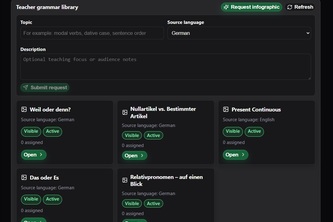
Bildmind is a self-reported educational tool for German grammar instruction that uses GPT-5.6 to generate structured visual guides. The author states the platform supports a teacher-to-student workflow where teachers enter German grammar topics and receive deterministic SVG outputs. It includes features like exact-version assignment, student access control, and personal library saving.
The project is described as an MVP built during the OpenAI 2026 hackathon, with a pilot in progress involving one teacher and 13 students across five language groups. The author emphasizes that Grammar Infographics are not yet rolled out to all students and that the current implementation only supports German grammar.
Key commercial due-diligence read
The description reveals a product concept but lacks evidence of revenue, customers, or adoption beyond a single pilot classroom. The author acknowledges significant limitations in reliability, scalability, and mobile experience, while also noting that the system is not yet production-ready.
What The Product Actually Is
The description states that Bildmind provides a controlled teacher-to-student workflow for German grammar materials using GPT-5.6.
- A teacher inputs a German grammar topic and optional teaching context.
- GPT-5.6 returns structured educational content.
- Backend validates and persists canonical content.
- The system creates one deterministic, application-controlled SVG guide.
- The teacher previews the exact generated material version.
- The teacher assigns that exact version to a class.
- Assigned students can open and save the protected material.
The final output is described as a natural-height visual grammar guide containing explanations, rule blocks, tables, German examples, common mistakes, corrections, notes, and summary or memory-aid material.
Evidence Self-reported by author. No independent verification of functionality or performance.
Positioning & Claim Evolution
The description indicates that Bildmind was built from an existing foundation and transformed into a working German Grammar Infographics teacher-to-student workflow during Build Week.
The author states:
- The platform already included authentication, user roles, organizations, classrooms, personal language profiles, vocabulary, tests, progress tracking, Teacher Sets, assignments, and media-storage foundations.
- During Build Week, the foundation was extended to include the Grammar Infographics authoring lifecycle.
- The current public claim is limited to German grammar support, not universal translation reliability.
The author also notes that the system is not yet production-deployed and does not claim universal reliability or mobile optimization.
Evidence Self-reported evolution of product scope. No evidence of prior commercial positioning or market traction.
Target Customer & ICP
The description states that Bildmind targets multilingual German language classrooms where students study the same target language but need explanations in different native languages.
- One teacher and 13 students across five native-language groups are currently piloted.
- The pilot covers vocabulary learning, tests, classrooms, progress, assignments, and Teacher Sets.
- Grammar Infographics have not yet been rolled out to the full class.
- A German teacher participating in the ongoing pilot identified visual vocabulary presentation, AI-supported word suggestions, thematic organization, Teacher Sets, assignments, and progress tracking as useful directions.
Evidence Self-reported target classroom environment. No evidence of broader customer segments or market size.
Business Model & Pricing Evidence
The description does not provide any information about pricing, revenue models, or monetization strategies.
Evidence Not evidenced. The author only describes the workflow and functionality without commercial details.
Technical & Delivery Signals
The system uses:
- Backend: Python, FastAPI, Pydantic, SQLAlchemy, Alembic, PostgreSQL, Redis, Docker, pytest
- Frontend: React, TypeScript, Vite, React Router, Vitest, Playwright
- AI: GPT-5.6 configured specifically for Grammar Infographics
Key technical features include:
- Structured Output handling
- Canonical grammar-content validation
- Privacy-safe failure categories
- Fail-closed publication
- Deterministic application-controlled SVG rendering
- Protected media access
- Teacher preview
- Exact-version assignment
- Student personal-library lifecycle
- Natural-height frontend presentation
- Ordinary document scrolling
The author notes that the system was built using a structured engineering approach with Codex as an agentic system, but emphasizes human control over product decisions.
Evidence Self-reported technical stack and implementation details. No evidence of production deployment or scalability metrics.
Traction & Maturity Signals
The description states that Bildmind is piloted in a multilingual German B2 classroom with:
- One teacher
- 13 students across five native-language groups
- All 13 students have recorded learning activity
- Current pilot covers vocabulary learning, tests, classrooms, progress, assignments, and Teacher Sets
A German teacher participating in the ongoing pilot gave feedback about visual vocabulary presentation, AI-supported word suggestions, thematic organization, Teacher Sets, assignments, and progress tracking as useful directions.
The author also notes that Grammar Infographics were not included in the previously reported pilot activity and have not yet been rolled out to the full class.
Evidence Self-reported pilot data. No evidence of revenue, customer acquisition, or adoption beyond one classroom.
Competitive Context
The description does not provide any information about competitors or market positioning.
Evidence Not evidenced. No mention of existing solutions or competitive landscape.
Open Questions & Risks
Several risks and open questions are evident from the self-reported description:
- Limited scope and reliability: The author explicitly states that Grammar Infographics have not yet been rolled out to all students, and that the system is not universally reliable.
- Mobile experience issues: The author acknowledges that mobile typography and zoom still need improvement.
- Production readiness concerns: The system is described as not yet production-deployed and not ready for unrestricted rollout.
- Single-person development: The team size is listed as one member (Dmytro Movchan).
- Unverified claims: The author repeatedly emphasizes that the current implementation only supports German grammar, not universal translation reliability.
- Agentic engineering limitations: The author notes that green tests are not the same as successful learning products and that automated evidence must be separated from human product review.
Evidence Self-reported concerns about system limitations and readiness.
Questions the description leaves open
- What specific metrics or KPIs are being used to evaluate the effectiveness of the Grammar Infographics in the pilot classroom?
- How does the team plan to address the mobile experience issues noted in the description?
- What is the timeline for expanding beyond the current single-class pilot?
- How will the system handle translation quality across different language pairs beyond German?
- What are the specific challenges with scaling from one teacher and 13 students to larger classroom sizes?
- How does the team plan to ensure pedagogical quality beyond technical validation?
- What is the current plan for monetization or revenue generation?
- How will the team address the limitations in agentic engineering systems noted in the description?
Overall Assessment
Not evidenced.
The description provides no information about funding rounds, valuations, headcount, customer names, logos, partnerships, pricing, growth rates, or any independent verification of traction, revenue, or adoption.
The author explicitly states that this is a self-reported, unverified account and that the system is not yet production-ready. The project appears to be an MVP built during a hackathon with limited commercial evidence.
Confidence level Low. This analysis is based entirely on self-reported information without any independent verification of functionality, traction, or business metrics.
User Stories BotA demo video on every pull request
Get a demo video on every new feature
GitHub App that watches your pull requests and records a narrated, captioned demo.
Save time on demo prep and make informed decisions faster with a video walkthrough of every new feature.
Source
Submitted to the OpenAI 2026 hackathon on Devpost. Project home on Devpost. Back to the full gallery on Devpost.
This competitive analysis was produced by top-founders.com (opens in a new tab)
Generated by a language model from this project's public Devpost page — its tagline, the author's own write-up and any built-with tags listed there — as captured in August 2026. Short quotations are the author's words. It is an opinion on the idea as a business, not on the people behind it, and it reflects the description as published then. If the project has moved on, request a correction below. The analysis is not independent research and contains no verified traction, revenue or customer data.
An independent guide by KFG International LLC — not affiliated with, endorsed by, or connected to Devpost or OpenAI.