

Archive position — measured, not model output
1 like on Devpost
505 of the 7,850 archived projects have more likes, and 1,758 share exactly 1 — so this project's #692 place in the like-ranked listing is a tie-break inside that group, not a ranking.
Projects (log scale)
Likes on Devpost. ▲ marks this project's group.
Show the figures
| Likes | Projects | Share of archive |
|---|---|---|
| 0 | 5,587 | 71.2% |
| 1 | 1,758 | 22.4% |
| 2 | 284 | 3.6% |
| 3–4 | 132 | 1.7% |
| 5–9 | 75 | 1.0% |
| 10+ | 14 | 0.2% |
 User Stories BotA demo video on every pull request
Get a demo video on every new feature
GitHub App that watches your pull requests and records a narrated, captioned demo.
Save time on demo prep and make informed decisions faster with a video walkthrough of every new feature.
Executive Summary
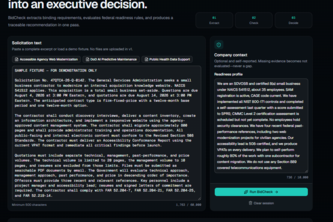
What the company appears to be: BidCheck is a self-reported tool that converts federal solicitations into evidence-linked bid/no-bid decisions using AI. The author states it uses GPT-5.6 Sol and structured outputs via Zod, with a Next.js/TypeScript frontend on Vercel.
What changed: The project was built as part of the OpenAI 2026 hackathon submission. It is described as a proof-of-concept decision-support workflow for federal contracting.
The single most important open question: Is there any evidence of real-world usage, customer feedback, or traction beyond the author's own development?
Note: This analysis is based entirely on self-reported information from the project description. No third-party verification, revenue data, customer names, or adoption metrics are available.
What The Product Actually Is
The description states that BidCheck:
- Converts federal solicitations into evidence-linked bid/no-bid decisions.
- Extracts metadata, deliverables, evaluation factors, and binding requirements.
- Evaluates a versioned federal acquisition-readiness rulebook.
- Combines solicitation evidence with optional company context.
- Produces executive BID, NO-BID, or BID WITH CONDITIONS memos.
- Links findings back to original requirements and authorities.
- Uses structured outputs validated by Zod.
- Is built using Next.js, TypeScript, OpenAI API (GPT-5.6 Sol), Codex, and Redis.
Inference: The tool is described as a decision-support workflow rather than a legal advice engine or contracting-officer determination.
Positioning & Claim Evolution
The author states:
- Federal solicitations are "dense, repetitive, and unforgiving."
- A small contractor can spend hours reviewing one opportunity and still overlook key details.
- The tool aims to shorten the time between receiving a solicitation and making an executive decision.
- It is positioned as a way to make defensible decisions by linking findings back to requirements.
Inference: The positioning evolved from a general document summarizer into a more structured, evidence-based decision-support system. The author emphasizes transparency and avoiding manufactured certainty.
Target Customer & ICP
The description states:
- The tool is aimed at small contractors reviewing federal solicitations.
- It supports "executive" decision-making.
- It integrates optional company context to assess readiness.
- It separates opportunity risk from contractor readiness.
Inference: The target customer appears to be small business owners or procurement teams within small-to-medium enterprises (SMEs) in the federal contracting space. However, no explicit ICP is defined beyond this general audience.
Business Model & Pricing Evidence
Not evidenced.
The description does not mention any pricing model, monetization strategy, or business model. It is described as a hackathon project with no indication of commercial intent or revenue streams.
Technical & Delivery Signals
The author states:
- Built with Next.js and TypeScript on Vercel.
- Uses OpenAI Responses API with GPT-5.6 Sol.
- Server-side pipeline has three stages: structured extraction, rulebook analysis, memo generation.
- Uses Codex for engineering assistance.
- Structured outputs validated via Zod.
- Results are streamed as NDJSON events.
- Submitted documents are not stored by the application.
- Active results remain in browser session storage.
Inference: The system is designed to be lightweight and privacy-conscious. It uses deterministic logic for some aspects, such as guardrails and risk calculations, rather than relying entirely on model outputs.
Traction & Maturity Signals
Not evidenced.
There is no mention of users, customers, or adoption beyond the author’s own development. No metrics, usage data, or feedback are provided.
Competitive Context
Not evidenced.
No information is given about competitors, market size, or competitive positioning in the federal contracting or AI decision-support space.
Open Questions & Risks
- Unverified claims: All statements are self-reported and unverified.
- No traction evidence: No customers, usage data, or revenue.
- Single-person team: The project is built by one individual (Daniel Lozovsky).
- Hackathon origin: Not a commercial product but a hackathon submission.
- Limited scope: Only supports solicitation text; no ingestion of PDFs or DOCX files.
- No integration with federal systems: SAM.gov or other platforms are mentioned as future possibilities, not current features.
Questions the description leaves open
- Has the tool been tested in real-world scenarios with actual federal solicitations?
- Are there any early adopters or pilot users?
- What is the plan for scaling beyond a single-person development effort?
- How will the rulebook be maintained and updated over time?
- Is there any intention to monetize this tool, and if so, how?
- What are the legal implications of using such a system in decision-making?
- Are there plans to integrate with federal databases or platforms like SAM.gov?
Overall Assessment
Not evidenced.
There is no evidence of revenue, customers, traction, or business model beyond the author’s own description. The project appears to be a hackathon submission without any indication of commercial viability or strategic value at this stage.
The tool is described as a proof-of-concept for decision support in federal contracting, but there is no indication that it has moved beyond prototype status or gained real-world adoption.
User Stories BotA demo video on every pull request
Get a demo video on every new feature
GitHub App that watches your pull requests and records a narrated, captioned demo.
Save time on demo prep and make informed decisions faster with a video walkthrough of every new feature.
Source
Submitted to the OpenAI 2026 hackathon on Devpost. Project home on Devpost. Back to the full gallery on Devpost.
This competitive analysis was produced by top-founders.com (opens in a new tab)
Generated by a language model from this project's public Devpost page — its tagline, the author's own write-up and any built-with tags listed there — as captured in August 2026. Short quotations are the author's words. It is an opinion on the idea as a business, not on the people behind it, and it reflects the description as published then. If the project has moved on, request a correction below. The analysis is not independent research and contains no verified traction, revenue or customer data.
An independent guide by KFG International LLC — not affiliated with, endorsed by, or connected to Devpost or OpenAI.