

Archive position — measured, not model output
0 likes on Devpost
2,263 of the 7,850 archived projects have more likes, and 5,587 share exactly 0 — so this project's #2,655 place in the like-ranked listing is a tie-break inside that group, not a ranking.
Projects (log scale)
Likes on Devpost. ▲ marks this project's group.
Show the figures
| Likes | Projects | Share of archive |
|---|---|---|
| 0 | 5,587 | 71.2% |
| 1 | 1,758 | 22.4% |
| 2 | 284 | 3.6% |
| 3–4 | 132 | 1.7% |
| 5–9 | 75 | 1.0% |
| 10+ | 14 | 0.2% |
 User Stories BotA demo video on every pull request
Get a demo video on every new feature
GitHub App that watches your pull requests and records a narrated, captioned demo.
Save time on demo prep and make informed decisions faster with a video walkthrough of every new feature.
Executive Summary
Company: Anonmyz
Self-reported basis: The description is entirely self-reported by the author, unverified, and lacks any evidence of revenue, customers, or traction.
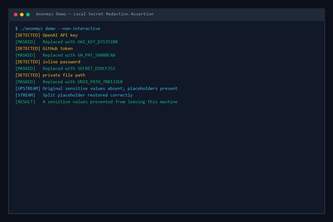
What it appears to be: A local-first privacy gateway for AI agents that masks sensitive data in API responses without exposing original values upstream, built as a single Go binary.
What changed: The project was submitted to the OpenAI 2026 hackathon and is described as a working prototype with security-focused features like fail-closed validation, streaming boundary handling, and deterministic demonstrations.
Single most important open question: Does Anonmyz have any commercial traction or evidence of adoption beyond its author's self-reported development work?
What The Product Actually Is
The description states that Anonmyz is a local-first privacy gateway for AI agents. It is described as:
- A single Go binary, built without third-party runtime libraries or hosted databases.
- Designed to mask sensitive data in API responses (e.g., from OpenAI-compatible clients) without exposing original values upstream.
- Capable of handling streamed responses with careful buffering across chunk boundaries.
- Supporting fail-closed behavior to prevent accidental data leakage.
- Including automated tests for masking, streaming, concurrency, and security boundaries.
It is not evidenced whether Anonmyz has any commercial product or service offering beyond its prototype.
Positioning & Claim Evolution
The author states that Anonmyz is positioned as a tool to help developers use AI agents while keeping secrets local. It is described as:
- A privacy gateway for AI agents.
- Built with a local-first approach, implying no cloud or third-party data handling.
- Designed to preserve developer productivity while maintaining control over sensitive data.
The project’s positioning appears to be evolving from a hackathon prototype into a potential privacy infrastructure tool. However, there is no evidence of how this positioning has changed since its inception, nor whether it has been tested in real-world use cases.
Target Customer & ICP
The description does not state the target customer or ideal customer profile (ICP). It implies that Anonmyz is aimed at developers using AI agents, particularly those working with OpenAI-compatible APIs. The author notes that it supports existing clients without extensive modification, suggesting a focus on compatibility with current tooling.
No evidence of specific customer segments, personas or use cases beyond the developer workflow is provided.
Business Model & Pricing Evidence
There is no evidence in the description of a business model or pricing structure. The project is described as a single-person hackathon submission and does not mention any monetization strategy, subscription plans, or commercial offerings.
Technical & Delivery Signals
The author states that Anonmyz:
- Is built in Go.
- Supports OpenAI-compatible clients.
- Handles streamed responses with careful buffering across chunk boundaries.
- Implements fail-closed validation.
- Uses no third-party runtime libraries or hosted databases.
- Includes automated tests for masking, streaming, concurrency, and security boundaries.
- Is a single binary, suggesting ease of deployment.
It is not evidenced whether this has been deployed in production environments or integrated into any existing systems.
Traction & Maturity Signals
There is no evidence of traction, adoption, or customer engagement. The project is described as:
- A hackathon submission.
- A single-person effort (team size: 1).
- A working prototype, not a commercial product.
No data on user feedback, usage metrics, or performance in real-world settings is provided.
Competitive Context
The description does not provide any information about competitors or the competitive landscape. It does not mention whether similar tools exist, nor how Anonmyz differentiates from them.
Open Questions & Risks
- No commercial traction: The project is a hackathon submission with no evidence of adoption.
- Single-person development: Limited resources and scalability concerns.
- Unverified claims: All features are self-reported without independent validation or testing.
- No pricing or business model: No indication of how the product would be monetized.
- Limited maturity: The project is described as a prototype, not a production-ready solution.
Questions the description leaves open
- What specific use cases are you targeting with Anonmyz?
- How do you plan to validate the security and privacy guarantees in real-world environments?
- Have you conducted any independent security reviews or audits?
- What is your roadmap for moving from prototype to a commercial product?
- Are there any existing integrations or partnerships with AI tooling or enterprise clients?
Overall Assessment
Not evidenced: There is no evidence of revenue, customers, traction, or a clear business model to support an investment or partnership decision. The project is described as a single-person hackathon submission and lacks any commercial signals.
The author claims the product works and includes security features, but there is no independent verification of its performance, scalability, or market fit. Any potential investment or partnership would be based on unproven assumptions about future development and adoption.
User Stories BotA demo video on every pull request
Get a demo video on every new feature
GitHub App that watches your pull requests and records a narrated, captioned demo.
Save time on demo prep and make informed decisions faster with a video walkthrough of every new feature.
Source
Submitted to the OpenAI 2026 hackathon on Devpost. Project home on Devpost. Back to the full gallery on Devpost.
This competitive analysis was produced by top-founders.com (opens in a new tab)
Generated by a language model from this project's public Devpost page — its tagline, the author's own write-up and any built-with tags listed there — as captured in August 2026. Short quotations are the author's words. It is an opinion on the idea as a business, not on the people behind it, and it reflects the description as published then. If the project has moved on, request a correction below. The analysis is not independent research and contains no verified traction, revenue or customer data.
An independent guide by KFG International LLC — not affiliated with, endorsed by, or connected to Devpost or OpenAI.