

Archive position — measured, not model output
0 likes on Devpost
2,263 of the 7,850 archived projects have more likes, and 5,587 share exactly 0 — so this project's #2,656 place in the like-ranked listing is a tie-break inside that group, not a ranking.
Projects (log scale)
Likes on Devpost. ▲ marks this project's group.
Show the figures
| Likes | Projects | Share of archive |
|---|---|---|
| 0 | 5,587 | 71.2% |
| 1 | 1,758 | 22.4% |
| 2 | 284 | 3.6% |
| 3–4 | 132 | 1.7% |
| 5–9 | 75 | 1.0% |
| 10+ | 14 | 0.2% |
 User Stories BotA demo video on every pull request
Get a demo video on every new feature
GitHub App that watches your pull requests and records a narrated, captioned demo.
Save time on demo prep and make informed decisions faster with a video walkthrough of every new feature.
Executive Summary
What the company appears to be
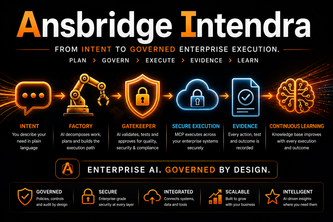
Ansbridge Intendra is a self-reported personal project by Josh Ansbridge, built as part of an OpenAI 2026 hackathon submission. The author describes it as a platform that transforms business intent into governed enterprise execution using AI, with a focus on secure orchestration, auditability and governance. It is built using Python, Flask, MariaDB, and the Model Context Protocol (MCP), and integrates with enterprise systems like Workday.
What changed
The project was initially a personal learning exercise to explore how enterprise AI could safely execute real work. The author states that it evolved into a demonstration of an "AI engineering organisation" capable of planning, building, governing, executing and improving enterprise tasks from a single natural language prompt.
Single most important open question
Is there any evidence of traction, revenue, or adoption beyond the author's own development and demonstration?
What The Product Actually Is
The description states that Ansbridge Intendra is a platform that transforms business intent into governed enterprise execution. It uses AI to decompose tasks, select knowledge from a locally hosted knowledge base, generate solutions, validate them through an AI Gatekeeper, and securely execute work via an MCP orchestration layer.
It includes components such as:
- A Factory for task decomposition
- A Gatekeeper for validation
- A Guardian for security and governance
- A Knowledge Base
- An MCP Orchestrator
The system is described as model-agnostic, using GPT-5.6 and Codex for reasoning and code generation, with the surrounding architecture providing governance, orchestration, and secure execution.
Evidence
- The author states that it combines OpenAI GPT-5.6 and Codex with a custom enterprise architecture built in Python using Flask, MariaDB, and the Model Context Protocol (MCP).
- It is described as being organized into specialized AI capabilities including Factory, Gatekeeper, Guardian, Knowledge Base, and MCP Orchestrator.
- The platform supports secure orchestration across enterprise systems like Workday.
Inference The architecture implies a layered system where AI reasoning interacts with governance and execution components. However, no details are provided about how these layers interact in practice or whether they are fully integrated.
Positioning & Claim Evolution
The author positions Ansbridge Intendra as an AI engineering organisation that can plan, build, govern, execute, and continuously improve enterprise work from a single natural language request. It is framed as a way to reduce the cost of enterprise integrations by automating processes that currently require expensive Studio integrations.
It emphasizes:
- Transparency
- Audibility
- Trustworthiness through design
The author also notes that this began as a personal learning project, evolving into a demonstration of how enterprise AI could safely execute real work.
Evidence
- The tagline: “Ansbridge Intendra plans, governs and executes enterprise work from a single prompt, combining AI, knowledge, validation and secure execution with complete audit trails.”
- The author states that it was built to explore what an AI engineering organisation would look like if it could perform these functions.
- It is described as solving a genuine implementation problem: loading data into Workday.
Inference The positioning suggests a shift from generic AI assistants toward purpose-built systems for enterprise automation. However, the claim of being an “AI engineering organisation” is not substantiated with evidence of operational use or business outcomes beyond the author’s own demonstration.
Target Customer & ICP
The author states that Ansbridge Intendra was inspired by seeing clients in a Workday implementation partner wanting to develop expensive Studio integrations for one-time deployment efforts. The platform is intended to reduce the cost and complexity of such tasks.
It is described as targeting users who need to:
- Understand business intent
- Follow governed processes
- Securely interact with enterprise systems
- Provide complete auditability
The demonstration focuses on Workday integrations, but the author mentions that future expansion includes finance, HR, cloud infrastructure, and business applications.
Evidence
- The inspiration comes from a Workday implementation partner.
- The demonstration uses Workday integrations to show how it selects the correct integration, creates an execution plan, validates it, securely connects to the tenant, and verifies successful execution.
- The author says the long-term vision is to support additional enterprise platforms beyond Workday.
Inference The target customer appears to be enterprise users or consultants who need to automate integrations or workflows within systems like Workday. However, no explicit ICP (Ideal Customer Profile) or segmentation data is provided.
Business Model & Pricing Evidence
There is no evidence of a business model or pricing structure in the description. The author describes the project as a personal learning exercise and a hackathon submission, built on low-cost, self-hosted infrastructure without requiring cloud-scale resources or sponsorship.
Evidence
- The platform was built using hardware the author already owned.
- It uses locally hosted infrastructure to keep costs low.
- No mention of monetization, licensing, or pricing models.
Inference It is unclear whether Ansbridge Intendra intends to be a commercial product or remains a prototype. There is no indication of any revenue streams or customer acquisition strategy.
Technical & Delivery Signals
The platform uses:
- GPT-5.6 and Codex for reasoning and code generation
- Flask as the web framework
- MariaDB for database storage
- Model Context Protocol (MCP) for secure orchestration
- Raspberry Pi, Dell Linux workstations, virtual machines, and Particle Tachyon hardware for deployment
It includes:
- Custom MCP services
- A backlog-driven workflow
- Automated validation and evidence capture
- Integration with enterprise systems like Workday
Evidence
- Built using Python, Flask, MariaDB, and the Model Context Protocol (MCP).
- Uses GPT-5.6 and Codex for primary reasoning and software engineering.
- Demonstrates secure orchestration across enterprise systems via MCP.
- Includes custom MCP services on various hardware platforms.
Inference The technical stack suggests a hybrid approach combining open-source tools with proprietary AI models, emphasizing local hosting and model agnosticism. However, no information is provided about scalability, performance, or production readiness.
Traction & Maturity Signals
There is no evidence of traction, revenue, customers, or adoption beyond the author’s own development and demonstration. The project is described as a personal learning exercise and hackathon submission.
Evidence
- The platform was built by one person (Josh Ansbridge).
- It is described as a side project with affordable development costs.
- No mention of users, clients, or real-world deployments.
- The demonstration focuses on solving a specific problem within Workday.
Inference The maturity level appears to be early-stage prototyping. There is no indication that the platform has moved beyond the experimental phase or has been adopted by any organization.
Competitive Context
No competitive landscape is described in the project write-up. The author does not reference existing tools or platforms that perform similar functions, nor does he compare Ansbridge Intendra to other AI-powered enterprise automation solutions.
Evidence
- No mention of competitors.
- No comparison with existing platforms for enterprise AI or workflow automation.
Inference It is unknown whether Ansbridge Intendra competes with or complements existing tools in the market. The lack of competitive context makes it difficult to assess its positioning or differentiation.
Open Questions & Risks
Key risks and open questions include:
- Lack of traction: No evidence of customers, revenue, or adoption.
- Single-person development: The entire project was built by one individual.
- Unverified claims: All descriptions are self-reported and unverifiable.
- No commercial viability: No indication of monetization or business model.
- Limited scope: Focus is on Workday and finance; no expansion to other domains mentioned in the vision.
- Prototype nature: The project is described as a hackathon submission, suggesting it’s not yet production-ready.
Evidence
- The author states that the platform was built using self-hosted infrastructure and low-cost hardware.
- It is described as a personal learning project.
- No evidence of real-world usage or feedback from users.
Inference The lack of traction and commercialization raises questions about whether Ansbridge Intendra will evolve into a viable product or remain a proof-of-concept.
Questions the description leaves open
- What specific enterprise workflows or integrations are you planning to support beyond Workday?
- How do you plan to scale the platform beyond a single developer’s capacity?
- Are there any real-world use cases or pilot projects where Ansbridge Intendra has been tested?
- What is your roadmap for monetization and customer acquisition?
- How does the platform ensure security and compliance in enterprise environments?
- Can you provide more details on how the AI Gatekeeper validates decisions before execution?
- What are the limitations of the current architecture in terms of performance, scalability, or reliability?
Overall Assessment
There is no evidence of traction, revenue, customers, or a clear business model beyond the author’s own development and demonstration. The project is described as a personal learning exercise and hackathon submission, built on low-cost infrastructure by one individual.
Evidence
- No revenue, customer data, or adoption metrics.
- The platform is not yet commercialized.
- The description does not indicate any intention to move beyond the prototype stage.
Inference At this stage, Ansbridge Intendra appears to be an early-stage concept with limited commercial potential. It may have future promise if it evolves into a scalable and adoptable solution, but currently lacks the signals necessary for investment or partnership consideration.
User Stories BotA demo video on every pull request
Get a demo video on every new feature
GitHub App that watches your pull requests and records a narrated, captioned demo.
Save time on demo prep and make informed decisions faster with a video walkthrough of every new feature.
Source
Submitted to the OpenAI 2026 hackathon on Devpost. Project home on Devpost. Back to the full gallery on Devpost.
This competitive analysis was produced by top-founders.com (opens in a new tab)
Generated by a language model from this project's public Devpost page — its tagline, the author's own write-up and any built-with tags listed there — as captured in August 2026. Short quotations are the author's words. It is an opinion on the idea as a business, not on the people behind it, and it reflects the description as published then. If the project has moved on, request a correction below. The analysis is not independent research and contains no verified traction, revenue or customer data.
An independent guide by KFG International LLC — not affiliated with, endorsed by, or connected to Devpost or OpenAI.