

Archive position — measured, not model output
0 likes on Devpost
2,263 of the 7,850 archived projects have more likes, and 5,587 share exactly 0 — so this project's #2,894 place in the like-ranked listing is a tie-break inside that group, not a ranking.
Projects (log scale)
Likes on Devpost. ▲ marks this project's group.
Show the figures
| Likes | Projects | Share of archive |
|---|---|---|
| 0 | 5,587 | 71.2% |
| 1 | 1,758 | 22.4% |
| 2 | 284 | 3.6% |
| 3–4 | 132 | 1.7% |
| 5–9 | 75 | 1.0% |
| 10+ | 14 | 0.2% |
 User Stories BotA demo video on every pull request
Get a demo video on every new feature
GitHub App that watches your pull requests and records a narrated, captioned demo.
Save time on demo prep and make informed decisions faster with a video walkthrough of every new feature.
Executive Summary
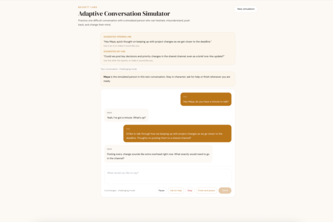
Beckett is a self-reported adaptive conversation simulator for neurodivergent workers, built using GPT-5.6 and other AI technologies. The project was submitted by a single founder, Sloane Oxley-Barnes, as part of the OpenAI 2026 hackathon. It aims to help users rehearse workplace conversations in a private, adaptive environment that simulates realistic interpersonal dynamics.
The description states Beckett is designed for neurodivergent workers who struggle with workplace communication due to unclear expectations and emotional uncertainty. It allows users to practice scenarios through text or phone calls, with GPT-5.6 maintaining an evolving model of the simulated person’s state and offering optional coaching nudges.
Key claims include:
- Beckett helps users rehearse conversations before real interactions.
- The system uses GPT-5.6 for reasoning and conversation simulation.
- It supports both text and phone modes, with distinct technical implementations.
- Coaching is private and optional, aiming to guide without controlling.
The single most important open question is: What is the actual commercial viability of this product, given that it appears to be a prototype or proof-of-concept built for a hackathon?
There is no evidence of revenue, customers, traction, or any business model beyond the author’s own description. The project has not been independently verified.
What The Product Actually Is
The description states Beckett is an adaptive conversation simulator for neurodivergent workers. It allows users to:
- Describe a scenario involving another person (e.g., colleague, manager).
- Set goals, concerns, relationship context, communication styles, and constraints.
- Practice the conversation through either text or phone call.
During the simulation:
- GPT-5.6 maintains an evolving model of the simulated person’s state (goals, concerns, defensiveness, trust, openness).
- It can offer a private coaching nudge when a clearer next move would help.
- At the end, Beckett provides a debrief with turning points, resistance analysis, goal progress, and practical guidance.
The product is described as:
- A dedicated GPT-5.6 extension, built using Codex.
- Supporting both text and phone modes.
- Using Realtime for audio handling in phone mode.
- Built with technologies including Next.js, React, Supabase, PostgreSQL, TailwindCSS, Vercel, TypeScript, OpenAI, and GPT-5.6.
Inference: The product appears to be a prototype or hackathon submission, not a commercial product. There is no evidence of deployment, user base, or monetization.
Positioning & Claim Evolution
The description states Beckett’s goal is:
“to help them rehearse, notice what is changing in the conversation, and enter the real interaction with more clarity and control.”
It also says:
“The goal is not to tell someone what to say or replace their judgment.”
This positioning emphasizes supportive practice, adaptive realism, and user autonomy. It positions Beckett as a tool for neurodivergent workers who struggle with workplace communication.
There is no indication of broader market expansion, branding beyond the hackathon, or evolution from prototype to product.
Inference: The positioning is narrow and focused on neurodivergence, but there is no evidence of how this might scale or be positioned in a commercial context beyond the author’s own narrative.
Target Customer & ICP
The description states:
“For neurodivergent workers, that uncertainty can make already high-stakes conversations even harder to prepare for.”
It also says:
“Beckett is an adaptive conversation simulator for neurodivergent workers.”
Target customer: Neurodivergent workers in workplace settings who struggle with communication dynamics.
ICP (Ideal Customer Profile): Not explicitly defined beyond the stated audience. No segmentation or persona details are provided.
Inference: The ICP is not clearly articulated, and there is no evidence of market research or user testing beyond the author’s own experience.
Business Model & Pricing Evidence
The description does not state:
- Whether Beckett will be offered as a freemium, subscription, or one-time purchase.
- If pricing exists or how it would be structured.
- If there are plans for monetization or revenue streams beyond the hackathon submission.
There is no mention of:
- B2B vs. B2C.
- Enterprise licensing.
- Usage-based or tiered pricing.
Inference: No business model or pricing evidence is provided. The product is described as a prototype, not a commercial offering.
Technical & Delivery Signals
The description states Beckett was built using:
- Codex for building the GPT-5.6 conversation simulator.
- GPT-5.6 as the reasoning layer.
- Realtime for phone call audio handling.
- Next.js, React, Supabase, PostgreSQL, TailwindCSS, Vercel, TypeScript, and other tech stack components.
Technical implementation:
- In text mode, GPT-5.6 generates replies and maintains conversation state.
- In phone mode, Realtime handles live speech, while GPT-5.6 evaluates exchanges and guides the simulation.
- The system separates live interaction from reasoning layer to maintain adaptivity.
Inference: The technical architecture is described in detail but not validated or tested beyond prototype status. No evidence of production-grade delivery or scalability.
Traction & Maturity Signals
The description states:
- Beckett was built for the OpenAI 2026 hackathon.
- It was submitted by a single founder, Sloane Oxley-Barnes.
- There is no mention of:
- Users or customers.
- Revenue or monetization.
- Product adoption or usage metrics.
- Any form of market validation.
Inference: No traction or maturity signals are evident. The project appears to be a prototype or proof-of-concept, not a product in use.
Competitive Context
The description does not mention:
- Competitors.
- Similar tools or platforms.
- Market size or landscape.
- Prior art in conversation coaching or AI-powered practice tools.
There is no evidence of competitive analysis or positioning against existing solutions.
Inference: No competitive context is provided. The project appears to be a standalone idea, not part of an existing market.
Open Questions & Risks
Key risks and open questions based on the description:
- Prototype only: Built for a hackathon; no evidence of commercial viability or product-market fit.
- No traction or revenue: No customers, users, or monetization strategy.
- Unproven market demand: No evidence of user research or validation beyond the author’s own experience.
- High technical complexity without verification: GPT-5.6 and Realtime integration are described but not tested in real-world use.
- Single founder: No team or support structure for scaling or product development.
Inference: The project is a self-contained idea with no evidence of commercial readiness or market traction.
Questions the description leaves open
- What is the intended target market beyond neurodivergent workers? Is there any evidence of broader demand?
- Has the prototype been tested with real users, and what feedback was received?
- Are there plans to monetize Beckett, and if so, how?
- How does Beckett differentiate from existing tools for communication coaching or AI practice?
- What are the technical limitations of GPT-5.6 in maintaining realistic conversation dynamics?
- Is there a roadmap for product development beyond this prototype?
- What is the long-term vision for scaling or deploying Beckett?
Overall Assessment
The description states that Beckett was built as part of a hackathon submission and is not independently verified.
Assessment: Not evidenced.
There is no evidence to support:
- Commercial viability.
- Product-market fit.
- Revenue or customer traction.
- Scalability or long-term strategy.
This project appears to be a self-contained prototype, not a commercial product. It lacks any evidence of business development, user adoption, or monetization.
Inference: The project is not ready for investment or partnership at this stage. It may represent an idea worth exploring further, but it does not meet the criteria for due-diligence readiness.
User Stories BotA demo video on every pull request
Get a demo video on every new feature
GitHub App that watches your pull requests and records a narrated, captioned demo.
Save time on demo prep and make informed decisions faster with a video walkthrough of every new feature.
Source
Submitted to the OpenAI 2026 hackathon on Devpost. Project home on Devpost. Back to the full gallery on Devpost.
This competitive analysis was produced by top-founders.com (opens in a new tab)
Generated by a language model from this project's public Devpost page — its tagline, the author's own write-up and any built-with tags listed there — as captured in August 2026. Short quotations are the author's words. It is an opinion on the idea as a business, not on the people behind it, and it reflects the description as published then. If the project has moved on, request a correction below. The analysis is not independent research and contains no verified traction, revenue or customer data.
An independent guide by KFG International LLC — not affiliated with, endorsed by, or connected to Devpost or OpenAI.