

Archive position — measured, not model output
0 likes on Devpost
2,263 of the 7,850 archived projects have more likes, and 5,587 share exactly 0 — so this project's #2,896 place in the like-ranked listing is a tie-break inside that group, not a ranking.
Projects (log scale)
Likes on Devpost. ▲ marks this project's group.
Show the figures
| Likes | Projects | Share of archive |
|---|---|---|
| 0 | 5,587 | 71.2% |
| 1 | 1,758 | 22.4% |
| 2 | 284 | 3.6% |
| 3–4 | 132 | 1.7% |
| 5–9 | 75 | 1.0% |
| 10+ | 14 | 0.2% |
 User Stories BotA demo video on every pull request
Get a demo video on every new feature
GitHub App that watches your pull requests and records a narrated, captioned demo.
Save time on demo prep and make informed decisions faster with a video walkthrough of every new feature.
Executive Summary
What the company appears to be
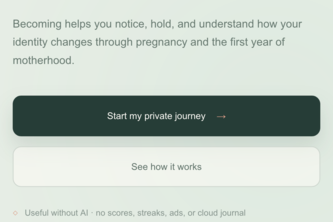
Becoming is a self-reported privacy-first AI identity companion for pregnancy and postpartum, designed to help users reflect on their evolving identity during these life transitions. It allows users to journal, record voice moments, and explore tentative identity connections through explainable AI interpretations — all while maintaining strict control over data privacy and AI usage.
What changed
The project description is a self-reported submission from a hackathon entry (OpenAI 2026). No prior version or evolution is described. It is presented as an initial prototype or proof-of-concept, not a product in market.
Single most important open question
Is there any evidence of user adoption, revenue, or traction beyond the author’s own description? The self-reported nature of the project and its hackathon origin suggest it has not yet reached commercial viability or market validation.
What The Product Actually Is
The description states that Becoming is a privacy-first AI identity companion for pregnancy and postpartum. It offers:
- Private journaling (text, voice)
- Encrypted device storage
- Identity connection interpretation using AI
- A “Just hold this” mode to exclude entries from analysis
- Ephemeral companion conversations with three modes: listen, reflect gently, help explore
- Safety features that detect serious-harm language and redirect users to support
It is built as a local-first application, meaning data stays on the device unless explicitly shared. AI interpretation uses GPT-5.6 but is optional and explainable.
Inference The product is not a general-purpose journaling app or wellness tracker, but rather one focused on identity reflection during a specific life phase (pregnancy/postpartum), with strong emphasis on privacy and user control.
Positioning & Claim Evolution
The description states:
- “Most pregnancy apps track the baby. Becoming helps the mother remain visible to herself.”
- The app is positioned as an identity companion, not a mood tracker or symptom monitor.
- It emphasizes that motherhood is an identity transition, not just a physical one.
Inference The positioning evolved from a niche need — helping mothers reflect on identity during pregnancy and postpartum — to a product that supports personal narrative, autonomy, and emotional processing. This is framed as a counterpoint to mainstream apps that overlook the mother’s inner experience.
Target Customer & ICP
The description states:
- The target audience is people becoming mothers, specifically those in pregnancy or postpartum.
- It focuses on identity transition, not general wellness or symptom tracking.
Inference The ICP appears to be women (or individuals) going through pregnancy and early motherhood, who are seeking a tool that supports introspection and emotional processing. It is not described as targeting fathers, partners, or broader demographics.
Business Model & Pricing Evidence
The description does not provide any information on:
- Revenue model
- Pricing strategy
- Monetization approach
- Subscription plans or freemium structure
Not evidenced.
Technical & Delivery Signals
The description states:
- Built with: codex, gpt, nextjs, node.js, openai, react, vinext, vite
- Uses GPT-5.6 as an identity relationship interpreter
- Supports local-first storage, including:
- Tab-only mode
- Encrypted device vault (AES-GCM encryption)
- AI is optional and explainable
- Companion conversations are ephemeral and not added to journal unless explicitly allowed
- Includes safety boundaries for detecting serious-harm language
Inference The technical stack suggests a modern, privacy-conscious web application. The use of local-first design and encryption indicates a strong focus on user data control.
Traction & Maturity Signals
The description states:
- This is a hackathon submission
- Team size: 0
- No mention of:
- Customers
- Revenue
- Users
- Product usage metrics
- Market traction or adoption
Not evidenced.
Competitive Context
The description does not reference:
- Competitors
- Existing apps in the pregnancy/postpartum space
- Market positioning relative to others
Not evidenced.
Open Questions & Risks
- No team or traction: The project is described as a hackathon submission with no team or commercial history.
- Unproven market demand: No evidence of user adoption, feedback, or market validation.
- AI dependency without clarity on scalability: While AI is used for interpretation, it is optional and explainable — but the long-term viability of this approach is unclear.
- Privacy model may be difficult to scale: The local-first, encrypted approach could complicate data aggregation or product improvements at scale.
- No commercialization path described: No roadmap, monetization strategy, or go-to-market plan.
Questions the description leaves open
- What is the intended path from this prototype to a commercial product?
- Are there any early users or feedback loops beyond the hackathon?
- How will the product scale beyond the current privacy-first, local-first model?
- What are the plans for monetization or revenue generation?
- Is there any intention to expand beyond pregnancy and postpartum identity support?
Overall Assessment
Not evidenced.
The project is described as a hackathon submission, with no evidence of traction, revenue, or commercial viability. It is not clear whether the founders intend to build a product beyond this prototype.
Given the self-reported nature of the description and lack of any external validation, there is insufficient basis for an investment or partnership decision at this stage. The project appears to be in early conceptual or prototyping phase, with no demonstrated market or commercial readiness.
User Stories BotA demo video on every pull request
Get a demo video on every new feature
GitHub App that watches your pull requests and records a narrated, captioned demo.
Save time on demo prep and make informed decisions faster with a video walkthrough of every new feature.
Source
Submitted to the OpenAI 2026 hackathon on Devpost. Project home on Devpost. Back to the full gallery on Devpost.
This competitive analysis was produced by top-founders.com (opens in a new tab)
Generated by a language model from this project's public Devpost page — its tagline, the author's own write-up and any built-with tags listed there — as captured in August 2026. Short quotations are the author's words. It is an opinion on the idea as a business, not on the people behind it, and it reflects the description as published then. If the project has moved on, request a correction below. The analysis is not independent research and contains no verified traction, revenue or customer data.
An independent guide by KFG International LLC — not affiliated with, endorsed by, or connected to Devpost or OpenAI.