

Archive position — measured, not model output
0 likes on Devpost
2,263 of the 7,850 archived projects have more likes, and 5,587 share exactly 0 — so this project's #2,898 place in the like-ranked listing is a tie-break inside that group, not a ranking.
Projects (log scale)
Likes on Devpost. ▲ marks this project's group.
Show the figures
| Likes | Projects | Share of archive |
|---|---|---|
| 0 | 5,587 | 71.2% |
| 1 | 1,758 | 22.4% |
| 2 | 284 | 3.6% |
| 3–4 | 132 | 1.7% |
| 5–9 | 75 | 1.0% |
| 10+ | 14 | 0.2% |
 User Stories BotA demo video on every pull request
Get a demo video on every new feature
GitHub App that watches your pull requests and records a narrated, captioned demo.
Save time on demo prep and make informed decisions faster with a video walkthrough of every new feature.
Executive Summary
What the company appears to be
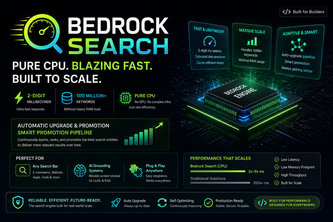
Bedrock Search is a self-reported plug-and-play autocomplete engine built for developers. The author states it uses deterministic search algorithms combined with optional GPT-5.6 enhancements to deliver fast, scalable search suggestions. It is described as deployable via Docker and integrates through REST APIs.
What changed
This project was submitted to the OpenAI 2026 hackathon by a single developer (Mayank Dwivedi), who describes building an end-to-end autocomplete system from scratch using Go, Fiber, and AI tools like Codex and GPT-5.6.
Single most important open question
Is there any evidence of actual usage or adoption beyond the author's own development work?
What The Product Actually Is
The description states that Bedrock Search is a high-performance autocomplete engine designed for developers, intended to simplify building fast, scalable search into applications. It includes:
- A REST API for integration
- An administrative dashboard
- Support for CSV data ingestion
- Adaptive Trie-based caching
- Disk-backed indexing
- Optional GPT-5.6-powered suggestion enhancement
The system is built in Go, uses the Fiber framework, and supports Docker deployment.
It claims to support prefix search over millions of entries, with capabilities such as:
- Search analytics
- Multi-dataset support
- Admin tools for dataset management
Inferred: The product is described as a developer tool, not a consumer-facing application.
Positioning & Claim Evolution
The author positions Bedrock Search as a plug-and-play solution that allows developers to avoid reinventing search infrastructure. It is framed as an alternative to complex, custom-built autocomplete systems.
Key claims:
- “Instead of every team reinventing search, developers can simply plug Bedrock Search into their existing products and immediately deliver a better search experience.”
- “We use AI where it adds real value: improving search quality, understanding user intent, and making integration easier for developers.”
The positioning evolves from a developer tool to a scalable infrastructure component, with an emphasis on AI-enhanced UX without sacrificing performance or determinism.
Inferred: The author sees Bedrock Search as a way to democratize high-quality search by combining traditional engineering with AI.
Target Customer & ICP
The description states that Bedrock Search is built for:
- Developers
- Organizations needing fast, scalable search
It is said to power applications such as:
- SaaS platforms
- E-commerce stores
- Documentation portals
- Enterprise applications
- Internal knowledge bases
- AI assistants
- Developer tools
Inferred: The target ICP appears to be technical teams or individual developers who need to add search functionality to their products, especially those with high performance and scalability needs.
Not evidenced: No specific customer segments, personas, or use cases beyond general application types are provided.
Business Model & Pricing Evidence
The description does not state a business model or pricing structure. It only mentions:
- A REST API
- An admin dashboard
- Support for bulk CSV import
Inferred: The product is likely intended to be sold as a developer tool, possibly via a SaaS or licensing model, but no details are given.
Not evidenced: No revenue streams, pricing tiers, monetization strategy, or customer acquisition plans are mentioned.
Technical & Delivery Signals
The author reports:
- Built in Go using the Fiber web framework
- Uses adaptive Trie-based caching
- Implements disk-backed indexing
- Supports CSV import pipeline
- Integrates with GPT-5.6 as an optional enhancement layer
- Delivered via Docker containerization
- Uses Codex for development acceleration
Inferred: The system is built with performance and scalability in mind, using deterministic algorithms with optional AI enhancements.
Not evidenced: No details on actual performance benchmarks, latency metrics, or deployment environments beyond Docker.
Traction & Maturity Signals
The description states that this was a hackathon project submitted to the OpenAI 2026 hackathon. It includes:
- A working prototype
- Full API and dashboard functionality
- Docker-based deployment
- Use of AI tools (Codex, GPT-5.6)
Inferred: The product is at an early stage — likely a proof-of-concept or MVP.
Not evidenced:
- No customer base
- No revenue data
- No user feedback or adoption metrics
- No production usage or performance data
Competitive Context
The description does not mention any competitors directly. However, it implies that Bedrock Search competes in the autocomplete/search infrastructure space, which includes:
- Traditional search engines (e.g., Elasticsearch, Algolia)
- Developer tools for search (e.g., Meilisearch, Typesense)
- AI-enhanced search platforms
Inferred: The product positions itself as a hybrid of traditional search and modern AI, targeting developers who want both speed and intelligence.
Not evidenced:
- No competitive analysis
- No market sizing or positioning against existing players
- No differentiation from similar tools
Open Questions & Risks
- Single-founder project: Only one member listed (Mayank Dwivedi), suggesting limited team capacity.
- No traction or revenue evidence: The product is described as a hackathon submission with no real-world usage.
- Unverified AI claims: GPT-5.6 is used optionally, but the description does not show how it improves quality or whether it’s actually functional.
- Lack of commercialization strategy: No mention of monetization, pricing, or go-to-market plans.
- Unclear scalability assumptions: While it supports millions of entries, no data on actual limits or performance under load.
Questions the description leaves open
- What is the current status of the product? Is it in production use anywhere?
- How does Bedrock Search compare to existing tools like Algolia or Elasticsearch in terms of performance and ease of integration?
- Can you provide examples of how GPT-5.6 improves search quality in practice?
- Are there any real-world users or pilot customers?
- What is the plan for monetization and customer acquisition?
- How does the adaptive Trie cache scale with increasing data volume?
- Has the team considered distributed deployment or clustering?
- What are the key assumptions about developer demand for this tool?
Overall Assessment
The description indicates that Bedrock Search is a self-reported hackathon project by one developer, with no evidence of traction, revenue, or customer adoption.
Inferred: At this stage, it appears to be an early-stage prototype, possibly with potential for growth if further developed and validated in the market.
Not evidenced:
- No financials
- No user data
- No competitive positioning
- No roadmap execution history
Assessment: Not ready for investment or partnership at this time. The project shows technical capability but lacks commercial evidence. It may be worth revisiting once there is a clear path to traction and product-market fit.
User Stories BotA demo video on every pull request
Get a demo video on every new feature
GitHub App that watches your pull requests and records a narrated, captioned demo.
Save time on demo prep and make informed decisions faster with a video walkthrough of every new feature.
Source
Submitted to the OpenAI 2026 hackathon on Devpost. Project home on Devpost. Back to the full gallery on Devpost.
This competitive analysis was produced by top-founders.com (opens in a new tab)
Generated by a language model from this project's public Devpost page — its tagline, the author's own write-up and any built-with tags listed there — as captured in August 2026. Short quotations are the author's words. It is an opinion on the idea as a business, not on the people behind it, and it reflects the description as published then. If the project has moved on, request a correction below. The analysis is not independent research and contains no verified traction, revenue or customer data.
An independent guide by KFG International LLC — not affiliated with, endorsed by, or connected to Devpost or OpenAI.