

Archive position — measured, not model output
0 likes on Devpost
2,263 of the 7,850 archived projects have more likes, and 5,587 share exactly 0 — so this project's #2,895 place in the like-ranked listing is a tie-break inside that group, not a ranking.
Projects (log scale)
Likes on Devpost. ▲ marks this project's group.
Show the figures
| Likes | Projects | Share of archive |
|---|---|---|
| 0 | 5,587 | 71.2% |
| 1 | 1,758 | 22.4% |
| 2 | 284 | 3.6% |
| 3–4 | 132 | 1.7% |
| 5–9 | 75 | 1.0% |
| 10+ | 14 | 0.2% |
 User Stories BotA demo video on every pull request
Get a demo video on every new feature
GitHub App that watches your pull requests and records a narrated, captioned demo.
Save time on demo prep and make informed decisions faster with a video walkthrough of every new feature.
Executive Summary
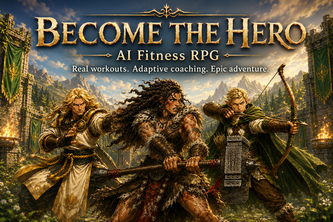
What the company appears to be: A self-developed, AI-powered fitness RPG built by a single founder (Josh Miller) as a hackathon project. The app combines real-world workout logging with fantasy narrative progression, where physical activity strengthens an in-game avatar through an AI coach that personalizes training plans.
What changed: The project evolved from an idea into a playable 21-day demo during OpenAI Build Week. It includes core gameplay elements like workout tracking, character progression, turn-based battles, and an integrated AI coach that generates personalized fitness plans based on user input.
Single most important open question: Is there evidence of traction or commercial viability beyond the single developer's personal use and hackathon deployment?
What The Product Actually Is
The description states that Become the Hero is:
- An AI-powered fitness RPG
- A fantasy-themed app where real-world workouts strengthen a fantasy hero
- A 21-day story arc with a village defense theme
- A system that logs workouts, tracks character stats, and unlocks abilities
- Integrated with an AI coach that creates personalized training plans
- Deployed using React/Vite frontend, Supabase backend, OpenAI API, and Vercel deployment
The author claims the app includes:
- Workout logging and progressive overload
- Character progression and unlockable abilities
- Turn-based battles
- Dialogue and relationship development
- Village upgrades
- Equipment, treasure, and rewards
- Voice performances
- Online competitions
- A personalized AI training coach
Evidence: Self-reported by author. No independent verification or data on actual usage.
Positioning & Claim Evolution
The description states:
- The app was inspired by the lack of immersive narrative in existing fitness apps
- It combines fitness with role-playing game storytelling
- The core fantasy draws from anime and fantasy stories where ordinary people become heroes
- The AI coach frames real-world training as preparation for game-world dangers
- The player's hero grows stronger through actual physical activity, not just gameplay
Inference: The positioning appears to be a hybrid of gamification and fitness motivation, targeting users who enjoy narrative-driven experiences and want their workouts to feel meaningful.
Evidence: Self-reported claims about inspiration and design intent. No evidence of market research or user feedback.
Target Customer & ICP
The description states:
- The app targets people interested in both working out and story-driven RPGs
- Users who want their fitness routine to move a meaningful story forward
- People looking for an immersive experience that connects real-world effort with game progression
Inference: Likely appeals to niche audiences: gamers, fitness enthusiasts, and those seeking narrative engagement in health apps.
Evidence: Self-reported claims about target audience. No data on actual users or market segmentation.
Business Model & Pricing Evidence
The description states:
- The app is currently a demo with no pricing information
- It includes features like online competitions and multiplayer systems
- Future expansion plans include guilds, more story arcs, and combat mechanics
Evidence: No pricing structure, monetization model, or revenue streams mentioned. The project is described as a hackathon demo.
Technical & Delivery Signals
The description states:
- Built with React, Vite, Supabase, OpenAI API, ElevenLabs, and ChatGPT/Codex
- Uses structured outputs from OpenAI Responses API
- AI coach selects from an approved catalog of exercises and programs
- Application code validates every plan before reaching the player
- Separation between AI reasoning and deterministic enforcement
Inference: The technical architecture shows deliberate design to balance personalization with safety and predictability.
Evidence: Self-reported technical details. No evidence of scalability, performance metrics, or production readiness.
Traction & Maturity Signals
The description states:
- The app was playable before the hackathon
- It includes a fully functioning 21-day opening arc
- The author has been beta testing with personal workouts
- Future plans include expanding to four additional 21-day arcs
- Multiplayer features are planned for expansion
Evidence: Playable demo, personal use, and roadmap. No evidence of user base, downloads, or engagement metrics.
Competitive Context
The description states:
- Hundreds of apps track workouts and recommend exercises
- A handful add light game mechanics
- There is no known app built around a true immersive narrative where workouts advance the story
Inference: The product positions itself as filling a gap in the market for narrative-driven fitness experiences.
Evidence: Self-reported competitive analysis. No data on competitors or market size.
Open Questions & Risks
- Single-founder development: The entire project was built by one person (Josh Miller), which raises questions about scalability and long-term maintenance.
- No commercial traction: There is no evidence of revenue, users, or adoption beyond the author’s personal use.
- Unverified claims: All descriptions are self-reported and unverified; there is no third-party validation.
- Limited scope: The current demo only covers a 21-day arc, with future expansion plans not yet realized.
- AI dependency: Heavy reliance on AI tools for development may create fragility if those tools change or become unavailable.
Questions the description leaves open
- What is the actual user base beyond personal testing?
- How do you plan to monetize this product, and what pricing model are you considering?
- Are there any plans to scale beyond a single developer?
- How do you intend to validate the AI-generated training plans for safety and efficacy?
- What are the key challenges in expanding from 21-day arcs to longer-form content?
- Have you considered how to handle user data privacy and security?
- What is your roadmap for building out multiplayer features and guild systems?
Overall Assessment
Not evidenced: There is no evidence of revenue, customers, or traction beyond the author’s personal development and demo deployment.
Confidence level: Low. The project is described as a hackathon demo with no commercial validation or market data.
Assessment: This appears to be an experimental, self-developed prototype with limited commercial viability at this stage. It lacks evidence of product-market fit, revenue, or scalable business model. Any investment or partnership would require further demonstration of traction and commercial potential.
User Stories BotA demo video on every pull request
Get a demo video on every new feature
GitHub App that watches your pull requests and records a narrated, captioned demo.
Save time on demo prep and make informed decisions faster with a video walkthrough of every new feature.
Source
Submitted to the OpenAI 2026 hackathon on Devpost. Project home on Devpost. Back to the full gallery on Devpost.
This competitive analysis was produced by top-founders.com (opens in a new tab)
Generated by a language model from this project's public Devpost page — its tagline, the author's own write-up and any built-with tags listed there — as captured in August 2026. Short quotations are the author's words. It is an opinion on the idea as a business, not on the people behind it, and it reflects the description as published then. If the project has moved on, request a correction below. The analysis is not independent research and contains no verified traction, revenue or customer data.
An independent guide by KFG International LLC — not affiliated with, endorsed by, or connected to Devpost or OpenAI.