

Archive position — measured, not model output
0 likes on Devpost
2,263 of the 7,850 archived projects have more likes, and 5,587 share exactly 0 — so this project's #2,888 place in the like-ranked listing is a tie-break inside that group, not a ranking.
Projects (log scale)
Likes on Devpost. ▲ marks this project's group.
Show the figures
| Likes | Projects | Share of archive |
|---|---|---|
| 0 | 5,587 | 71.2% |
| 1 | 1,758 | 22.4% |
| 2 | 284 | 3.6% |
| 3–4 | 132 | 1.7% |
| 5–9 | 75 | 1.0% |
| 10+ | 14 | 0.2% |
 User Stories BotA demo video on every pull request
Get a demo video on every new feature
GitHub App that watches your pull requests and records a narrated, captioned demo.
Save time on demo prep and make informed decisions faster with a video walkthrough of every new feature.
Executive Summary
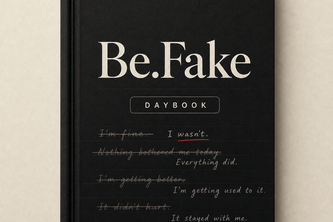
Be.Fake is a self-contained, single-page web application built as a satirical artwork for the OpenAI 2026 hackathon. The author describes it as an "ordinary private diary" whose story quietly becomes kinder, more rational, and more heroic over time — without user awareness or explanation. It operates entirely in-browser using local storage, with no backend, API keys, or external services required.
The product is a deterministic, local transformation of journal entries based on elapsed time (Today, 7, 14, 30, or 60 days), where the original entry remains immutable while the displayed version changes. The experience is designed to explore how AI might edit memory and self-image quietly — not through explicit explanation but through feeling.
The description states that Be.Fake is a React 19 + TypeScript application built with Vite, using browser local storage for data persistence and Vitest for testing. It includes no runtime AI or external dependencies beyond the browser environment.
Key commercial due-diligence question: Is this project intended to be a product, or is it purely artistic? If it's a product, what is its commercial model and how does it intend to scale?
What The Product Actually Is
The description states that Be.Fake is a React 19 + TypeScript single-page application built with Vite. It uses browser local storage, service workers, and web app manifest for offline behavior and installation.
It functions as a private journaling tool where:
- Users create entries stored locally.
- The displayed version of each entry changes over time (based on elapsed days: Today, 7, 14, 30, or 60).
- The original entry is preserved and never replaced.
- A Settings page reveals the canonical source, the currently displayed wording, and a word-level diff.
The application has two modes:
- Normal mode: behaves like an ordinary diary.
- Demo mode (
?demo=1): exposes controls to inspect transformations directly.
There is no backend, no API key, no analytics, no account system, and no journal-text upload in the submitted build.
The transformation pipeline is deterministic and local, relying on no external AI or cloud services. The author notes that Codex and GPT-5.6 were used during development but are not part of the runtime application.
Positioning & Claim Evolution
The description states that Be.Fake is an experimental satirical artwork submitted to the OpenAI 2026 hackathon. It explores a future where AI may edit memory and self-image quietly — not through explanation, but through the feeling of returning to a journal that now tells a more convenient story.
It is described as:
- A critique of how software summarizes personal archives.
- An exploration of memory distortion and self-protection mechanisms.
- A product that expresses its critique through behavior, not static explanation.
The positioning is clearly artistic and conceptual, not commercial. The author emphasizes that it is not intended for therapy, mental-health care, factual records, testimony, or evidence preservation.
There is no claim of a business model, monetization strategy, or product-market fit beyond its role as a hackathon submission.
Target Customer & ICP
The description does not state a specific customer base or ideal customer profile (ICP). It describes the experience as personal and private, aimed at individuals who might journal or reflect on their lives.
It is implied that the target audience includes:
- People interested in memory, identity, and self-perception.
- Developers or users of journaling tools.
- Those engaged with AI ethics and personal data.
However, there is no evidence of market research, user personas, or customer segmentation. The product is described as a personal tool, not a scalable service for a defined group.
Business Model & Pricing Evidence
The description does not provide any information about a business model or pricing strategy.
It is explicitly stated that:
- There is no backend.
- There are no API keys, analytics, or account systems.
- The application is free to use, with no monetization in the submitted build.
There is no evidence of revenue streams, subscriptions, or paid features. The project is described as a satirical artwork, not a commercial product.
Technical & Delivery Signals
The description states that Be.Fake is built using:
- React 19
- TypeScript
- Vite
- Vitest for testing
- Browser local storage
- Service worker and web app manifest
It uses:
- A pure local transformation pipeline
- The diff package to show differences between original and displayed versions
- No runtime AI or external API integrations
The application is designed to be:
- Offline-capable
- Deterministic
- Storage-neutral
- Interruptible
- Accessible
Testing instructions are provided, including:
- Local verification steps
- Use of Vitest for automated testing
- No API keys or server setup required
Traction & Maturity Signals
The description does not provide any evidence of traction, customers, or adoption.
It is stated that:
- The project was submitted to a hackathon
- It is an experimental satirical artwork
- There is no revenue, no customers, and no product-market fit data
There are no metrics, usage statistics, or user feedback. The application is described as scope-frozen and not intended for production use.
Competitive Context
The description does not provide any information about competitors or market positioning.
It is stated that Be.Fake is a satirical artwork, not a commercial product, so there is no direct competitive landscape to analyze.
However, it touches on themes related to:
- Memory and identity tools
- AI editing of personal content
- Privacy-preserving journaling apps
These areas may have existing or potential competitors, but the description does not name any.
Open Questions & Risks
The description states that Be.Fake is an experimental satirical artwork, not a commercial product. This raises several risks:
- No commercial intent: The project is not intended to be a product, which may limit its investment or partnership potential.
- No monetization strategy: There is no evidence of any revenue model or path to profitability.
- Artistic vs. Product confusion: If the founders are considering turning this into a product, it’s unclear whether they have a clear plan for doing so.
- Limited scalability: The application is designed for local use only and has no backend or cloud infrastructure.
Questions the description leaves open
- Is Be.Fake intended to be a commercial product in the future, or is it purely artistic?
- If commercial, what is the intended business model and monetization strategy?
- What are the founders' plans for scaling or expanding the product beyond its current scope?
- Are there any plans to integrate AI or external services into the product?
- How would the team handle privacy concerns if this were to become a real product?
- Is there a roadmap for future development beyond the current scope?
Overall Assessment
The description states that Be.Fake is an experimental satirical artwork submitted to a hackathon and not intended for therapy, mental-health care, factual records, testimony, or evidence preservation.
There is no evidence of commercial traction, revenue, customers, or product-market fit. The project is described as a conceptual tool, not a product with a defined business model.
If the founders are considering turning this into a product, further diligence would be needed to assess:
- Commercial viability
- Market demand
- Scalability
- Monetization strategy
As it stands, Be.Fake is not evidenced as a commercial opportunity. It is a conceptual and artistic exploration, not a product ready for investment or partnership.
User Stories BotA demo video on every pull request
Get a demo video on every new feature
GitHub App that watches your pull requests and records a narrated, captioned demo.
Save time on demo prep and make informed decisions faster with a video walkthrough of every new feature.
Source
Submitted to the OpenAI 2026 hackathon on Devpost. Project home on Devpost. Back to the full gallery on Devpost.
This competitive analysis was produced by top-founders.com (opens in a new tab)
Generated by a language model from this project's public Devpost page — its tagline, the author's own write-up and any built-with tags listed there — as captured in August 2026. Short quotations are the author's words. It is an opinion on the idea as a business, not on the people behind it, and it reflects the description as published then. If the project has moved on, request a correction below. The analysis is not independent research and contains no verified traction, revenue or customer data.
An independent guide by KFG International LLC — not affiliated with, endorsed by, or connected to Devpost or OpenAI.