

Archive position — measured, not model output
0 likes on Devpost
2,263 of the 7,850 archived projects have more likes, and 5,587 share exactly 0 — so this project's #2,890 place in the like-ranked listing is a tie-break inside that group, not a ranking.
Projects (log scale)
Likes on Devpost. ▲ marks this project's group.
Show the figures
| Likes | Projects | Share of archive |
|---|---|---|
| 0 | 5,587 | 71.2% |
| 1 | 1,758 | 22.4% |
| 2 | 284 | 3.6% |
| 3–4 | 132 | 1.7% |
| 5–9 | 75 | 1.0% |
| 10+ | 14 | 0.2% |
 User Stories BotA demo video on every pull request
Get a demo video on every new feature
GitHub App that watches your pull requests and records a narrated, captioned demo.
Save time on demo prep and make informed decisions faster with a video walkthrough of every new feature.
Executive Summary
What the company appears to be
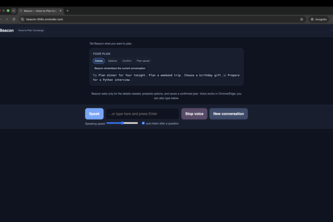
Beacon — Voice-to-Plan Concierge is a self-reported voice-first AI assistant that turns spoken goals into guided, auditable plans through conversational interaction. It is built as a single-developer project for the OpenAI 2026 hackathon and uses a provider-agnostic LLM layer.
What changed
The description does not indicate any prior version or evolution of the product; it is presented as a new submission to a hackathon.
Single most important open question
Is there evidence that Beacon has been tested with users beyond its developer, and whether it can scale beyond a hackathon prototype?
What The Product Actually Is
The description states that Beacon is a voice-to-plan concierge, which:
- accepts spoken or typed goals;
- identifies planning domains such as dining, travel, gifting, study, and open-ended tasks;
- collects missing details through short voice-friendly questions;
- presents three transparent plan options;
- requires an explicit “yes” before saving a final plan receipt;
- supports PDF receipt downloads and retains recent sessions in SQLite;
- always honours “bye” and “stop” through deterministic code, even if the LLM is unavailable.
Inference The product is a conversational AI assistant designed to help users plan tasks via voice or text, with an emphasis on structured output, explicit confirmation, and session persistence.
Positioning & Claim Evolution
The author states that Beacon was built to make voice interaction feel more practical, by:
- remembering context;
- asking only useful questions;
- reaching a clear decision;
- keeping an auditable record.
It is positioned as a tool for real-world tasks such as planning trips, choosing gifts, preparing for interviews, or organizing events. The product claims to move beyond standard AI assistants that answer one prompt and stop.
Inference Beacon positions itself as a practical, conversational planning assistant, with an emphasis on usability, clarity, and accountability in voice-based interactions.
Target Customer & ICP
The description does not identify specific customer segments or personas. It only mentions that Beacon is intended for tasks such as:
- planning a trip;
- choosing a gift;
- preparing for an interview;
- organizing an event.
Inference The target user appears to be someone who needs help with structured planning and prefers voice interaction, but no explicit ICP (Ideal Customer Profile) is defined.
Business Model & Pricing Evidence
There is no evidence of a business model or pricing strategy in the description. The product is presented as a hackathon submission.
Inference No commercial model or pricing information is provided; this is an unverified claim.
Technical & Delivery Signals
The author states that Beacon was built with:
- Frontend: HTML, CSS, JavaScript, Web Speech API
- Backend: Python, SQLite
- LLM Layer: provider-agnostic (supports Gemini, Groq, OpenAI, Anthropic, DeepSeek, Ollama, etc.)
- Deployment: Docker service on Render
It includes safeguards for:
- speech cancellation;
- fresh-session handling;
- polling safeguards;
- deterministic exit detection.
Inference The technical stack is minimal and hackathon-grade. It uses open-source tools and supports multiple LLM providers but lacks evidence of production-grade reliability or scalability.
Traction & Maturity Signals
The description does not provide any traction data, customer feedback, or usage metrics. It is a single-developer hackathon project with no mention of users, adoption, or revenue.
Inference No evidence of traction or product maturity beyond the prototype stage.
Competitive Context
The description does not reference competitors or market positioning beyond stating that most AI assistants answer one prompt and stop. There is no mention of existing solutions in the voice planning or conversational AI space.
Inference No competitive analysis or differentiation strategy is evident; the author does not describe how Beacon compares to other tools.
Open Questions & Risks
- The product is a single-developer hackathon submission, with no evidence of team, funding, or traction.
- It is not verified as functional beyond its developer’s environment.
- No commercial model, pricing, or customer data are provided.
- The use of SQLite for session storage suggests limited scalability.
- The claim that it works with multiple LLM providers may be aspirational without evidence of integration or performance consistency.
Questions the description leaves open
- What is the intended user base and how did you validate the need for this product?
- How does Beacon handle edge cases in voice recognition or LLM failures?
- Are there any plans to move beyond a prototype, and what would that look like?
- Have you tested Beacon with real users outside of your own development environment?
- What is the long-term vision for Beacon’s business model or monetization?
Overall Assessment
Not evidenced.
The description presents Beacon as a single-developer hackathon project, with no evidence of traction, revenue, customers, or commercial viability. It is not clear whether it has been tested beyond the developer's own use or if it is intended to evolve into a product.
Confidence: Low. This is a self-reported prototype with no external validation or business signals.
User Stories BotA demo video on every pull request
Get a demo video on every new feature
GitHub App that watches your pull requests and records a narrated, captioned demo.
Save time on demo prep and make informed decisions faster with a video walkthrough of every new feature.
Source
Submitted to the OpenAI 2026 hackathon on Devpost. Project home on Devpost. Back to the full gallery on Devpost.
This competitive analysis was produced by top-founders.com (opens in a new tab)
Generated by a language model from this project's public Devpost page — its tagline, the author's own write-up and any built-with tags listed there — as captured in August 2026. Short quotations are the author's words. It is an opinion on the idea as a business, not on the people behind it, and it reflects the description as published then. If the project has moved on, request a correction below. The analysis is not independent research and contains no verified traction, revenue or customer data.
An independent guide by KFG International LLC — not affiliated with, endorsed by, or connected to Devpost or OpenAI.