

Archive position — measured, not model output
0 likes on Devpost
2,263 of the 7,850 archived projects have more likes, and 5,587 share exactly 0 — so this project's #6,816 place in the like-ranked listing is a tie-break inside that group, not a ranking.
Projects (log scale)
Likes on Devpost. ▲ marks this project's group.
Show the figures
| Likes | Projects | Share of archive |
|---|---|---|
| 0 | 5,587 | 71.2% |
| 1 | 1,758 | 22.4% |
| 2 | 284 | 3.6% |
| 3–4 | 132 | 1.7% |
| 5–9 | 75 | 1.0% |
| 10+ | 14 | 0.2% |
 User Stories BotA demo video on every pull request
Get a demo video on every new feature
GitHub App that watches your pull requests and records a narrated, captioned demo.
Save time on demo prep and make informed decisions faster with a video walkthrough of every new feature.
Executive Summary
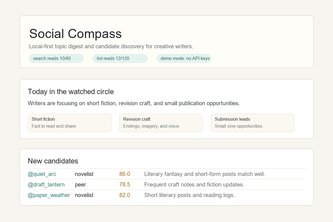
What the company appears to be: Social Compass is a local-first dashboard for writers and creative people, built as a personal project by one developer (恭子 仲村). It aggregates content from a watched list of X (formerly Twitter) accounts, summarizes topics, and helps users discover new creative accounts. The tool enforces daily limits, avoids automation, and stores data locally.
What changed: The author describes building this tool as a response to the overwhelming nature of social feeds and a desire for intentional engagement. It was developed over a short timeframe (likely a hackathon project) using Python, SQLite, Jinja templates, OpenAI models, and the X API.
The single most important open question: Is there any evidence that this product has traction or adoption beyond the author’s own use? The description states no revenue, customers, or user data are available. It is unclear whether the tool is being used by others or if it remains a personal prototype.
What The Product Actually Is
- The description states that Social Compass is a local-first dashboard for writers and creative people.
- It summarizes what people in a watched X list are talking about today, and can create a daily list of new creative accounts to review.
- Both actions are button-based and limited to once per day.
- The tool never posts, follows, likes, DMs, or replies automatically.
- It uses SQLite for local storage, Jinja templates, Python, and the X API.
- It was built using OpenAI Codex and GPT-5.6 for rapid iteration.
Note: The product is described as a personal prototype, not a commercial offering.
Positioning & Claim Evolution
- The author states that the tool was inspired by the desire to stay connected to community without endless scrolling, and to avoid automating human interaction.
- It positions itself as a calmer alternative to social feeds, focused on intentional engagement.
- The product is described as not an engagement machine, with manual buttons, daily limits, and no write actions.
- The author emphasizes that the tool helps people participate more intentionally instead of pushing them to automate behavior.
Inference: The positioning reflects a niche, personal solution to a perceived problem in social media consumption. It is not a scalable or commercial product as described.
Target Customer & ICP
- The description states that Social Compass is for writers and creative people.
- It targets users who want to stay connected to their community, find new writers, and decide what is worth attention.
- The tool is built for intentional engagement, not mass automation.
Note: No evidence of customer segmentation, personas, or specific user groups beyond "writers and creative people."
Business Model & Pricing Evidence
- The description does not state any business model or pricing.
- It is described as a personal project with no commercial intent.
- There is no mention of monetization, subscriptions, or paid features.
Inference: No evidence of a business model or pricing strategy exists in the provided description.
Technical & Delivery Signals
- The tool was built using:
- Python
- SQLite (local storage)
- Jinja templates
- X API
- OpenAI Codex and GPT-5.6
- It includes:
- A local dashboard
- A topic digest flow
- A candidate discovery flow
- SQLite persistence
- Daily button limits
- Tests
- Clear setup instructions
Inference: The tool is a functional prototype, not a production-ready product. It uses modern tools but lacks enterprise-grade features or scalability.
Traction & Maturity Signals
- The project was submitted to the OpenAI 2026 hackathon.
- The author states that it has a working local dashboard, generated visual design, and clear setup instructions.
- It includes tests, daily button limits, and SQLite persistence.
- No evidence of user adoption, revenue, or customer base is provided.
Inference: The tool appears to be a working prototype with no evidence of traction or market adoption.
Competitive Context
- The description does not mention any direct competitors.
- It is positioned as a personal solution to the problem of social media overload and automated engagement.
- It contrasts itself with engagement machines and endless scrolling.
- No comparison to existing tools for content discovery or community tracking is made.
Inference: The competitive landscape is not described. It may be a niche solution in a space with limited direct competition.
Open Questions & Risks
- The tool is described as a personal project, not a commercial offering.
- No evidence of revenue, customers, or adoption beyond the author’s own use.
- The product is not scalable and appears to be built for one user (the author).
- It uses local storage and manual buttons, which may limit its utility in a broader market.
- There is no indication of any monetization strategy or go-to-market plan.
Inference: The product is not ready for commercial use, and there is no evidence of market demand or traction.
Questions the description leaves open
- What is the intended user base beyond the author?
- Are there any users or early adopters of this tool?
- Is there a plan to monetize or scale this product?
- How does the tool handle data privacy and local storage in a broader context?
- What are the technical limitations that prevent scaling beyond one user?
- Has the author considered integrating with other platforms or APIs beyond X?
Overall Assessment
- The project is described as a personal prototype, not a commercial product.
- No evidence of traction, revenue, or customer adoption exists.
- It was built for a specific use case (intentional social engagement) and lacks scalability or monetization strategy.
- There is no indication that this tool is intended for investment or partnership.
Assessment: Not evidenced as a viable commercial opportunity. The description suggests it is a personal project with no clear path to market traction or revenue generation.
User Stories BotA demo video on every pull request
Get a demo video on every new feature
GitHub App that watches your pull requests and records a narrated, captioned demo.
Save time on demo prep and make informed decisions faster with a video walkthrough of every new feature.
Source
Submitted to the OpenAI 2026 hackathon on Devpost. Project home on Devpost. Back to the full gallery on Devpost.
This competitive analysis was produced by top-founders.com (opens in a new tab)
Generated by a language model from this project's public Devpost page — its tagline, the author's own write-up and any built-with tags listed there — as captured in August 2026. Short quotations are the author's words. It is an opinion on the idea as a business, not on the people behind it, and it reflects the description as published then. If the project has moved on, request a correction below. The analysis is not independent research and contains no verified traction, revenue or customer data.
An independent guide by KFG International LLC — not affiliated with, endorsed by, or connected to Devpost or OpenAI.