

Archive position — measured, not model output
1 like on Devpost
505 of the 7,850 archived projects have more likes, and 1,758 share exactly 1 — so this project's #929 place in the like-ranked listing is a tie-break inside that group, not a ranking.
Projects (log scale)
Likes on Devpost. ▲ marks this project's group.
Show the figures
| Likes | Projects | Share of archive |
|---|---|---|
| 0 | 5,587 | 71.2% |
| 1 | 1,758 | 22.4% |
| 2 | 284 | 3.6% |
| 3–4 | 132 | 1.7% |
| 5–9 | 75 | 1.0% |
| 10+ | 14 | 0.2% |
 User Stories BotA demo video on every pull request
Get a demo video on every new feature
GitHub App that watches your pull requests and records a narrated, captioned demo.
Save time on demo prep and make informed decisions faster with a video walkthrough of every new feature.
Executive Summary
What the company appears to be
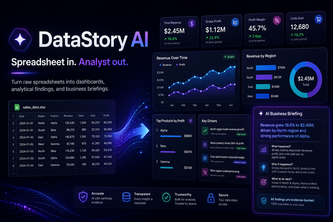
Data Story AI is a self-reported tool that processes spreadsheet uploads (CSV/Excel) into structured analytical outputs, including KPIs, visualizations, findings, and summaries. It claims to focus on trustworthy analysis by embedding semantic understanding, canonical metrics, and domain intelligence to avoid misleading conclusions.
What changed
Originally conceived as a dashboard generator, the project evolved into an analytical engine focused on preventing semantically incorrect inferences through a multi-layered trust architecture. The author states this shift was driven by the realization that generating charts is easy, but ensuring their accuracy and business relevance is hard.
The single most important open question
Is there evidence of any real-world usage or adoption beyond the author’s own development work? The description contains no mention of customers, revenue, or product-market fit beyond a personal project.
Note: This analysis is based entirely on the self-reported and unverified account provided by the author. No third-party verification, traction data, or commercial evidence exists in this report.
What The Product Actually Is
The description states that Data Story AI allows users to upload CSV or Excel files and then walks them through an automated analytics workflow. This includes:
- Spreadsheet upload and preview
- Data cleaning and profiling
- KPI generation
- Visual analysis and chart generation
- Business-focused findings
- Limitations and unsupported-analysis warnings
- Briefing-style summaries
- Exportable reporting
Behind the interface, it uses a “canonical intelligence architecture” designed to prevent mathematically valid but semantically incorrect analysis.
The system recognizes 15 analytical domains (e.g., Sales, Marketing, Expenses) and falls back to generic language when a domain cannot be confidently identified.
Claim: The product is described as an automated analytics engine for spreadsheets.
Evidence: Author’s own write-up.
Positioning & Claim Evolution
The author states that the original idea was to build a dashboard generator, but during development, they realized that generating charts was easy; ensuring those charts were trustworthy was harder. This led to a shift in focus from visualization to trust and correctness in analysis.
Claim: The product evolved from a simple dashboard tool into one focused on trustworthy spreadsheet analysis.
Evidence: Author’s own write-up.
Target Customer & ICP
The description does not explicitly name target customers or define an ideal customer profile (ICP). However, it implies that the intended users are individuals or teams who work with spreadsheets and need to turn them into meaningful business insights.
It also suggests a need for more than dashboards—users want “clear, defensible and decision-ready understanding.”
Claim: The target user is likely someone working with spreadsheets who needs reliable analytical outputs.
Evidence: Author’s own write-up; inferred from product scope.
Business Model & Pricing Evidence
There is no mention of pricing, monetization strategy, or business model in the description. The project appears to be a personal development effort submitted for a hackathon.
Claim: No evidence of business model or pricing.
Evidence: Not evidenced.
Technical & Delivery Signals
The system uses:
- Codex and GPT-5.6 during development
- A multi-layered architecture:
- Workbook reconstruction
- Semantic understanding
- Canonical metrics
- Analytical facts
- Findings and domain intelligence
- Analytical briefings
It includes features such as:
- Deterministic workbook reconstruction
- Source-cell provenance tracking
- Multi-sheet/table handling
- Safe general fallback behavior
- Contradiction and deduplication handling
- Evidence-safe analytical briefings
The author also mentions using adversarial datasets, QA fixtures, and golden regression baselines.
Claim: The system implements a structured, trust-focused architecture with semantic safeguards.
Evidence: Author’s own write-up.
Traction & Maturity Signals
There is no evidence of traction or adoption beyond the author's own development. No customers, revenue, usage metrics, or product-market fit data are provided.
Claim: No traction or maturity signals.
Evidence: Not evidenced.
Competitive Context
The description does not reference any competitors or market positioning. It does not indicate whether similar tools exist in the marketplace or how this tool differentiates from them.
Claim: No competitive context.
Evidence: Not evidenced.
Open Questions & Risks
- The entire project is self-reported and unverified; no external validation of claims.
- No evidence of real-world usage, customers, or revenue.
- The author is a single individual (team size: 1), which raises questions about scalability and long-term maintenance.
- The tool is presented as a hackathon submission, suggesting it may not yet be production-ready or fully tested in the wild.
Inference: Without external validation or traction, the project lacks commercial viability indicators.
Evidence: Author’s own write-up; absence of third-party data.
Questions the description leaves open
- What specific problems have you observed in real-world spreadsheet analysis workflows?
- Have you tested the system with actual users or teams outside of your own development?
- How do you plan to scale beyond a single-person development effort?
- Are there any known limitations or edge cases where the system fails to deliver trustworthy results?
- What is the timeline for moving from QA to production use?
Note: These are questions designed to probe the unverified claims and assumptions made in the description.
Overall Assessment
There is no evidence of commercial traction, revenue, or customer adoption. The project appears to be a personal development effort submitted for a hackathon, with no indication of market validation or product-market fit.
Claim: No commercial viability or investment-ready signal.
Evidence: Not evidenced.
User Stories BotA demo video on every pull request
Get a demo video on every new feature
GitHub App that watches your pull requests and records a narrated, captioned demo.
Save time on demo prep and make informed decisions faster with a video walkthrough of every new feature.
Source
Submitted to the OpenAI 2026 hackathon on Devpost. Project home on Devpost. Back to the full gallery on Devpost.
This competitive analysis was produced by top-founders.com (opens in a new tab)
Generated by a language model from this project's public Devpost page — its tagline, the author's own write-up and any built-with tags listed there — as captured in August 2026. Short quotations are the author's words. It is an opinion on the idea as a business, not on the people behind it, and it reflects the description as published then. If the project has moved on, request a correction below. The analysis is not independent research and contains no verified traction, revenue or customer data.
An independent guide by KFG International LLC — not affiliated with, endorsed by, or connected to Devpost or OpenAI.