

Archive position — measured, not model output
1 like on Devpost
505 of the 7,850 archived projects have more likes, and 1,758 share exactly 1 — so this project's #637 place in the like-ranked listing is a tie-break inside that group, not a ranking.
Projects (log scale)
Likes on Devpost. ▲ marks this project's group.
Show the figures
| Likes | Projects | Share of archive |
|---|---|---|
| 0 | 5,587 | 71.2% |
| 1 | 1,758 | 22.4% |
| 2 | 284 | 3.6% |
| 3–4 | 132 | 1.7% |
| 5–9 | 75 | 1.0% |
| 10+ | 14 | 0.2% |
 User Stories BotA demo video on every pull request
Get a demo video on every new feature
GitHub App that watches your pull requests and records a narrated, captioned demo.
Save time on demo prep and make informed decisions faster with a video walkthrough of every new feature.
Executive Summary
AstroData AI is a self-reported tool that allows users to upload telescope observation data and receive structured scientific analysis through a bilingual interface. The system performs deterministic scientific calculations using Python-based tools like Astropy and Photutils, with GPT-5.6 used only for generating explanations of results rather than performing calculations. The author states the goal is to make astronomical data analysis more accessible without sacrificing scientific rigor.
The project appears to be a single-person development effort built for an OpenAI hackathon. No revenue, customers or traction data are evidenced. The most important open question is whether the described scientific pipeline can reliably process real-world telescope data and produce reproducible results at scale — a claim not substantiated by evidence.
What The Product Actually Is
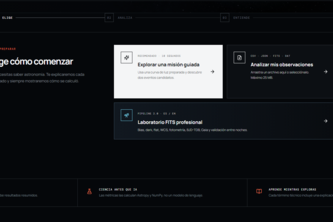
The description states that AstroData AI allows users to upload telescope observations and follow complete analysis through a visual, bilingual interface. For time-series and light-curve data, it performs:
- Schema and data-quality validation
- Missing-value and uncertainty checks
- Robust anomaly detection
- Lomb–Scargle periodicity analysis
- Box Least Squares transit detection
- Harmonic comparison and signal classification
- Phase-folded light-curve visualization
- Transit depth, duration, signal-to-noise, and event estimation
- Reproducible reports with file hashes and pipeline information
For FITS observations, it supports:
- Bias, dark, and flat calibration
- HDU selection
- Header and WCS inspection
- Two-dimensional star detection with Photutils
- Aperture photometry
- Uncertainty propagation
- Temporal and barycentric corrections
- Comparison-star analysis
- Astronomical catalog cross-matching
- Independent-observation validation guidance
The system uses a React and TypeScript frontend with a Python and FastAPI backend. Scientific calculations use Astropy, Photutils, NumPy, and SciPy. GPT-5.6 is used only for explanations of results, not for calculations.
Positioning & Claim Evolution
The author states that AstroData AI was created to make astronomical data analysis more accessible without sacrificing scientific responsibility. The goal is not to let generative AI invent discoveries but to combine reproducible astronomical calculations with clear explanations.
The positioning has evolved from a hackathon project into a tool that claims to help students, citizen astronomers, and researchers perform initial quality-controlled reviews of observations. It explicitly states it does not claim to discover planets automatically, but rather identifies scientifically interesting candidates and explains why they deserve attention.
Target Customer & ICP
The description states that AstroData AI is intended for:
- Students learning astronomical data analysis
- Citizen astronomers inspecting observations
- Researchers performing initial quality-controlled reviews before using specialized workflows
No specific customer segments or personas are detailed. The author does not provide evidence of any existing user base or target market definition beyond these general categories.
Business Model & Pricing Evidence
Not evidenced. The description provides no information about pricing, monetization strategy, or business model.
Technical & Delivery Signals
The system is built with:
- Frontend: React and TypeScript
- Backend: Python and FastAPI
- Scientific libraries: Astropy, Photutils, NumPy, SciPy
- AI tools: GPT-5.6, Codex
Architecture separates deterministic scientific pipeline from GPT explanation layer. The author states that GPT-5.6 does not calculate anomalies or periods and does not receive original uploaded files. The system is designed to continue working even if the AI service is unavailable.
Traction & Maturity Signals
Not evidenced. No revenue, customer adoption, usage metrics, or product maturity data are provided beyond the author's own account of a hackathon submission.
Competitive Context
Not evidenced. No information about existing competitors or market positioning is provided in the description.
Open Questions & Risks
- Single-person development effort (1 team member)
- No evidence of revenue, customers or traction
- Self-reported scientific pipeline without validation data
- GPT-5.6 used for explanations but not calculations, which may limit AI's utility
- Hackathon project context suggests early-stage development
- No information about scalability or production deployment
Questions the description leaves open
- What specific telescope datasets have been tested and validated?
- How is uncertainty propagation handled in the scientific pipeline?
- What validation methods exist for the GPT explanations?
- Are there any known limitations or edge cases in the current implementation?
- What are the plans for scaling beyond the current single-developer scope?
- How does the system handle different telescope data formats and calibration requirements?
Overall Assessment
Not evidenced. No information about funding, valuation, or partnership opportunities is provided in the description. The project appears to be a single-person hackathon submission with no demonstrated traction or commercial viability.
User Stories BotA demo video on every pull request
Get a demo video on every new feature
GitHub App that watches your pull requests and records a narrated, captioned demo.
Save time on demo prep and make informed decisions faster with a video walkthrough of every new feature.
Source
Submitted to the OpenAI 2026 hackathon on Devpost. Project home on Devpost. Back to the full gallery on Devpost.
This competitive analysis was produced by top-founders.com (opens in a new tab)
Generated by a language model from this project's public Devpost page — its tagline, the author's own write-up and any built-with tags listed there — as captured in August 2026. Short quotations are the author's words. It is an opinion on the idea as a business, not on the people behind it, and it reflects the description as published then. If the project has moved on, request a correction below. The analysis is not independent research and contains no verified traction, revenue or customer data.
An independent guide by KFG International LLC — not affiliated with, endorsed by, or connected to Devpost or OpenAI.