

Archive position — measured, not model output
1 like on Devpost
505 of the 7,850 archived projects have more likes, and 1,758 share exactly 1 — so this project's #638 place in the like-ranked listing is a tie-break inside that group, not a ranking.
Projects (log scale)
Likes on Devpost. ▲ marks this project's group.
Show the figures
| Likes | Projects | Share of archive |
|---|---|---|
| 0 | 5,587 | 71.2% |
| 1 | 1,758 | 22.4% |
| 2 | 284 | 3.6% |
| 3–4 | 132 | 1.7% |
| 5–9 | 75 | 1.0% |
| 10+ | 14 | 0.2% |
 User Stories BotA demo video on every pull request
Get a demo video on every new feature
GitHub App that watches your pull requests and records a narrated, captioned demo.
Save time on demo prep and make informed decisions faster with a video walkthrough of every new feature.
Executive Summary
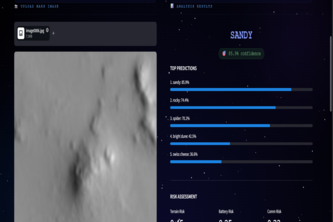
AstroPilot AI is a self-reported AI-powered decision-support system for space missions, built as a hackathon project by one developer (Wasan Al-Salhi). The description states it aims to assist planetary rovers, satellites and landers in making autonomous decisions with explainable reasoning. It combines computer vision (ResNet18), GPT-5.6 reasoning, and decision intelligence modules into a modular system with an interactive dashboard. The project is described as end-to-end functional, achieving 87.77% accuracy on a NASA dataset and claiming to provide human-readable explanations for decisions.
The single most important open question is: What is the actual commercial viability or applicability of this system beyond a hackathon prototype?
This analysis is based entirely on the self-reported description provided by the author — no external verification, traction data, revenue figures, customer base or independent assessments are available. The project has not been independently validated and may not reflect real-world performance or scalability.
What The Product Actually Is
The description states that AstroPilot AI is an "AI-powered mission decision system" designed to support space operations including planetary rovers, satellites, and landers. It processes mission data, assesses risks, and generates intelligent, explainable recommendations using:
- Computer Vision (ResNet18 trained on 73,031 NASA HiRISE images, 87.77% accuracy)
- Decision Intelligence (risk-weighted scoring across terrain, battery, and communication)
- GPT-5.6 Reasoning (natural language mission reports and explanations)
It includes an AI Mission Assistant (GPT-5.6), a Computer Vision Module, a Decision Engine, and an Interactive Web Dashboard built with Flask.
Inferred: The system is described as modular and designed for flexibility across different types of space missions.
Positioning & Claim Evolution
The description positions AstroPilot AI as an "intelligent decision-support system" that helps future space missions operate more safely and efficiently without relying on continuous human intervention. It claims to be a co-pilot for autonomous space exploration, aiming to make decisions faster, safer, and more informed.
It describes itself as an alternative to traditional black-box AI by providing explainable recommendations — "building trust and enabling engineers to understand autonomous system behavior."
The project's evolution appears to have started from the inspiration of creating an AI assistant that can operate in environments where communication delays prevent real-time human control. It evolved into a working prototype with multiple integrated components.
Inferred: The positioning suggests a shift from conceptual idea to functional prototype, but there is no evidence of prior versions or iterative development beyond this single submission.
Target Customer & ICP
The description states that AstroPilot AI supports diverse space operations including:
- Planetary Rovers
- Satellites
- Landers
It is intended for use in environments where communication delays make real-time human control impossible, such as Mars missions.
Inferred: The primary users appear to be engineers or mission controllers working with autonomous spacecraft. However, no specific customer personas, roles, or organizational structures are described.
Not evidenced: No evidence of target customer segments beyond general space operations; no indication of whether this is for government agencies, private companies, or research institutions.
Business Model & Pricing Evidence
The description does not contain any information about pricing, licensing models, revenue streams, or monetization strategies.
Inferred: Since it's a hackathon project with only one developer, there is no evidence of a formal business model or commercial strategy at this stage.
Not evidenced: No details on how the product would be sold, who would pay for it, or what kind of value proposition exists beyond technical demonstration.
Technical & Delivery Signals
The system is described as modular and designed for flexibility. It uses:
- ResNet18 trained on 73,031 NASA HiRISE images (87.77% accuracy)
- GPT-5.6 for reasoning
- Decision engine combining terrain risk, battery status, and communication delay
- Flask-based web dashboard
Development tools used include Codex, gpt-5.6, OpenAI APIs, and Python.
Inferred: The architecture is described as scalable to support rovers, satellites, and landers, suggesting a platform approach.
Not evidenced: No evidence of production deployment, scalability testing, or integration with actual space systems.
Traction & Maturity Signals
The description states that the system is end-to-end functional and claims 88% accuracy on real NASA planetary imagery. It also mentions:
- Real-world dataset (73,031 NASA HiRISE images)
- Accomplishments such as explainable AI and scalable architecture
- Plans for future enhancements including real-time telemetry, advanced simulation, reinforcement learning
However, there is no evidence of actual deployment, usage metrics, user feedback, or performance in live missions.
Inferred: The project shows technical maturity in prototype form but lacks any indication of operational readiness or market traction.
Not evidenced: No data on customer adoption, revenue, ARR, or product-market fit.
Competitive Context
The description does not mention any competitors or existing solutions in the space exploration AI decision-support space.
Inferred: Given the niche nature of autonomous space missions and the specific focus on explainable AI for mission control, there may be limited direct competition. However, no evidence exists to confirm this.
Not evidenced: No information about market size, competitive landscape, or differentiation from existing technologies.
Open Questions & Risks
- Unverified Claims: Accuracy claims (e.g., 87.77%) and performance metrics are self-reported without independent validation.
- Single Developer: The entire project was built by one person, raising questions about scalability, maintainability, and long-term development capacity.
- Limited Scope: The system is described as a hackathon prototype with no indication of integration into real-world systems or operational environments.
- No Commercial Viability Evidence: No evidence of business model, pricing, or customer traction beyond the author’s own description.
- Technology Stack Risks: Reliance on GPT-5.6 and Codex raises concerns about dependency on proprietary APIs and potential limitations in production use.
Questions the description leaves open
- What is the actual performance of the system in real-world conditions, beyond the test dataset?
- How does the system handle edge cases or unexpected scenarios not covered in the training data?
- Is there any plan for integration with actual space hardware or mission control systems?
- What are the limitations of the current architecture that would prevent scaling to full operational use?
- Are there any partnerships or collaborations with space agencies or industry players already underway?
- How is the explainability feature implemented and tested in practice?
- What are the key assumptions underlying the decision logic, and how were they validated?
Overall Assessment
Not evidenced.
The description does not provide sufficient evidence to assess whether this project has investment potential or strategic value for partnerships. There is no indication of commercial viability, traction, or a clear path to market adoption beyond its current prototype status. The single developer team and lack of verified performance data raise significant concerns about scalability and real-world applicability.
The author states the vision is to evolve AstroPilot AI into a complete mission control assistant for future space exploration, but no evidence supports that this evolution has begun or is likely to occur without substantial additional development and resources.
User Stories BotA demo video on every pull request
Get a demo video on every new feature
GitHub App that watches your pull requests and records a narrated, captioned demo.
Save time on demo prep and make informed decisions faster with a video walkthrough of every new feature.
Source
Submitted to the OpenAI 2026 hackathon on Devpost. Project home on Devpost. Back to the full gallery on Devpost.
This competitive analysis was produced by top-founders.com (opens in a new tab)
Generated by a language model from this project's public Devpost page — its tagline, the author's own write-up and any built-with tags listed there — as captured in August 2026. Short quotations are the author's words. It is an opinion on the idea as a business, not on the people behind it, and it reflects the description as published then. If the project has moved on, request a correction below. The analysis is not independent research and contains no verified traction, revenue or customer data.
An independent guide by KFG International LLC — not affiliated with, endorsed by, or connected to Devpost or OpenAI.