

Archive position — measured, not model output
1 like on Devpost
505 of the 7,850 archived projects have more likes, and 1,758 share exactly 1 — so this project's #639 place in the like-ranked listing is a tie-break inside that group, not a ranking.
Projects (log scale)
Likes on Devpost. ▲ marks this project's group.
Show the figures
| Likes | Projects | Share of archive |
|---|---|---|
| 0 | 5,587 | 71.2% |
| 1 | 1,758 | 22.4% |
| 2 | 284 | 3.6% |
| 3–4 | 132 | 1.7% |
| 5–9 | 75 | 1.0% |
| 10+ | 14 | 0.2% |
 User Stories BotA demo video on every pull request
Get a demo video on every new feature
GitHub App that watches your pull requests and records a narrated, captioned demo.
Save time on demo prep and make informed decisions faster with a video walkthrough of every new feature.
Executive Summary
Company: ATAN - Autonomous Disaster Response AI Agent Network
Self-reported basis: The entire analysis is based on a single project description submitted by the author to the OpenAI 2026 hackathon on Devpost. No independent verification, archived data or third-party corroboration is available.
Commercial due-diligence read: ATAN is described as an AI-powered platform that coordinates multiple AI agents and autonomous systems for disaster response missions. It positions itself as a "Mission Commander" that automates decision-making in emergency scenarios. The author states the system uses a team of specialized AIs under one coordinator, but provides no evidence of revenue, customers, traction or commercial viability. The project is early-stage and self-reported; there is no evidence of product-market fit, scalability, or operational maturity.
What The Product Actually Is
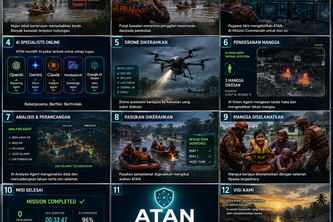
The description states that ATAN is a disaster response platform built around the concept of a “Mission Commander” that coordinates AI agents, drones, computer vision, and real-time reasoning. It is described as a system where:
- A single voice command triggers a coordinated rescue mission.
- The Mission Commander assigns tasks to different AI models (e.g., OpenAI for planning, Gemini for multimodal analysis, NotebookLM for knowledge retrieval).
- The platform integrates hardware like drones, Raspberry Pi, and communication protocols such as MAVLink and WebSockets.
- It uses technologies including FastAPI, Python, YOLO, OpenCV, and various LLMs (OpenAI, Gemini, NotebookLM, etc.).
Inference: ATAN appears to be a prototype or proof-of-concept for an AI agent network designed to assist in emergency response. It is not a commercial product but rather a hackathon submission.
Positioning & Claim Evolution
The author states that ATAN was inspired by the difficulty of coordinating tools during disasters and aims to make AI part of the rescue team, not just another tool. The platform positions itself as:
- An AI Mission Commander that makes decisions automatically.
- A system that removes decision-making from responders during emergencies.
- A coordinator of specialized AI agents, rather than a single general-purpose AI.
The claim evolution shows a shift from a simple idea (AI helping in disasters) to a more structured approach (a team of AI agents under one commander). However, the description does not indicate any prior positioning or product iteration history — it is presented as a new concept.
Inference: The positioning is aspirational and conceptual. No evidence of prior market testing, customer feedback or commercial positioning beyond the hackathon submission.
Target Customer & ICP
The author states that ATAN is built for disaster responders, including those involved in flood, landslide, and earthquake response. It is designed to help people focus on saving lives while ATAN handles coordination.
Inference: The target customer is emergency responders or first responders in disaster scenarios. However, there is no evidence of actual users, partnerships with emergency services, or market validation.
Business Model & Pricing Evidence
The description does not provide any information about:
- How ATAN would generate revenue.
- Whether it is a SaaS product or a one-time deployment.
- Any pricing model or monetization strategy.
- Whether the platform is intended for public use or private enterprise.
Inference: No evidence of a business model or pricing structure exists in the description. The project appears to be a prototype, not a commercial offering.
Technical & Delivery Signals
The author describes ATAN as built using:
- AI models: OpenAI, Gemini, NotebookLM, GPT-4o, Claude, Hermes (future).
- Hardware: Drones, Raspberry Pi, IoT devices.
- Software stack: FastAPI, Python, WebSockets, MAVLink, YOLO, OpenCV, Kotlin, Android.
- Integration approach: A team of AI agents coordinated by a Mission Commander.
Inference: The technical architecture is described as modular and distributed. However, there is no evidence of deployment, performance metrics, or delivery success beyond the hackathon submission.
Traction & Maturity Signals
The description states:
- ATAN was built for the OpenAI 2026 hackathon.
- It is a single-person project (1 team member).
- The author notes that coordination between AI models and hardware was challenging and still being improved.
- There is no mention of users, customers, or real-world deployments.
Inference: No traction or maturity signals are evident. The system is described as a prototype with ongoing development. No evidence of adoption, usage data, or product-market fit.
Competitive Context
The description does not mention any competitors or existing solutions in the disaster response or AI coordination space. It does not reference:
- Existing AI platforms for emergency response.
- Drone or robotics systems used in disasters.
- Other AI agent coordination tools.
Inference: No competitive context is provided. The project appears to be in a niche or emerging area, but there is no evidence of prior market analysis or competitive positioning.
Open Questions & Risks
- Single-person team: No evidence of scaling or operational capacity.
- No commercial traction: The platform is described as a hackathon submission with no revenue or user data.
- Unproven integration: The author notes that integrating AI models and hardware was difficult, suggesting technical risks.
- No pricing or monetization model: No indication of how the product would be sold or used commercially.
- Unverified claims: All descriptions are self-reported and unverified.
Inference: High risk due to lack of evidence for viability, scalability, or commercial readiness. The project is early-stage and lacks any real-world validation.
Questions the description leaves open
- What specific disaster scenarios have you tested ATAN in?
- Are there any partnerships with emergency response teams or organizations?
- How do you plan to monetize this platform if deployed at scale?
- What are the technical challenges you've faced in integrating AI models and hardware, and how are you solving them?
- Have you conducted any user research or field testing with actual responders?
- What is your roadmap for scaling beyond the hackathon prototype?
Overall Assessment
Not evidenced: The description does not provide sufficient evidence to assess whether ATAN has investment or partnership potential. It is a self-reported hackathon project with no commercial traction, revenue, or customer data.
Confidence level: Very low. The project is early-stage and lacks any indicators of product-market fit, scalability, or operational maturity.
Inference: While the idea may have promise in a future market, there is no evidence to support a current investment or partnership decision. Any strategic interest would require further due diligence into prototype performance, team capacity, and market validation.
User Stories BotA demo video on every pull request
Get a demo video on every new feature
GitHub App that watches your pull requests and records a narrated, captioned demo.
Save time on demo prep and make informed decisions faster with a video walkthrough of every new feature.
Source
Submitted to the OpenAI 2026 hackathon on Devpost. Project home on Devpost. Back to the full gallery on Devpost.
This competitive analysis was produced by top-founders.com (opens in a new tab)
Generated by a language model from this project's public Devpost page — its tagline, the author's own write-up and any built-with tags listed there — as captured in August 2026. Short quotations are the author's words. It is an opinion on the idea as a business, not on the people behind it, and it reflects the description as published then. If the project has moved on, request a correction below. The analysis is not independent research and contains no verified traction, revenue or customer data.
An independent guide by KFG International LLC — not affiliated with, endorsed by, or connected to Devpost or OpenAI.