

Archive position — measured, not model output
1 like on Devpost
505 of the 7,850 archived projects have more likes, and 1,758 share exactly 1 — so this project's #635 place in the like-ranked listing is a tie-break inside that group, not a ranking.
Projects (log scale)
Likes on Devpost. ▲ marks this project's group.
Show the figures
| Likes | Projects | Share of archive |
|---|---|---|
| 0 | 5,587 | 71.2% |
| 1 | 1,758 | 22.4% |
| 2 | 284 | 3.6% |
| 3–4 | 132 | 1.7% |
| 5–9 | 75 | 1.0% |
| 10+ | 14 | 0.2% |
 User Stories BotA demo video on every pull request
Get a demo video on every new feature
GitHub App that watches your pull requests and records a narrated, captioned demo.
Save time on demo prep and make informed decisions faster with a video walkthrough of every new feature.
Executive Summary
What the company appears to be
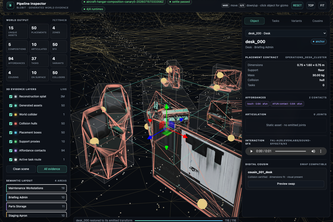
Astra is a world compiler for embodied AI that converts spatial content into simulator-ready environments with both visual and physical representations. The system compiles worlds that preserve task-relevant structure for policy execution, supports multiple simulation engines, and generates structured distributions of worlds for training and evaluation.
What changed
The project description indicates development of Astra Real2Sim, which extends the compiler to reconstruct observed environments from video into Astra's canonical representation, bridging generated and evidence-grounded reconstructions.
Single most important open question
What is the actual commercial traction or adoption of Astra's world compilation system, and how does it compare to existing simulation tools in robotics and AI research?
What The Product Actually Is
The description states that Astra is "our world compiler for spatial intelligence." It converts generated spatial content into canonical, simulator-ready worlds containing:
- Visual appearance
- Metric geometry
- Collision information
- Articulated assets
- Semantic identities
- Affordances
- Layouts
- Tasks
- Validation evidence
Astra maintains a dual representation: visual layer using splats and render geometry, and physical layer carrying structure required for policy execution (collision geometry, support constraints, joint models, object state, spawn regions, affordance predicates, runtime packages).
The system is described as not being coupled to one simulator, with canonical world contracts compiled through engine adapters supporting systems including MuJoCo, Genesis, Isaac, Drake, Unity, and Unreal.
Positioning & Claim Evolution
The description states that Astra addresses the gap between world generation and embodied learning by building "the layer that is usually omitted" in this process. It positions itself as a system that:
- Converts generated worlds into structured physical environments rather than stopping at render, splat, or mesh
- Provides engine-neutral policy substrate where one canonical world can be compiled across major robotics, simulation, and interactive engines
- Maintains coupled visual and physical worlds where splats preserve appearance while meshes, colliders, articulated assets, and stateful scene structure provide interaction substrate
The claim evolution shows a progression from basic world generation to:
- Simulation-ready compilation
- Multi-engine support
- Real2Sim extension for evidence-grounded reconstructions
- Scientific instrument for embodied intelligence
Target Customer & ICP
Not evidenced. The description does not identify specific target customers, user personas, or ideal customer profiles (ICP). It describes the technical capabilities but does not state who would use this system or what their needs are.
Business Model & Pricing Evidence
Not evidenced. There is no information provided about pricing models, revenue streams, or business model assumptions in the description.
Technical & Delivery Signals
The description indicates Astra was built as "a sequence of constrained compilation stages" rather than a monolithic generative pass. Key technical elements include:
- Resolution of scene structure, placement and settling of objects, construction of collision representations
- Preservation of articulation, generation of task-compatible variants and cousins, building of affordance graphs
- Exporting simulator packages with validation at each irreversible boundary
- Engine adapters that preserve invariants across target engines (C_e(𝑊) ≃ Φ(𝑊))
The system uses Codex with GPT-5.6 Sol as a research instrument for triangulating between code, geometry, simulation behavior, visual evidence, and evaluation traces.
Traction & Maturity Signals
Not evidenced. The description does not contain any information about revenue, customers, adoption rates, or traction metrics beyond the project being submitted to a hackathon.
Competitive Context
The description indicates Astra is positioned as a world compiler for embodied AI that bridges generated worlds and embodied learning. It supports multiple simulation engines (MuJoCo, Genesis, Isaac, Drake, Unity, Unreal) and claims to be "not coupled to one simulator." The system is described as addressing a gap in the market where "the layer that is usually omitted" between world generation and embodied learning is built.
Open Questions & Risks
- Unproven commercial viability: The project is described as submitted to a hackathon with no evidence of revenue, customers or traction
- Technical complexity claims: The description makes extensive technical claims about constraint satisfaction, multi-objective optimization, and simulation readiness that are not independently verified
- Research vs. product confusion: The description mentions "Astra Real2Sim" as a research path that is "not yet the live generation path," raising questions about whether this represents a product or research project
- Limited evidence of impact: No information on how Astra compares to existing simulation tools in robotics and AI research
Questions the description leaves open
- What specific problems are you solving that existing simulation tools don't address?
- How do you plan to monetize this technology, and what is your go-to-market strategy?
- What evidence do you have of demand for this type of world compilation system in the robotics or AI research community?
- Can you demonstrate measurable improvements in policy training or evaluation using Astra compared to existing approaches?
- How do you plan to scale beyond the current team size of 2 members?
- What are your plans for addressing the technical challenges around representation boundaries and constraint satisfaction?
Overall Assessment
Confidence: Low
The description provides extensive technical details about Astra's world compilation system but lacks any evidence of commercial traction, revenue, customers, or market validation. The project is described as a hackathon submission with no indication of product-market fit or business model development.
Key limitations:
- No revenue or customer data
- No evidence of adoption or usage metrics
- No pricing or business model information
- Limited team size (2 members)
- Self-reported technical claims without independent verification
The system appears technically sophisticated and addresses a potential gap in embodied AI development, but there is insufficient evidence to assess commercial viability or competitive positioning. The lack of any traction signals makes it difficult to evaluate whether this represents a viable investment opportunity or partnership target.
Recommendation
Further due diligence required to validate technical claims and assess market demand before considering investment or partnership opportunities.
User Stories BotA demo video on every pull request
Get a demo video on every new feature
GitHub App that watches your pull requests and records a narrated, captioned demo.
Save time on demo prep and make informed decisions faster with a video walkthrough of every new feature.
Source
Submitted to the OpenAI 2026 hackathon on Devpost. Project home on Devpost. Back to the full gallery on Devpost.
This competitive analysis was produced by top-founders.com (opens in a new tab)
Generated by a language model from this project's public Devpost page — its tagline, the author's own write-up and any built-with tags listed there — as captured in August 2026. Short quotations are the author's words. It is an opinion on the idea as a business, not on the people behind it, and it reflects the description as published then. If the project has moved on, request a correction below. The analysis is not independent research and contains no verified traction, revenue or customer data.
An independent guide by KFG International LLC — not affiliated with, endorsed by, or connected to Devpost or OpenAI.