

Archive position — measured, not model output
0 likes on Devpost
2,263 of the 7,850 archived projects have more likes, and 5,587 share exactly 0 — so this project's #4,561 place in the like-ranked listing is a tie-break inside that group, not a ranking.
Projects (log scale)
Likes on Devpost. ▲ marks this project's group.
Show the figures
| Likes | Projects | Share of archive |
|---|---|---|
| 0 | 5,587 | 71.2% |
| 1 | 1,758 | 22.4% |
| 2 | 284 | 3.6% |
| 3–4 | 132 | 1.7% |
| 5–9 | 75 | 1.0% |
| 10+ | 14 | 0.2% |
 User Stories BotA demo video on every pull request
Get a demo video on every new feature
GitHub App that watches your pull requests and records a narrated, captioned demo.
Save time on demo prep and make informed decisions faster with a video walkthrough of every new feature.
Executive Summary
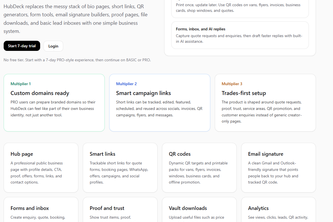
HubDeck is a self-reported SaaS platform for tradespeople and local service businesses, designed to centralize business identity, promotions, and lead management. The author states it allows updating information once and keeps all customer touchpoints (e.g., QR codes, links, flyers) synchronized. It includes features like dynamic QR codes, Smart Links, analytics, email signatures, and AI-powered tools for content creation and lead replies.
The project was built during a hackathon as an enhancement to an existing product, with no verified revenue, customers or traction data. The author reports improvements in security, billing controls, framework upgrades, and AI integration, but does not claim any commercial adoption or market validation.
Key open question
Is HubDeck a viable business model for local service providers, or is it a prototype that requires further development before customer acquisition?
What The Product Actually Is
The description states that HubDeck is:
- A connected business identity, promotion and lead-management platform.
- Designed mainly for tradespeople and local service businesses.
- Intended to be used from one dashboard to manage:
- Public business page
- Services, offers and contact details
- Testimonials and before-and-after work
- Dynamic QR codes
- Smart Links and campaign links
- Enquiry forms and incoming leads
- HTML and plain-text email signatures
- Page, click, QR and lead analytics
- Private Vault files
- Billing, account and domain settings
It is not described as a link-in-bio page, but rather as a tool to connect customer discovery points with trust-building elements and lead generation.
Inferred: The product appears to be a SaaS platform that integrates various digital touchpoints for small businesses into a single dashboard. It supports both static and dynamic content updates across multiple media types (e.g., QR codes, emails, web pages).
Positioning & Claim Evolution
The author states the core idea is:
"Update your business once. Keep every link, QR code and customer touchpoint up to date."
This positions HubDeck as a solution to the problem of scattered business information across multiple platforms and media.
It claims to be more than just another link-in-bio tool — aiming instead to unify how customers interact with a business from discovery through lead conversion.
Inferred: The positioning evolved from an existing product to one that emphasizes safety, cleanliness, and readiness for real-world use during the Build Week competition. It reflects a shift toward a production-ready version of a pre-existing SaaS offering.
Target Customer & ICP
The description states:
- HubDeck is designed mainly for tradespeople and local service businesses.
- These are described as having scattered information across multiple touchpoints (van, flyers, invoices, social profiles, etc.).
Inferred: The target customer segment appears to be small-to-medium-sized local service providers who rely heavily on physical and digital marketing materials. The ICP likely includes those with limited technical resources but needing consistent branding and lead management.
Not evidenced: No specific buyer personas, job functions, or segmentation criteria are provided beyond general industry categories.
Business Model & Pricing Evidence
The description states:
- HubDeck is a SaaS platform.
- It includes billing and account settings.
- Basic and Pro plans are the intended initial offerings.
- A future Edge tier may be introduced after proving the main product with real customers.
Inferred: The business model appears to be subscription-based, with tiered pricing (Basic, Pro, potentially Edge). However, no actual pricing details, revenue models, or monetization strategies beyond billing controls are described.
Not evidenced: No evidence of pricing tiers, customer acquisition costs, gross margins, or any financial performance metrics.
Technical & Delivery Signals
The description states:
- Built with Next.js 15.5.20, React 19, TypeScript, Supabase (Auth, Postgres, Storage), Stripe Billing, OpenAI-powered AI helpers.
- Uses Server Actions, route handlers, Tailwind CSS.
- Repository includes 53 generated routes covering public site, dashboard, redirects, forms, QR codes, account tools, billing and APIs.
- AI features include:
- AI Page Builder
- AI Text Improver
- AI Lead Reply Generator
Inferred: The technical stack indicates a modern full-stack SaaS architecture using open-source components (Next.js, Supabase) and cloud services (Stripe, OpenAI). The use of AI tools suggests an attempt to automate content creation and response handling.
Not evidenced: No information about scalability, infrastructure robustness, or deployment practices beyond Build Week validation.
Traction & Maturity Signals
The description states:
- HubDeck existed before Build Week as a working SaaS project.
- During Build Week, it was improved for safety, cleanliness, and readiness.
- Improvements included Supabase Row Level Security, Storage and privilege hardening; account export/deletion safety; billing behavior; legal consistency; deployment-readiness checks.
- Final validation completed:
- Clean dependency installation
- Zero npm audit vulnerabilities
- TypeScript typechecking
- Lint with no warnings or errors
- Successful production build
Inferred: The platform shows signs of iterative development and has undergone recent hardening for production readiness. However, there is no evidence of actual customer adoption, usage metrics, or revenue generation.
Not evidenced: No data on active users, retention rates, conversion funnels, or market traction.
Competitive Context
The description does not mention specific competitors or direct substitutes.
Inferred: Given its focus on local service businesses and centralized business identity management, HubDeck likely competes with tools like:
- Link-in-bio platforms (e.g., Linktree)
- Local SEO and listing management services
- CRM systems tailored for small businesses
- Marketing automation tools for service-based industries
However, no competitive analysis or differentiation strategy is described.
Not evidenced: No competitive landscape, pricing comparison, or unique value proposition relative to existing solutions.
Open Questions & Risks
The description indicates:
- The product is presented as a working release candidate, not yet fully production-proven.
- Several remaining tasks are listed before public customer acceptance:
- Final operator, support and legal details
- Live deployment verification
- Production Stripe webhook and subscription-lifecycle testing
- DNS, TLS and custom-domain verification
- Broader failure-path and permission testing
- More automated test coverage
- Final pricing and launch polish
Inferred: The biggest risk is that the platform is not yet ready for real-world use, despite being submitted as a release candidate. There are also risks related to:
- AI integration limitations (e.g., AI Page Builder paths still need testing)
- Lack of verified customer feedback or market validation
- Unclear monetization strategy beyond basic subscriptions
Not evidenced: No evidence of competitive threats, regulatory concerns, or technical debt beyond stated improvements.
Questions the description leaves open
- What is the current stage of development outside of Build Week?
- Are there any existing customers or beta users?
- How does HubDeck plan to acquire its first paying customers?
- What are the key assumptions about user behavior and adoption in the local service sector?
- Can you provide evidence of how the AI features perform in practice, especially for lead reply generation?
- What is the timeline for completing the remaining tasks before full public launch?
- How does HubDeck differentiate itself from existing link-in-bio or CRM tools?
- What are the expected customer lifetime values and churn rates?
Overall Assessment
The description presents HubDeck as a preliminary working release of an existing SaaS product that has been enhanced during Build Week.
It is not evidenced to have generated revenue, traction or validated demand.
Inferred: While the technical foundation appears solid and the author shows discipline in improving the product, there is no commercial due-diligence evidence to support investment or partnership decisions at this time. The platform requires further validation through customer feedback, market testing, and financial performance before any strategic move can be made.
Confidence Level Low — based on self-reported evidence only, with no independent verification of claims or outcomes.
User Stories BotA demo video on every pull request
Get a demo video on every new feature
GitHub App that watches your pull requests and records a narrated, captioned demo.
Save time on demo prep and make informed decisions faster with a video walkthrough of every new feature.
Source
Submitted to the OpenAI 2026 hackathon on Devpost. Project home on Devpost. Back to the full gallery on Devpost.
This competitive analysis was produced by top-founders.com (opens in a new tab)
Generated by a language model from this project's public Devpost page — its tagline, the author's own write-up and any built-with tags listed there — as captured in August 2026. Short quotations are the author's words. It is an opinion on the idea as a business, not on the people behind it, and it reflects the description as published then. If the project has moved on, request a correction below. The analysis is not independent research and contains no verified traction, revenue or customer data.
An independent guide by KFG International LLC — not affiliated with, endorsed by, or connected to Devpost or OpenAI.