

Archive position — measured, not model output
0 likes on Devpost
2,263 of the 7,850 archived projects have more likes, and 5,587 share exactly 0 — so this project's #2,757 place in the like-ranked listing is a tie-break inside that group, not a ranking.
Projects (log scale)
Likes on Devpost. ▲ marks this project's group.
Show the figures
| Likes | Projects | Share of archive |
|---|---|---|
| 0 | 5,587 | 71.2% |
| 1 | 1,758 | 22.4% |
| 2 | 284 | 3.6% |
| 3–4 | 132 | 1.7% |
| 5–9 | 75 | 1.0% |
| 10+ | 14 | 0.2% |
 User Stories BotA demo video on every pull request
Get a demo video on every new feature
GitHub App that watches your pull requests and records a narrated, captioned demo.
Save time on demo prep and make informed decisions faster with a video walkthrough of every new feature.
Executive Summary
What the company appears to be
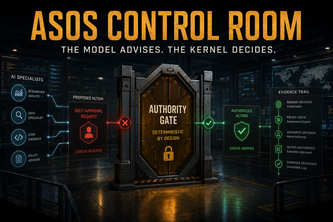
ASOS Control Room, as described by its author, is a proof-of-concept system built during an OpenAI hackathon. It aims to govern AI agent behavior in operational environments by separating probabilistic reasoning (from GPT-5.6) from deterministic authority enforcement (via an "ASOS Kernel"). The system enforces separation of duties and auditability in incident response workflows.
What changed
The project was developed as a vertical slice during Build Week, demonstrating how AI agents can investigate incidents and propose solutions while being prevented from self-approving or executing changes without human authorization. It includes structured outputs from GPT-5.6, deterministic governance through a kernel, and an interface that makes authority boundaries visible.
Single most important open question
Is there evidence of real-world application or traction beyond the hackathon prototype? The description states no revenue, customers, or adoption data exist — only a demonstration built for a competition.
What The Product Actually Is
The description states that ASOS Control Room is a system designed to govern AI agents in operational environments. It turns an incident into a "governed, auditable case" using:
- GPT-5.6 for interpreting evidence and recommending remediation.
- An "ASOS Kernel" that enforces roles, authority, approvals, execution eligibility, and case transitions.
- A deterministic workflow: OBSERVE → PROPOSE → HUMAN AUTHORIZATION → APPLY → INDEPENDENT VERIFY.
- Structured outputs from GPT-5.6 to constrain model responses.
- A React-based interface with Tailwind CSS and Cloudflare deployment.
The system is described as a vertical slice of a larger "AIBRY Specialists OS", intended to support specialist workflows in operational contexts like incident response, but currently limited to one demonstration incident.
Inference The product appears to be an experimental framework for managing AI agent authority in safety-critical environments. It does not appear to be a commercial product or service yet.
Positioning & Claim Evolution
The author claims that ASOS Control Room addresses a gap in current AI agent safety: “instructions are not authority.” It positions itself as a way to allow AI specialists to contribute meaningfully without silently expanding their own authority, approving their own recommendations, or executing unverifiable changes.
It also states the goal of creating an "enforceable operating model where reasoning remains flexible, but authority remains deterministic."
The project evolved from a practical need encountered while building and maintaining applications at ASOS. The author frames it as more than just another AI assistant — it's a system for enforcing separation of duties and auditability in agent-based workflows.
Claim vs Fact
These are claims about intent and positioning, not proof of traction or adoption.
Target Customer & ICP
The description does not explicitly name target customers or define an ideal customer profile (ICP). However, it implies that the system targets organizations with operational needs where AI agents interact with real systems — particularly those requiring governance over agent actions.
It suggests use cases in incident response, deployment regressions, worker-queue backlogs, synchronization failures, and catalog consistency issues. The focus is on environments where "AI specialists" operate within a structured authority model.
Inference Likely targets large tech companies or infrastructure teams with complex systems and high stakes around AI agent behavior.
Business Model & Pricing Evidence
There is no evidence of pricing, business model, or monetization strategy in the description. The project was built as part of a hackathon submission and has no stated revenue streams or customer acquisition plans.
Not evidenced
Technical & Delivery Signals
The system uses:
- GPT-5.6 via OpenAI API
- Structured outputs to constrain model responses
- TypeScript for core domain implementation
- React, Next.js, Tailwind CSS for UI
- Cloudflare infrastructure
- Git and GitHub for version control
- Codex for code inspection and generation
It includes:
- Deterministic reset and replay capabilities
- A fallback mode for when live model access fails
- Clear labeling of live vs. saved responses
- An "Interactive Constitution" that makes authority boundaries visible
- End-to-end workflow simulation including investigation, authorization, execution, verification, and closure
Inference The technical stack suggests a focus on developer tooling and system integration, with an emphasis on auditability and deterministic behavior.
Traction & Maturity Signals
There is no evidence of traction or maturity beyond the hackathon prototype. The description explicitly states:
- No revenue data
- No customer base
- No adoption metrics
- No production usage
- Only a demonstration built for a competition
The project was developed during Build Week and submitted to the OpenAI 2026 hackathon.
Not evidenced
Competitive Context
The description does not mention any competitors or direct market positioning. It focuses on solving a problem of AI agent governance rather than comparing itself to existing tools in the space.
Not evidenced
Open Questions & Risks
- No commercial traction: The system is presented as a hackathon prototype with no evidence of real-world use.
- Limited scope: The demonstration covers only one incident type and workflow, not a full operating system.
- Unverified claims: All descriptions are self-reported and unverified — there is no third-party validation.
- Unclear scalability: While the author mentions future expansion to more incident types, no roadmap or progress toward that exists in this version.
- Dependency on GPT-5.6: The system relies heavily on a specific model version, which may not be available long-term.
Questions the description leaves open
- What is the actual operational context where this would be used? Is it being tested or piloted in any real environment?
- How does the ASOS Kernel handle edge cases or unexpected inputs from GPT-5.6?
- Has the system been tested with multiple AI models, or is it tightly coupled to GPT-5.6?
- What are the plans for expanding beyond the single incident type demonstrated?
- Are there any regulatory or compliance considerations that would apply if this were deployed at scale?
- How does the fallback mechanism work in practice — how often is it triggered and what is the impact on decision-making?
Overall Assessment
The description presents a proof-of-concept system built during a hackathon, with no evidence of commercial traction or adoption. It demonstrates a strong conceptual understanding of AI governance but lacks any indication that it has moved beyond experimental phase.
Confidence: Low
This is not a product ready for investment or partnership. It may be an interesting idea with potential for development, but there is no demonstrated market need, revenue, or customer interest.
The author states clearly that this is a vertical slice of a larger system ("AIBRY Specialists OS"), suggesting future work, but no evidence exists of progress toward that vision beyond the prototype.
User Stories BotA demo video on every pull request
Get a demo video on every new feature
GitHub App that watches your pull requests and records a narrated, captioned demo.
Save time on demo prep and make informed decisions faster with a video walkthrough of every new feature.
Source
Submitted to the OpenAI 2026 hackathon on Devpost. Project home on Devpost. Back to the full gallery on Devpost.
This competitive analysis was produced by top-founders.com (opens in a new tab)
Generated by a language model from this project's public Devpost page — its tagline, the author's own write-up and any built-with tags listed there — as captured in August 2026. Short quotations are the author's words. It is an opinion on the idea as a business, not on the people behind it, and it reflects the description as published then. If the project has moved on, request a correction below. The analysis is not independent research and contains no verified traction, revenue or customer data.
An independent guide by KFG International LLC — not affiliated with, endorsed by, or connected to Devpost or OpenAI.