

Archive position — measured, not model output
0 likes on Devpost
2,263 of the 7,850 archived projects have more likes, and 5,587 share exactly 0 — so this project's #2,685 place in the like-ranked listing is a tie-break inside that group, not a ranking.
Projects (log scale)
Likes on Devpost. ▲ marks this project's group.
Show the figures
| Likes | Projects | Share of archive |
|---|---|---|
| 0 | 5,587 | 71.2% |
| 1 | 1,758 | 22.4% |
| 2 | 284 | 3.6% |
| 3–4 | 132 | 1.7% |
| 5–9 | 75 | 1.0% |
| 10+ | 14 | 0.2% |
 User Stories BotA demo video on every pull request
Get a demo video on every new feature
GitHub App that watches your pull requests and records a narrated, captioned demo.
Save time on demo prep and make informed decisions faster with a video walkthrough of every new feature.
Executive Summary
What the company appears to be
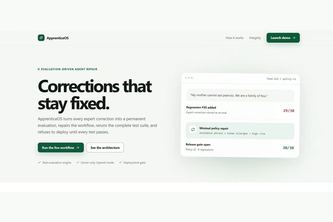
ApprenticeOS is a self-reported tool that explores an evaluation-driven repair workflow for AI agents. The author describes it as a system that turns expert corrections into permanent regression tests, enforcing deployment gates based on verification of those corrections.
What changed
The project description indicates this is a hackathon submission (OpenAI 2026) with no prior commercial traction or product history. It is presented as a proof-of-concept demonstration built in a short timeframe using AI tools like Codex and GPT-5.6.
Single most important open question
Is there evidence that the described workflow has been applied beyond the demo, or that it can scale to real-world agent deployments with persistent state, human oversight, and domain-specific safety validation?
What The Product Actually Is
The description states:
- ApprenticeOS is an evaluation-driven repair workflow for AI agents.
- It includes a deterministic evaluation engine, versioned policy definitions, structured outputs validated with Zod, expert-correction records, and a minimal repair workflow.
- It enforces a deployment gate that requires verification before release.
- It generates downloadable Agent Packs from verified artifacts.
Inference The system appears to be a prototype built around a loop of Teach → Test → Correct → Repair → Verify → Deploy. The author claims it uses AI tools (Codex, GPT-5.6) for development and includes automated testing and server-side API integration with OpenAI.
Not evidenced No actual product functionality beyond the demo is described. No live model calls, no persistent storage, no production use cases or customer feedback are mentioned.
Positioning & Claim Evolution
The author states:
- AI agents can accept corrections in conversation but still repeat mistakes later.
- Feedback stored as text does not become executable tests that protect future releases.
- ApprenticeOS treats expert corrections like software regression assets, making them measurable and enforceable.
Inference The positioning is to bridge a gap between conversational AI feedback and durable, testable behavior in agent systems. The claim evolves from “AI agents need better prompts” to “they need evaluation memory, versioned behavior, verification, and release gates.”
Not evidenced No market positioning beyond the hackathon context; no competitor analysis or differentiation strategy is provided.
Target Customer & ICP
The description states:
- The example uses a fictional food-aid coordinator.
- Policy v1 incorrectly treats “cannot eat peanuts” as a preference and skips human review. After correction, policy v2 routes the request to a human.
Inference The target is likely developers or teams working with AI agents in regulated domains (e.g., healthcare, public services) where safety and compliance are critical.
Not evidenced No explicit customer segments, personas, or use cases beyond the demo scenario. No evidence of actual customers or pilot programs.
Business Model & Pricing Evidence
The description states:
- The public deployment runs in Deterministic Demo Mode.
- It requires no API key and does not claim live model calls.
- A downloadable Agent Pack is generated only from verified artifacts.
Inference There is no evidence of a commercial business model or pricing structure. The project appears to be a demo with no monetization strategy described.
Not evidenced No revenue streams, pricing tiers, or monetization plans are mentioned.
Technical & Delivery Signals
The description states:
- Built with Next.js, TypeScript, React, Node.js, OpenAI, Vercel, Zod, Vitest.
- Includes deterministic evaluation engine, versioned policy definitions, structured outputs, expert-correction records, and a deployment gate.
- Uses Codex for development and GPT-5.6 for assistance.
- Has 17 automated tests across 10 test files, 11 routes, and successful build checks.
Inference The technical stack suggests a modern web application with strong type safety and testing practices. The use of AI tools in development indicates an experimental or rapid-prototyping approach.
Not evidenced No information on scalability, infrastructure, or production readiness beyond the demo.
Traction & Maturity Signals
The description states:
- A public Vercel deployment and open-source GitHub repository.
- 30 evaluation cases including a dynamically created regression.
- 17 automated tests, 11 routes, successful TypeScript/ESLint/integration checks.
- The demo uses controlled runtime state that may reset after cold start.
Inference This is a functional prototype with some test coverage and deployment infrastructure. It has not been validated in production or at scale.
Not evidenced No customer data, usage metrics, or adoption indicators. No evidence of product-market fit or traction beyond the demo.
Competitive Context
The description states:
- The project was submitted to the OpenAI 2026 hackathon.
- It explores a workflow for AI agents that includes evaluation memory and deployment gates.
Inference There is no direct competitor mentioned, but this concept overlaps with areas like agent testing frameworks, AI governance tools, or software engineering practices applied to AI systems.
Not evidenced No competitive landscape analysis, no mention of similar tools or platforms in the market.
Open Questions & Risks
The description states:
- The public demo uses deterministic runtime state that may reset after cold start.
- It does not make live OpenAI API calls and runs in a controlled environment.
- Human review was part of the engineering process, but no persistent human oversight is described.
Inference Key risks include lack of production-grade infrastructure, limited scalability, and absence of real-world validation or domain-specific safety checks.
Open questions
- No evidence of persistent storage or long-term correction tracking.
- No indication of how this would work in a multi-user or enterprise setting.
- The demo is not representative of a production system.
Questions the description leaves open
- Has the workflow been tested beyond the demo with real-world data or domain-specific examples?
- How does the system handle persistent storage of corrections and policy versions in a production environment?
- What is the plan for integrating human review into the repair process at scale?
- Are there any plans to support live model calls or integrate with actual AI services beyond the demo?
- How would this system be adapted for different domains (e.g., finance, healthcare)?
- What are the technical limitations of the current architecture that would prevent production use?
Overall Assessment
The description states:
- This is a hackathon submission with no commercial traction or revenue data.
- It is presented as a proof-of-concept for an idea around AI agent evaluation and deployment.
Inference This project has potential as a concept but lacks evidence of product-market fit, scalability, or real-world application. It may be a seed idea for further development rather than a ready-to-invest or partner opportunity.
Not evidenced No financials, no customer traction, no clear path to monetization or commercial viability. The project is not yet a product but an idea in prototype form.
User Stories BotA demo video on every pull request
Get a demo video on every new feature
GitHub App that watches your pull requests and records a narrated, captioned demo.
Save time on demo prep and make informed decisions faster with a video walkthrough of every new feature.
Source
Submitted to the OpenAI 2026 hackathon on Devpost. Project home on Devpost. Back to the full gallery on Devpost.
This competitive analysis was produced by top-founders.com (opens in a new tab)
Generated by a language model from this project's public Devpost page — its tagline, the author's own write-up and any built-with tags listed there — as captured in August 2026. Short quotations are the author's words. It is an opinion on the idea as a business, not on the people behind it, and it reflects the description as published then. If the project has moved on, request a correction below. The analysis is not independent research and contains no verified traction, revenue or customer data.
An independent guide by KFG International LLC — not affiliated with, endorsed by, or connected to Devpost or OpenAI.