

Archive position — measured, not model output
1 like on Devpost
505 of the 7,850 archived projects have more likes, and 1,758 share exactly 1 — so this project's #596 place in the like-ranked listing is a tie-break inside that group, not a ranking.
Projects (log scale)
Likes on Devpost. ▲ marks this project's group.
Show the figures
| Likes | Projects | Share of archive |
|---|---|---|
| 0 | 5,587 | 71.2% |
| 1 | 1,758 | 22.4% |
| 2 | 284 | 3.6% |
| 3–4 | 132 | 1.7% |
| 5–9 | 75 | 1.0% |
| 10+ | 14 | 0.2% |
 User Stories BotA demo video on every pull request
Get a demo video on every new feature
GitHub App that watches your pull requests and records a narrated, captioned demo.
Save time on demo prep and make informed decisions faster with a video walkthrough of every new feature.
Executive Summary
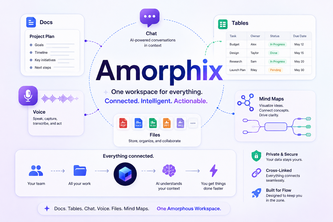
The company appears to be a solo project (1 person) submitted to the OpenAI 2026 hackathon. The author describes Amorphix as a productivity platform that unifies chat, documents, tasks, AI, and other tools into one workspace. It is built with node.js, supabase, sveltekit, and vite, and uses AI (Codex, GPT5.6) for content creation and structuring.
What changed
The project was submitted to a hackathon, indicating it is in an early development or prototype phase. There is no evidence of prior traction, revenue, or customer adoption.
Single most important open question
Is this a viable product concept that can scale beyond a hackathon prototype, or is it a proof-of-concept with limited commercial potential?
What The Product Actually Is
The description states:
- Amorphix is a unified workspace that brings together docs, tables, chat, voice, files, tasks, decisions, mind maps, and AI into one connected platform.
- It allows conversations to become structured and AI-editable work instead of disappearing into message history.
- AI-generated outputs are treated as real workspace objects (editable, shareable, linkable) rather than just copied text.
Inference The product is described as a productivity tool that integrates multiple work functions into one interface, with AI-native features for content creation and structuring.
Positioning & Claim Evolution
The description states:
- Amorphix positions itself as a "unified workspace" that replaces the need to switch between tools like Slack, Discord, Google Docs, Miro, and ClickUp.
- It claims to be “AI native” and adjusts to teams' unique needs through AI.
Inference The positioning is that of a productivity platform aiming to reduce tool fragmentation and increase team efficiency via AI integration. However, the claim of being “AI native” is not substantiated with evidence of actual AI implementation or performance metrics.
Target Customer & ICP
The description states:
- Amorphix targets teams that currently use multiple tools (Slack, Discord, Google Docs, etc.) and want to reduce context switching.
- It aims to support team members who may have different preferences for how information is presented to them.
Inference The target customer is likely small to mid-sized teams or organizations looking to streamline their workflow by consolidating tools. However, no specific ICP (Ideal Customer Profile) is defined beyond "teams."
Business Model & Pricing Evidence
The description states:
- No explicit business model or pricing information is provided.
Not evidenced There is no mention of monetization strategy, pricing tiers, or revenue streams.
Technical & Delivery Signals
The description states:
- Built with node.js, supabase, sveltekit, and vite.
- Uses Codex (cli) and GPT5.6 for AI implementation.
- Implements a shared workspace model connecting different content types.
- Structured AI outputs allow @ai to create artifacts like tables and mind maps from team conversations.
Inference The technical stack suggests a modern web-based platform with backend support via Supabase and frontend via SvelteKit. The use of AI is described but not demonstrated in terms of performance or reliability.
Traction & Maturity Signals
The description states:
- This project was submitted to the OpenAI 2026 hackathon.
- It is a solo effort by Robin Kohze.
- No revenue, customers, or adoption data are mentioned.
Not evidenced There is no evidence of traction, user base, or product maturity beyond a prototype.
Competitive Context
The description states:
- Amorphix aims to unify tools like Slack, Discord, Google Docs, Miro, and ClickUp.
- It positions itself as an alternative to these platforms by integrating them into one workspace.
Inference The competitive landscape includes existing productivity suites (e.g., Notion, Slack, Microsoft Teams) and collaboration tools. However, no specific competitor analysis or differentiation strategy is provided.
Open Questions & Risks
The description states:
- The hardest challenge was making different tools feel like one coherent product.
- AI output reliability was a concern.
- Interface must remain fast and understandable despite being feature-rich.
Inference
- Risk of poor user experience due to integration complexity.
- Risk of unreliable AI outputs affecting usability.
- Risk of technical debt or scalability issues if the prototype is not well-architected.
- Risk of limited commercial viability without clear monetization or traction.
Questions the description leaves open
- What specific problems are teams facing today that Amorphix solves, and how do you know?
- How does Amorphix ensure data consistency and security across its integrated tools?
- Can you demonstrate a working prototype or alpha version of the platform?
- What is your plan for scaling beyond a single developer?
- How do you intend to monetize this product, and what are your initial customer acquisition plans?
Overall Assessment
The description states:
- This is a hackathon submission by one person (Robin Kohze).
- No evidence of revenue, customers, or traction.
Not evidenced There is no basis to assess commercial viability, scalability, or investment potential. The project appears to be an early-stage prototype with no verified product-market fit or business model.
Confidence level Low — based entirely on a self-reported hackathon submission, with no external validation or data points.
User Stories BotA demo video on every pull request
Get a demo video on every new feature
GitHub App that watches your pull requests and records a narrated, captioned demo.
Save time on demo prep and make informed decisions faster with a video walkthrough of every new feature.
Source
Submitted to the OpenAI 2026 hackathon on Devpost. Project home on Devpost. Back to the full gallery on Devpost.
This competitive analysis was produced by top-founders.com (opens in a new tab)
Generated by a language model from this project's public Devpost page — its tagline, the author's own write-up and any built-with tags listed there — as captured in August 2026. Short quotations are the author's words. It is an opinion on the idea as a business, not on the people behind it, and it reflects the description as published then. If the project has moved on, request a correction below. The analysis is not independent research and contains no verified traction, revenue or customer data.
An independent guide by KFG International LLC — not affiliated with, endorsed by, or connected to Devpost or OpenAI.