

Archive position — measured, not model output
0 likes on Devpost
2,263 of the 7,850 archived projects have more likes, and 5,587 share exactly 0 — so this project's #2,603 place in the like-ranked listing is a tie-break inside that group, not a ranking.
Projects (log scale)
Likes on Devpost. ▲ marks this project's group.
Show the figures
| Likes | Projects | Share of archive |
|---|---|---|
| 0 | 5,587 | 71.2% |
| 1 | 1,758 | 22.4% |
| 2 | 284 | 3.6% |
| 3–4 | 132 | 1.7% |
| 5–9 | 75 | 1.0% |
| 10+ | 14 | 0.2% |
 User Stories BotA demo video on every pull request
Get a demo video on every new feature
GitHub App that watches your pull requests and records a narrated, captioned demo.
Save time on demo prep and make informed decisions faster with a video walkthrough of every new feature.
Executive Summary
What the company appears to be
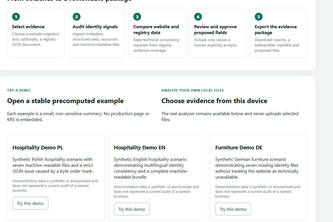
AKTRU Verified AI Identity Builder is a self-reported local-first web application designed to audit how companies are represented across various digital formats (websites, metadata, structured data, registry documents). It classifies evidence into four categories and requires human approval before exporting machine-readable identity proposals. The tool operates entirely client-side with no backend or telemetry.
What changed
The project evolved from a functional prototype into a documented, testable release (v1.0.1) with clear evidence boundaries, deterministic exports, and public demonstrations in multiple languages. It includes improvements based on AI interpretation feedback, such as enhanced crawlability and clearer terminology.
Single most important open question
Is there any evidence of usage beyond the author’s own development and synthetic demonstrations?
What The Product Actually Is
The description states that AKTRU Verified AI Identity Builder is a local-first web application that audits company representations across:
- Website content;
- Metadata;
- Structured data (Schema.org, JSON-LD);
- Machine-readable identity files;
- Optional registry documents provided by the user.
It classifies detected values into four evidence classes:
- Supported by supplied registry document
- Declared by website owner
- Inferred from technical content
- Unresolved
The tool exports:
- Technical audit reports;
- Markdown and JSON summaries;
- Before-and-after manifests;
- Deterministic machine-readable identity proposals;
- ZIP evidence packages.
It does not modify original files and requires explicit human approval before export.
Evidence
- The author describes the product's functionality in detail.
- The tool is built with React, TypeScript, Vite, and browser File APIs.
- It uses GitHub Actions for deployment and GitHub Pages for hosting.
- Codex was used during development to implement parts of the system.
Inference The application is a static web tool that processes local files without uploading them. It is not an API or SaaS offering.
Positioning & Claim Evolution
The author states that the product aims to preserve provenance, expose uncertainty, and keep final decisions with human reviewers, rather than merging inconsistent data into one answer.
Early versions had issues like:
- AI systems interpreting only a minimal HTML shell due to JavaScript rendering.
- Terminology such as “verified from registry” which implied authentication of the document itself.
These were corrected by:
- Adding meaningful static HTML content for crawlers.
- Changing terminology to reflect what the tool can actually prove: “Supported by supplied registry document.”
Evidence
- The author explicitly describes the evolution of product goals and terminology.
- Mention of AI feedback leading to improvements in crawlability, documentation, and clarity.
Inference The positioning has shifted from a general-purpose identity audit tool to one focused on transparency, traceability, and human-in-the-loop validation.
Target Customer & ICP
The description does not clearly define target customers or ideal customer profiles (ICP). It implies the tool may be used by individuals or organizations auditing company identities, but no specific buyer personas or use cases are described.
Evidence
- The author mentions using the tool to audit a company’s website and supplied evidence.
- The next step includes offering a professional human-reviewed service, suggesting potential B2B or enterprise users.
Inference Potential customers could include SEO professionals, data analysts, or content creators working with structured data and identity signals. However, no explicit customer segments are defined.
Business Model & Pricing Evidence
There is no evidence of any business model or pricing structure in the description. The tool is presented as a self-hosted, open-source-like solution with no monetization strategy described.
Evidence
- No mention of subscriptions, fees, licensing, or paid features.
- The author says the next step is to use the tool as a foundation for a professional human-reviewed service, implying future revenue potential, but not current operations.
Inference If this evolves into a commercial offering, it might be based on consulting or service-based pricing. But no such model exists yet.
Technical & Delivery Signals
The application is built using:
- React
- TypeScript
- Vite
- Browser File APIs
- GitHub Actions and Pages
It was developed during OpenAI Build Week 2026, with Codex assisting in implementation tasks including:
- Repository architecture
- Auditing engine
- Local file parsing
- Export generation
- Automated testing
- Accessibility improvements
The tool supports deterministic exports, handles encoding issues (e.g., BOM), and separates technical consistency from registry evidence coverage.
Evidence
- Author lists technologies used.
- Describes how Codex helped with development tasks.
- Mentions automated tests, dependency audits, and mobile validation.
Inference The delivery approach is lightweight, client-side, and focused on reproducibility and traceability. It avoids cloud dependencies or telemetry.
Traction & Maturity Signals
The project has reached version 1.0.1, with:
- 30 of 30 automated tests passing
- Production build success
- Dependency audit showing zero known vulnerabilities
- Mobile validation at 375 px
- Keyboard accessibility checks
- Console validation without errors or warnings
- Public demonstrations in Polish, English, and German
However, there is no evidence of:
- Real-world usage
- Customer adoption
- Revenue or monetization
- Active user base
Evidence
- Release v1.0.1 is documented.
- Public demonstrations exist but are synthetic or anonymized.
- All tests pass.
Inference The tool shows technical maturity and readiness for public use, but lacks real-world traction or commercial validation.
Competitive Context
No explicit competitors are mentioned in the description. The author does not reference similar tools or platforms that perform identity auditing or structured data validation.
Evidence
- No mention of existing solutions or competitive landscape.
- The tool is described as unique in its approach to preserving provenance and requiring human review.
Inference It may operate in a niche space related to identity signals, structured data, and AI interpretation. However, no direct comparison or competitive positioning is evident.
Open Questions & Risks
- No real-world usage or adoption: The tool has only been demonstrated publicly with synthetic data.
- Unclear monetization path: While the author mentions a future service model, there is no current business plan or revenue source.
- Limited scalability: As a client-side tool, it may not scale well for large-scale audits or enterprise use cases.
- Single-person team: With only one member listed, operational capacity and long-term sustainability are unclear.
- No external validation or third-party integration: The tool does not appear to integrate with major platforms or APIs.
Evidence
- No customer base, revenue, or partnerships.
- Only one person involved in the project.
- Public demos use anonymized data.
Inference The risk of failure lies in whether the author can successfully transition from prototype to scalable, monetizable product.
Questions the description leaves open
- What is your plan for transitioning from a prototype to a commercial offering?
- Have you identified any specific use cases or customers who would pay for this tool?
- How do you intend to validate the accuracy of the registry documents users provide?
- Are there plans to expand beyond local-first processing, e.g., adding cloud capabilities or API access?
- What are your thoughts on integrating with existing identity management systems or platforms?
Overall Assessment
Not evidenced
There is no evidence of revenue, customers, traction, or a clear path to monetization. The tool is described as a prototype that has reached version 1.0.1 and includes public demonstrations, but lacks any indication of commercial viability.
Confidence Level Low This analysis is based solely on the self-reported description provided by the author. No external validation, customer data, or financial metrics are available to assess the project's potential for investment or partnership.
User Stories BotA demo video on every pull request
Get a demo video on every new feature
GitHub App that watches your pull requests and records a narrated, captioned demo.
Save time on demo prep and make informed decisions faster with a video walkthrough of every new feature.
Source
Submitted to the OpenAI 2026 hackathon on Devpost. Project home on Devpost. Back to the full gallery on Devpost.
This competitive analysis was produced by top-founders.com (opens in a new tab)
Generated by a language model from this project's public Devpost page — its tagline, the author's own write-up and any built-with tags listed there — as captured in August 2026. Short quotations are the author's words. It is an opinion on the idea as a business, not on the people behind it, and it reflects the description as published then. If the project has moved on, request a correction below. The analysis is not independent research and contains no verified traction, revenue or customer data.
An independent guide by KFG International LLC — not affiliated with, endorsed by, or connected to Devpost or OpenAI.